
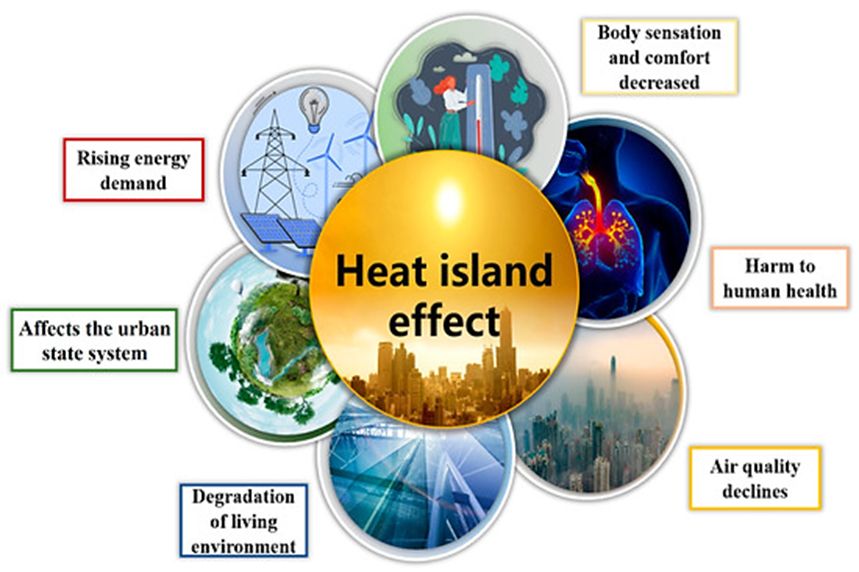
About Urban Heat Island (UHI)
The Urban Heat Island (UHI) effect is a localized microclimatic phenomenon where urban centers experience significantly higher ambient temperatures than their surrounding rural peripheries, primarily driven by dense infrastructure, loss of vegetation, and anthropogenic heat emissions.
Climatological Mechanisms
- The “Island” Nomenclature: Originates from thermal mapping where warm metropolitan regions appear as isolated “islands” amidst cooler rural “seas.”
- Thermal Mass & Re-radiation: Impermeable surfaces (asphalt, concrete) absorb solar insolation during the day and release it very slowly at night via longwave radiation.
- Nocturnal Amplification: The temperature differential between urban and rural areas peaks during the night, with differentials reaching up to 12°C.
- The Moisture Quirk: While absolute moisture content remains comparable between urban and rural atmospheres, higher urban temperatures lower the relative humidity in cities (as warm air possesses a higher moisture-holding capacity).
Key Drivers & Contributing Mechanisms
- Reduced Evapotranspiration (“Urban Deserts”): Depletion of green cover and soil limits natural evaporative cooling, substantially increasing sensible heat transfer over latent heat.
- Urban Canyon Effect: Tall, closely spaced buildings trap radiant thermal energy within vertical surfaces and obstruct convective wind circulation, suppressing natural ventilation.
- Urban Haze Blanket: Particulate matter and air pollutants create a localized greenhouse blanket, trapping outgoing terrestrial infrared radiation.
- Anthropogenic Heat Flux: Direct heat discharged from internal combustion engines, air conditioning heat-rejection units, and industrial processes.
Key Environmental, Health & Economic Impacts
- Secondary Pollutant Formation: Elevated temperatures combined with stagnant air accelerate photochemical reactions, leading to the formation of harmful ground-level ozone and persistent thermal inversions.
- Energy Consumption Surge: Increased cooling requirements can raise urban electricity demand by up to 20%, amplifying greenhouse gas emissions and straining power grids.
- Hydrological Disruption: Impermeable surfaces alter local precipitation patterns, accelerate high-velocity stormwater runoff, and degrade the thermal and chemical quality of urban water bodies.
- Socio-Economic Stress: Triggers heat exhaustion and heatstroke, lowers outdoor labor productivity, and increases urban healthcare costs.
Conclusion
The Urban Heat Island phenomenon underscores the critical need for sustainable spatial planning and blue-green infrastructure in modern cities. Mitigating these localized thermal anomalies is imperative to safeguard public health, optimize energy consumption, and ensure long-term climate resilience.
| This concept has been elaborately discussed in the following article: Rethinking Urban Resilience in the Era of Climate Change |