
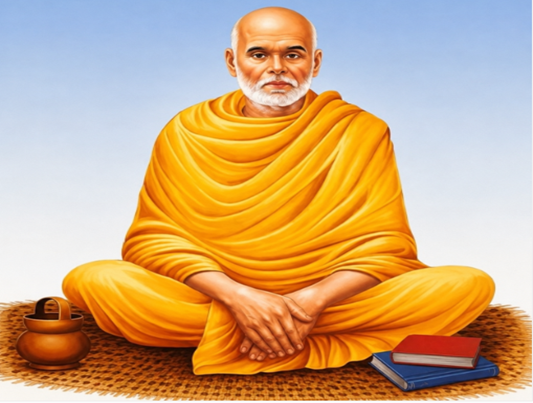
About Sree Narayana Guru
Sree Narayana Guru, born in Chempazhanthy, Kerala, was a social reformer, philosopher and spiritual leader from the Ezhava community who challenged caste discrimination.
He reinterpreted Advaita Vedanta as a practical philosophy of social equality, turning the idea of oneness into a movement against caste hierarchy.
Core Philosophical Dictums
- “One Caste, One Religion, One God for All” (Oru Jathi, Oru Matham, Oru Daivam) — the defining clarion call of his movement.
- “Jati Nirnayam” (Critique of Caste): argued, on grounds of common human biological origin, that caste-based stratification is a fictitious superimposition.
- “Whatever the religion, it is enough if man becomes good” (1923): held that moral conduct supersedes dogmatic religious affiliation.
Temple Reforms and Consecrations
- Aruvippuram Consecration (1888): Consecrated a Shivalinga on Shivaratri, defying Brahmanical objections with the reply, “This is not a Brahmin Shiva, this is an Ezhava Shiva.”
- Innovative installations: Consecrated a mirror instead of an idol at Kalavancode temple, and lamps (Jyothi) elsewhere, symbolising the divine within the individual.
- Prioritising schools over temples (1917): Advised against further temple construction, directing that temples instead house schools, lecture halls, and libraries.
Institutional and Economic Reform
- SNDP Yogam, registered 1903: The Sree Narayana Dharma Paripalana Yogam was founded with Sree Narayana Guru as permanent lifetime President, Dr. Padmanabhan Palpu as Vice President, and poet Kumaran Asan as General Secretary; drove mass education and access to public services.
- Abolishing regressive customs: Campaigned against Talikettu Kalyanam (mock pre-puberty marriage) and costly puberty feasts, replacing them with simplified sacramental weddings; also opposed animal sacrifice and, from 1921, liquor consumption.
- Economic independence: Organised the first All India Industrial and Agricultural Exhibition (Kollam, 1905) and guided formation of the Travancore Labour Association (1922), Kerala’s first organised labour union.
National Mobilisation and Legacy
- Vaikom Satyagraha (1924–1925): Provided spiritual and moral impetus to the movement demanding public road access around the Vaikom Shiva Temple, which paved the way for Travancore’s Temple Entry Proclamation of 1936.
- Meeting with Mahatma Gandhi (March 1925): Held a landmark dialogue at Sivagiri Mutt on untouchability, conversion, and non-violence.
- Aluva All-Religion Conference (1924): Hosted India’s first interfaith conference under the guiding slogan “Not to argue and win, but to know and inform.”
- Literary legacy: Authored 45 works in Malayalam, Sanskrit, and Tamil, including “Atmopadesa Satakam” and “Daiva Dasakam.”
Conclusion
Sree Narayana Guru’s reinterpretation of Advaita Vedanta as a doctrine of social equality, backed by concrete institution-building through the SNDP Yogam and successive temple reforms, made him a foundational figure of the Kerala Renaissance.
His influence extended beyond Kerala through the Vaikom Satyagraha and his dialogue with Mahatma Gandhi, linking regional anti-caste reform to the wider national social reform movement.
| This concept has been elaborately discussed in the following article – Prime Minister Pays Tributes To Sree Narayana Guru On Birth Anniversary |