
About WW1
- By the early 20th century, Europe had become divided into rival power blocs. Industrialisation and imperial competition encouraged an arms race, while nationalism—especially in the Balkans—created political instability.
Reason Behind WW1
A. Militarism
- European powers expanded their armies and naval forces.
- Anglo-German naval rivalry intensified tensions.
- Military preparedness made countries more willing to resort to war.
B. Alliance System
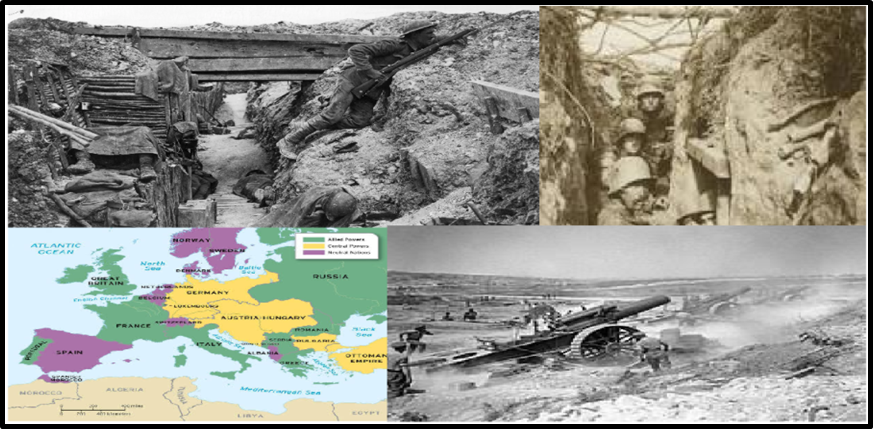
Europe was divided into two major blocs:
| Triple Alliance (1882) Germany, Austria-Hungary & Italy | Triple Entente Britain , France & Russia |
C. Imperialism
- European powers competed for colonies, markets and resources.
- Rivalry particularly intensified between Germany, Britain and France.
D. Nationalism
- Nationalist aspirations were particularly strong in the Balkans.
- Serbian nationalism challenged Austro-Hungarian control over Slavic populations.
E. Balkan Crisis
- Decline of the Ottoman Empire created a power vacuum.
- Austria-Hungary, Russia and emerging Balkan nationalities competed for influence.
Immediate Trigger: Sarajevo Assassination
On 28 June 1914, Archduke Franz Ferdinand, heir to the Austro-Hungarian throne, was assassinated at Sarajevo, Bosnia.
- Assassin: Gavrilo Princip
- He was associated with Serbian nationalist circles.
- Austria-Hungary held Serbia responsible.
From European War to World War
The alliance system transformed the Austria-Serbia conflict into a much larger confrontation.
| Central Powers Germany Austria-Hungary Ottoman Empire Bulgaria | Allied Powers Britain France Russia Later joined by Italy, USA, Japan and others. |
Treaty of Versailles — 1919
- Germany accepted responsibility under the war guilt clause.
- Reparations were imposed.
- German military capability was restricted.
- Germany lost territories and overseas colonies.
- Alsace-Lorraine was returned to France.
Conclusion
The legacy of World War I continues to strengthen India–Belgium relations. The sacrifice of Indian soldiers in Flanders Fields remains a shared historical bond, now complemented by expanding cooperation in defence, technology, trade and multilateral affairs, transforming wartime memories into a modern strategic partnership.
| This concept has been elaborately discussed in the following article — India–Belgium Strategic and Defence Partnership |