
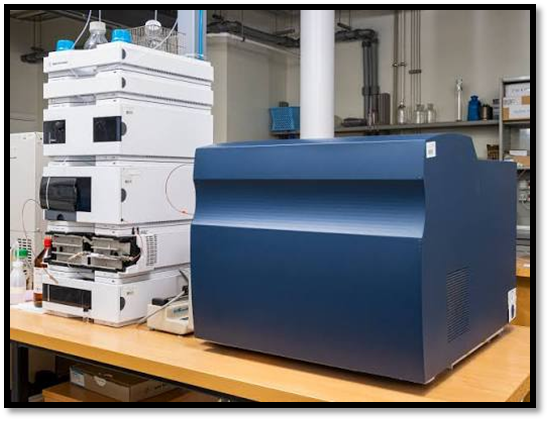
About
- It is an analytical technique used to separate, identify and quantify chemical compounds in complex samples.
- Widely used in pharmaceuticals, biotechnology, food safety, environmental analysis and biomedical research.
How does it work?
- Separates different compounds in a mixture based on their interaction with a stationary phase and mobile phase under high pressure.
- Converts compounds into ions and separates them according to their mass-to-charge ratio (m/z).
- Helps determine the molecular mass and chemical identity of compounds.
Key Features
- High sensitivity → Detects compounds even at very low concentrations.
- High resolution → Separates closely related compounds.
- Rapid analysis → Faster than conventional HPLC in many applications.
- Useful for analysing small molecules, metabolites, drugs, pesticides and biomarkers.
Applications
- Pharmaceuticals: Drug analysis and impurity detection.
- Biomedicine: Metabolomics and biomarker identification.
- Agriculture: Detection of pesticide residues.
- Food safety: Detection of contaminants and additives.
- Environment: Detection of pollutants and trace chemicals.
Conclusion:
- UHPLC-MS is a powerful analytical platform combining high-resolution liquid chromatographic separation with mass spectrometric identification and quantification of compounds.
| This concept has been elaborately discussed in the following article Spider Venom Shows Anti-Cancer Potential in Stegodyphus sarasinorum |