
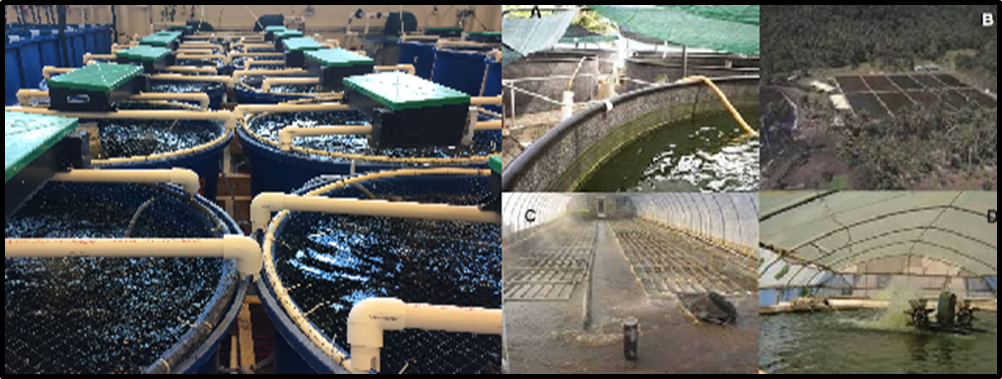
About RAS and Biofloc Technology
- RAS (Recirculating Aquaculture System): A modern fish-farming system in which water is continuously filtered, treated and reused, requiring only a small amount of fresh water. It enables high-density and controlled fish production.
- Biofloc Technology (BFT): An aquaculture method in which beneficial microorganisms convert toxic nitrogenous waste into microbial biomass (bioflocs). These bioflocs also provide additional food for fish and shrimp.
How does RAS work?
- Process: Fish tank → solid waste removal → biofilter → water treatment → oxygenation → fish tank. Filters remove faeces and uneaten feed, while beneficial bacteria convert toxic ammonia into less harmful compounds; degassing removes CO₂ and oxygenation adds dissolved oxygen before water is recirculated.
- Benefits: Uses very little fresh water, supports high-density, year-round production, allows better control of temperature, oxygen, water quality and disease, enables farming near cities/markets, and reduces nutrient-rich wastewater discharge. Fresh water mainly replaces losses from evaporation, sludge removal and other processes.
- Limitations: Requires high initial investment in tanks, pumps, filters and monitoring equipment, continuous electricity and skilled management. Failure of pumps, aeration or filtration can quickly harm or kill densely stocked fish.
Biofloc Technology (BFT)
- Basic principle: Fish waste releases ammonia; with a suitable C:N ratio, heterotrophic bacteria convert it into bioflocs made of bacteria, algae and organic matter, which fish/shrimp can eat as supplementary food.
- Requirements & benefits: Continuous aeration, high C:N ratio, limited water exchange and monitoring of pH, oxygen, ammonia, nitrite and alkalinity are essential. It reduces water exchange, recycles nutrients, improves feed efficiency and supports high stocking density.
- Limitations & risk: Requires continuous aeration, electricity and monitoring; poor management or incorrect C:N ratio can worsen water quality. Aeration failure can rapidly deplete oxygen and cause mass fish mortality.
Comparison between RAS and Biofloc
| Feature | RAS | Biofloc |
| Full form | Recirculating Aquaculture System | Biofloc Technology |
| Main principle | Filter and reuse water | Use microbes to recycle waste |
| Main treatment | Mechanical + biological filtration | Microbial conversion of nitrogenous waste |
| Water use | Very low | Low |
| Role of microbes | Mainly in biofilters | Central to the entire system |
| Feed benefit | Mainly through efficient controlled production | Biofloc acts as supplementary food |
| Aeration | Important | Essential |
| Main challenge | High capital and energy cost | Maintaining oxygen and C:N balance |
Conclusion
RAS and Biofloc Technology (BFT) are water-efficient, intensive aquaculture systems that can reduce water use by up to 99%.
BFT offers better nutrient recycling and lower costs, while RAS provides more stable water quality and slightly higher survival; hybrid Bio-RAS combines both advantages.
| This concept has been elaborately discussed in the following article – Next-Generation Aquaculture in India |