
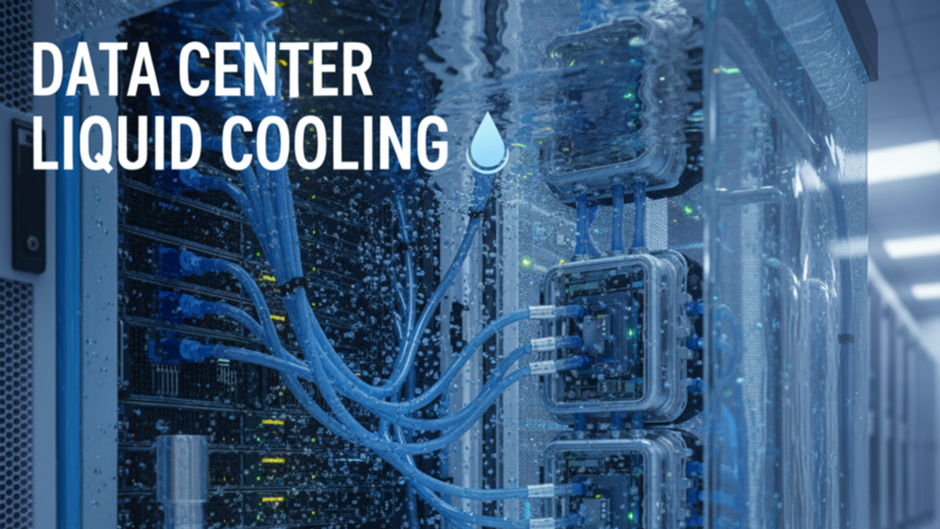
What is Liquid Cooling Technology?
An advanced thermal management system using non-conductive liquids to absorb heat directly from electronics. It replaces traditional air-cooling, which fails when modern AI and EV heat densities exceed 100 kilowatts (kW) per rack.
Objectives:
- Maximize heat dissipation from high-power microchips.
- Enhance energy efficiency by eliminating power-intensive mechanical server fans.
- Prolong hardware lifespan by stabilizing operating temperatures.
- Enable high-performance computing for next-generation AI hardware.
Liquid Cooling Mechanisms
- Cold Plates: Mounted directly on chips to absorb heat via microchannels; 50–80% more efficient than fans.
- Single-Phase Immersion Cooling: Electronics are fully submerged in a circulating dielectric (non-conductive) liquid that transfers heat to an exchanger.
- Two-Phase Immersion Cooling: Electronics are submerged in a low-boiling fluid. Vapor rises, condenses on a top panel, and drips back down, operating autonomously without pumps.
Why is Liquid Cooling Technology Important?
- Supports Electric Mobility: Battery Thermal Management Systems (BTMS) prevent electrical hazards and extend the life of high-capacity (e.g., 300 kWh) EV batteries.
- Enables AI Expansion: Mandatory for scaling high-density AI data halls where traditional forced air is highly ineffective.
- Enhances Data Centre Efficiency: Eliminates legacy infrastructure like raised floors and Computer Room Air Handlers (CRAH).
- Reduces Energy Consumption: Transitioning to liquid systems cuts overall facility energy use by 15–20%.
- Strengthens Self-Reliance: Indigenous innovations like Friction Stir Channelling (FSC) replace costly imports, advancing the Make in India mission.
- Promotes Water Conservation: Slashes data centre water usage by 31–52% amidst global water scarcity.
What are the Key Features of Liquid Cooling Technology?
- Superior Heat Transfer Capability: Liquids possess significantly higher thermal conductivity than forced air.
- Lower Energy Requirements: Shifts the cooling workload from power-hungry fans to highly efficient fluid pumps.
- Compact Design: Shrinks facility footprints by enabling tightly packed, vertically mounted servers.
- Enhanced System Stability: Maintains uniform temperatures across components, completely eliminating localized “hot spots.”
- Improved Thermal Performance: Dielectric fluids safely surround electrical parts without causing short circuits, maximizing heat extraction.
- Advanced Manufacturing Techniques: Indigenous FSC technology plastically deforms metal to create internal channels without melting, replacing defect-prone vacuum brazing.
Benefits of Liquid Cooling Technology
- Better Battery Performance: Regulates EV temperatures, allowing continuous operation and maximizing output from synchronous motors.
- Reduced Operational Costs: Lowers overall EV operating expenses by 40–60% and energy costs by 60–70%.
- Higher Computing Efficiency: Prevents thermal throttling, allowing processors to sustain peak workloads and optimal signal speeds.
- Improved Reliability of Electronic Systems: Creates 100% leak-proof solid-state cold plates capable of withstanding structural pressures above 35 bar.
- Lower Carbon Footprint: Reduces global ICT sector emissions by 15–21%, aiding the 2030 emission reduction targets.
- Quieter Operations: Submerging servers eliminates noisy mechanical fans, converting deafening data centres into silent industrial facilities.
Conclusion
Liquid cooling overcomes the thermal limits of air-based systems to support high-density infrastructure. By maximizing efficiency and reducing resource consumption, it ensures sustainable AI and EV expansion.
| This concept has been elaborately discussed in the following article India’s Evolving Data Centre Ecosystem: Balancing Digital Growth and Water Security |