
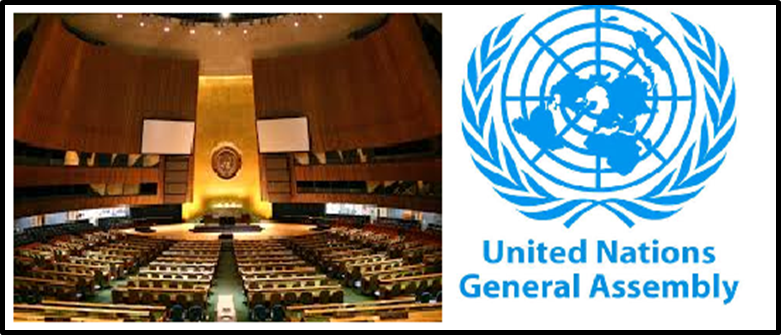
What is the United Nations General Assembly (UNGA)?
About the UNGA
- The United Nations General Assembly (UNGA) was established in 1945 under the Charter of the United Nations as the primary deliberative, policymaking, and representative organ of the UN.
- Its first session convened on 10 January 1946 at Methodist Central Hall, Westminster, London, attended by the 51 founding nations. It moved to its permanent home at UN Headquarters, Manhattan, New York City, at the start of its seventh session on 14 October 1952.
Membership, Presidency, and Voting
- The UNGA comprises all 193 Member States, each holding one vote under the principle of sovereign equality; permanent observer status is held by the Holy See, Palestine, and the European Union (since 1974).
- At least three months before a session opens, the Assembly elects a President (one-year term) and 21 Vice-Presidents; the presidency rotates annually among five regional groups, while the P5 (China, France, Russia, UK, US) always hold Vice-Presidencies on the General Committee.
- Main Committees decide by simple majority; the plenary requires a two-thirds majority for “important questions” — peace and security recommendations, election of non-permanent Security Council/ECOSOC/Trusteeship Council members, admission/suspension/expulsion of members, and budgetary questions (Article 18, Rule 83).
Subsidiary Committee System
- Six Main Committees negotiate resolutions before plenary adoption: First (Disarmament & International Security), Second (Economic & Financial), Third (Social, Humanitarian & Cultural), Fourth (Special Political & Decolonization), Fifth (Administrative & Budgetary), Sixth (Legal).
- Resolution 47/233 (17 August 1993) merged the Special Political Committee with the Fourth Committee to create today’s Fourth Committee.
- The General Committee (President + 21 Vice-Presidents + six Main Committee Chairs) allocates agenda items but cannot decide political questions; the Credentials Committee (nine members) verifies representatives’ credentials.
Powers and Functions
- UNGA resolutions are primarily recommendatory, not legally binding (barring internal administrative/budgetary matters), but carry major normative weight — e.g., the Universal Declaration of Human Rights (1948).
- It holds budgetary power (setting Member States’ financial assessments) and electoral power — electing non-permanent Security Council members, ECOSOC and Trusteeship Council members, ICJ judges, and appointing the Secretary-General on Security Council recommendation.
- Under Article 5, it can suspend or expel a member’s rights on Security Council recommendation.
“Uniting for Peace” (Resolution 377 A (V))
- Adopted 3 November 1950 (52-5, with India and Argentina abstaining) during the Korean War to let the UNGA act via an Emergency Special Session (ESS) when Security Council unanimity fails; an ESS can convene within 24 hours, triggered by a majority of Member States or a procedural Security Council vote (9 votes, no P5 veto).
- Invoked 11–13 times, including the 1st ESS (Suez Crisis, 1956), which created UNEF I, the UN’s first peacekeeping force; the 10th ESS (Palestine, 1997–present); and the 11th ESS (Ukraine, February 2022).
Conclusion
The UN General Assembly (UNGA) is the UN’s most representative body, giving all 193 member states equal voting rights. It serves as the central forum for global debate, cooperation and collective action on major international issues.