
About Green Steel
- Green Steel refers to the manufacturing of steel without the use of fossil fuels, utilizing low-carbon energy sources like Green Hydrogen, renewable electricity, or biomass.
- According to the Ministry of Steel, steel is categorized as “Green” only if its carbon dioxide equivalent emission intensity is less than 2.2 tonnes of CO2 per tonne of finished steel.
Production Methods of Green Steel
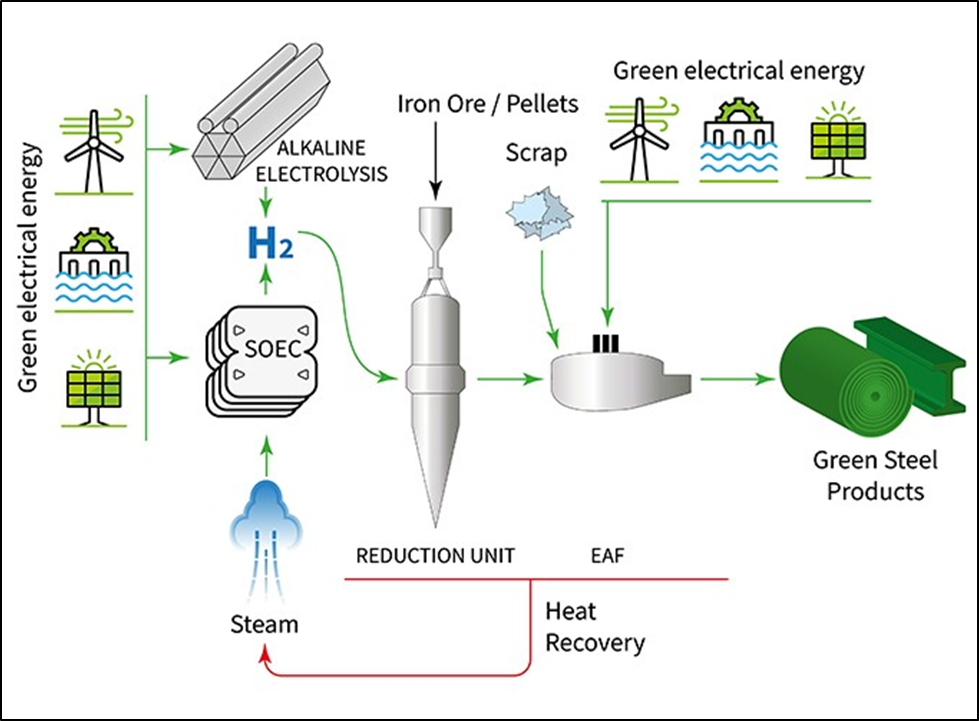
- Green Hydrogen-Based DRI: Replaces coking coal with green hydrogen as a reducing agent in the Direct Reduced Iron (DRI) process.
- Electric Arc Furnace (EAF): Uses renewable electricity to melt steel scrap or DRI, significantly reducing the reliance on traditional Blast Furnaces.
- Carbon Capture, Utilization, and Storage (CCUS): Captures emissions from conventional plants to prevent them from entering the atmosphere.
- Steel Scrap Recycling: Utilizing ferrous scrap reduces the energy required for smelting compared to primary ore processing.
Key Government Initiatives
- Green Steel Mission: A comprehensive roadmap with a budget of ₹15,000 crore focusing on technology switchover and public procurement mandates (up to 37% for 5-star green steel).
- National Green Hydrogen Mission: Has allocated ₹455 crore for pilot projects specifically in the steel sector.
- Steel Scrap Recycling Policy (2019): Aims to increase the availability of domestically generated scrap to reduce coal consumption.
- Perform, Achieve and Trade (PAT) Scheme: A market-based mechanism under the National Mission for Enhanced Energy Efficiency (NMEEE) that incentivizes energy savings in the steel sector.
- Green Steel Taxonomy: Provides the standards for measurement, reporting, and verification (MRV) handled by the National Institute of Secondary Steel Technology (NISST).
About the Steel Sector in India
- India is currently the world’s 2nd largest producer of crude steel and the largest producer of Direct Reduced Iron (DRI)/Sponge Iron.
- Steel accounts for nearly 12% of India’s total greenhouse gas emissions.
- India’s steelmaking emissions intensity is around 2.55–2.65 tCO₂e per tonne of crude steel, higher than the global average.
- Major pollutants from traditional steel plants include Oxides of Sulphur, Oxides of Nitrogen (Nox), Carbon Monoxide (CO), and Particulate Matter (PM 2.5).
- India produced around 160 million tonnes of crude steel in FY 2025–26, making it the world’s second-largest steel producer after China.
- A major challenge is avoiding new coal-intensive BF–BOF (Blast Furnace–Basic Oxygen Furnace) capacity while meeting rapidly growing steel demand.
Conclusion
- Green steel is critical to decouple India’s rapid industrial growth from carbon lock-ins while protecting exporters against global carbon border taxes. It remains a foundational pillar for achieving national net-zero targets by 2070.
| This concept has been discussed elaborately in the following article: Decarbonisation of India’s Steel Sector & Green Steel Transition |