
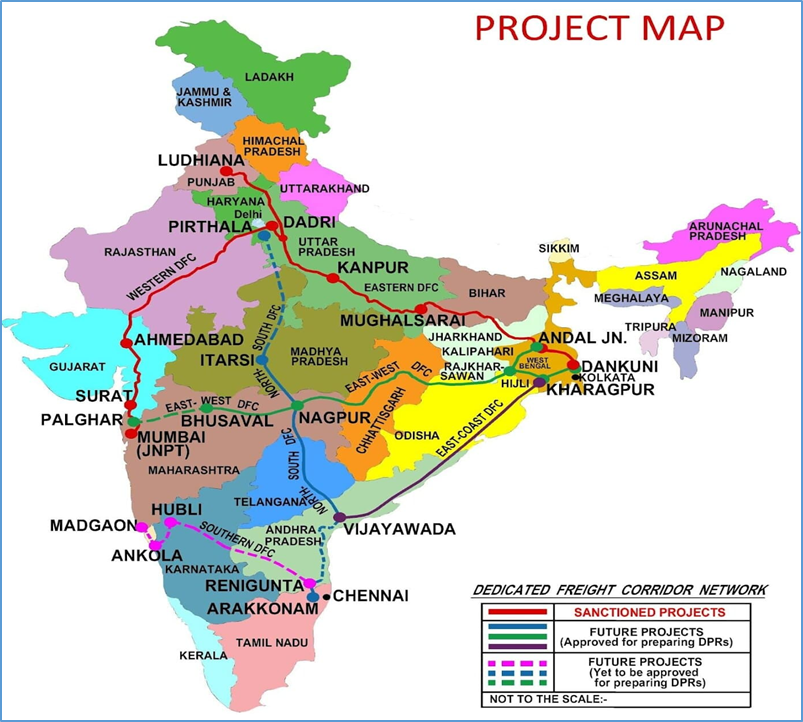
About Dedicated Freight Corridor (DFC) Project
- DFCs are specialized railway tracks designed solely for freight transport. These corridors, utilizing double-stack container and heavy-haul trains, increase capacity and ensure faster freight transit.
Implementing Agency
- DFCCIL (Dedicated Freight Corridor Corporation of India Limited):
- A Special Purpose Vehicle (SPV) incorporated as a Public Sector Undertaking under the Companies Act, 1956 (not a statutory body).
- Functions under the administrative control of the Ministry of Railways.
- Eastern Dedicated Freight Corridor (EDFC):
- Connects Sahnewal/Ludhiana (Punjab) to Dankuni (West Bengal) covering ~1,875 km.
- Funded primarily by the World Bank.
- Present Status of Dedicated Freight Corridor (DFC)
- DFCs now handle over 10% of Indian Railways’ freight.
- An average of 325 trains run on DFC tracks daily, a 60% increase from previous years.
- Since their inception, DFCs have managed over 232 billion Gross Tonne Kilometres (GTKMs) and 122 billion Net Tonne Kilometres (NTKMs), underscoring their role in enhancing rail freight capacity.
Key Corridors & Funding Architecture
- Eastern Dedicated Freight Corridor (EDFC):
- Route: Extends ~1,337 km from Sahnewal/Ludhiana (Punjab) to Sonnagar (Bihar).
- Primary Funding: Supported primarily by the World Bank.
- Cargo Focus: Moves bulk commodities such as coal, iron ore, steel, and agricultural products.
- Western Dedicated Freight Corridor (WDFC):
- Route: Extends ~1,506 km connecting Dadri (Uttar Pradesh) to Jawaharlal Nehru Port Terminal (JNPT, Maharashtra).
- Primary Funding: Funded primarily by the Japan International Cooperation Agency (JICA).
- Cargo Focus: Optimized for export-import (EXIM) containers, connecting industrial hubs to ports like JNPT and Mundra.
Operational Features
- Operating Speeds: Freight trains can achieve speeds up to 100 km/h compared to average operational speeds of 25–30 km/h on conventional mixed-rail routes.
- Axle Load: Built for double-stack container operations using high-reach Overhead Equipment (OHE) with an upgraded axle load capacity of 32.5 tonnes (vs 22.9–25 tonnes on existing tracks).
- Safety Integration: Equipped with automated signaling systems and Kavach (Indigenous Automatic Train Protection System) to prevent collisions.
Conclusion
Dedicated Freight Corridors form the infrastructure backbone for Viksit Bharat @2047, operationalizing PM Gati Shakti and the National Logistics Policy. By shifting freight from road to rail, DFCs cut supply chain costs, elevate India’s Logistics Performance Index (LPI) ranking, and boost global export competitiveness.
| This concept has been discussed elaborately in the following article: Dedicated Freight Corridor (DFC) & Completion of the Western DFC |