
After Reading This Article You Can Solve This UPSC Mains PYQ
To enhance the quality of democracy in India the Election Commission of India has proposed electoral reforms in 2016. What are the suggested reforms and how far are they significant to make democracy successful? (15 marks GS 2 Polity)
Context
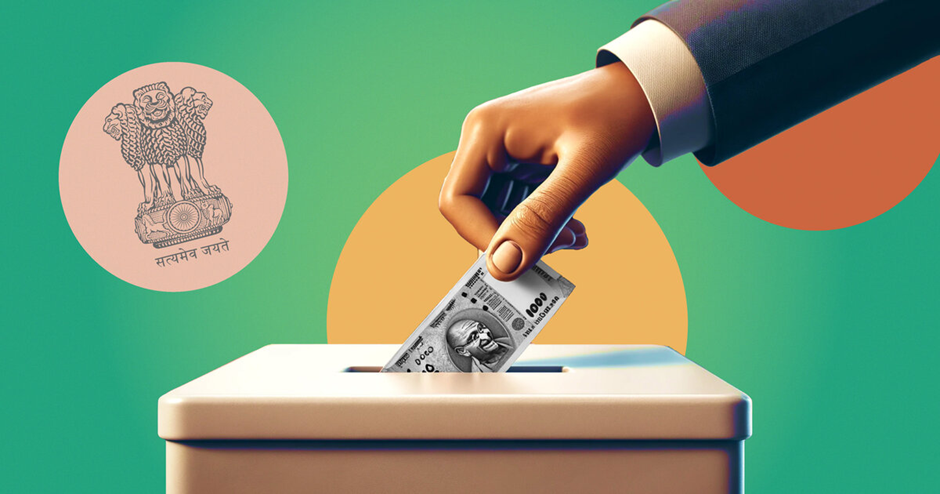
A recent investigation found that six Gujarat-based Registered Unrecognised Political Parties (RUPPs) received ₹1,700 crore in donations in 2023–24, exceeding the ₹1,480 crore received collectively by five major national parties. The anomaly highlights the potential misuse of shell parties and opaque financial channels for tax evasion and money laundering.
Introduction
Electoral funding is the financial backbone of representative democracy, enabling elections and political participation. However, opaque and unregulated funding can foster a politico-corporate nexus, criminalisation of politics and plutocratic influence. Hence, a transparent and accountable political finance framework is essential for safeguarding electoral integrity.
Constitutional and Legal Basis of Political Parties
- Fundamental Right: Article 19(1)(c) of the Indian Constitution grants citizens the fundamental right to form associations or unions, forming the bedrock for political organization.
- Statutory Registration: Section 29A of the Representation of the People Act (RPA), 1951, governs the formal registration of political parties with the Election Commission of India (ECI).
- Constitutional Recognition: Political parties were not explicitly mentioned in the original Constitution but gained constitutional status via the 52nd Amendment Act (1985), which introduced the Anti-Defection Law under the Tenth Schedule.
Types of Political Parties in India
- National Parties: Parties that secure a widespread electoral footprint across multiple states, entitling them to an exclusive nationwide reserved symbol.
- State Parties (Regional Parties): Parties demonstrating significant electoral presence within a specific state or states, granted a reserved symbol within that jurisdiction.
- Registered Unrecognised Political Parties (RUPPs): Newly registered parties or those that have not secured a sufficient vote/seat share to attain State or National party status. They must choose from a list of “free symbols.”
Recognition of Political Parties
- Regulatory Framework: The formal recognition of parties is strictly governed by the Election Symbols (Reservation and Allotment) Order, 1968.
- Criteria for National Party: Must secure 6% of valid votes in four or more states plus 4 Lok Sabha seats; OR win 2% of Lok Sabha seats from at least three states; OR be recognized as a State Party in at least four states.
- Criteria for State Party: Must secure 6% of valid votes and win 2 Assembly seats; OR win 3% of total Assembly seats (or 3 seats, whichever is higher); OR secure 8% of the total valid votes polled in the state.
The Mechanics of Electoral Funding in India
Registered Unrecognised Political Parties (RUPPs)
- Formed under Section 29A of the Representation of the People Act (RPA), 1951, RUPPs are granted common symbols, star campaigners, and 100% tax exemptions (Section 12, IT Act, 2025).
- While intended to expand grassroots representation, thousands exist solely on paper to harvest financial benefits without genuine electoral participation.
Corporate Funding and Trusts
- Regulated under Section 182 of the Companies Act, 2013, corporate funding was drastically expanded following the 2017 amendment that removed the 7.5% net-profit cap on donations.
- Electoral Trusts serve as pooled intermediary bodies (e.g., Prudent Electoral Trust), maintaining partial anonymity while transferring corporate funds to political entities.
The Electoral Bonds Scheme
- Introduced in 2018 as anonymous bearer instruments sold exclusively via the State Bank of India (SBI) to formalize donations.
- On February 15, 2024, the Supreme Court struck down the scheme as unconstitutional, citing severe violations of the citizens’ fundamental Right to Information.
Global Paradigms & State Funding
- Unlike France or New Zealand, which employ strict state-funding models and corporate bans, India relies heavily on private capital.
- Committees like Indrajit Gupta (1998) and the 2nd Administrative Reforms Commission have repeatedly advocated for partial, in-kind state subsidies to establish a level playing field.
Significance of Transparent Electoral Funding
- Sustains Democratic Exercises: Provides the necessary capital to conduct complex, large-scale electoral processes across a vast demographic without compromising systemic integrity.
- Fosters Political Inclusivity: Fair funding distribution allows marginalized voices and independent grassroots candidates to effectively compete against legacy parties.
- Prevents Policy Capture: Transparent financing restricts the influence of “Big Money,” ensuring state policies are dictated by public welfare rather than corporate quid pro quo.
- Enhances Voter Empowerment: Mandatory disclosures enable the electorate to make highly informed decisions by tracking the ideological and financial backers of their representatives.
- Curbs the Parallel Economy: Formalizing political finance directly attacks the circulation of black money and illicit capital within the national economy.
Challenges
- The “Letter Pad Party” Loophole: Hundreds of RUPPs act as opaque conduits for money laundering, protected by the Election Commission’s lack of explicit statutory power to de-register inactive parties (upheld in the 2002 INC vs. Institute of Social Welfare ruling).
- Unchecked Corporate Nexus: The removal of the corporate donation cap allows wealthy conglomerates to disproportionately influence democratic outcomes and skew the electoral playing field.
- Foreign Funding Risks: Amendments to the Foreign Contribution (Regulation) Act (FCRA), 2010, permit foreign entities with Indian subsidiaries to fund parties, threatening sovereign policy autonomy.
- Cash Donation Anonymity: Lowering the anonymous cash donation limit from ₹20,000 to ₹2,000 paradoxically increased the volume of untraceable micro-donations, defeating the purpose of transparency.
- Exorbitant Campaign Costs: The soaring expense of modern elections acts as a high barrier to entry, forcing political parties into a perpetual cycle of fund-seeking from vested commercial interests.
Way Forward
- Empower the Election Commission: Amend the RPA to grant the EC explicit authority to de-register political parties that fail to contest elections for ten consecutive years, as recommended by the Law Commission’s 255th Report.
- Link Tax Benefits to Performance: Stipulate a minimum legislative vote percentage threshold for RUPPs to avail of income tax exemptions, thereby deterring the formation of shell organizations.
- Bring Parties Under the RTI Act: Classify recognized political parties as “public authorities” under the Right to Information Act to enforce absolute financial transparency and public accountability.
- Establish a National Election Fund: Implement former CEC T.S. Krishnamurthy’s proposal for an independent, state-managed fund that distributes corporate and public donations based on objective metrics like vote share.
- Reinstate Corporate Contribution Caps: Restore the 7.5% net-profit ceiling on corporate donations to strictly limit business interference in legislative policymaking.
- Adopt Partial State Funding: Operationalize the 2nd ARC recommendations for partial, in-kind state subsidies (e.g., free media airtime, transport logistics) to reduce reliance on illicit private capital.
- Enhance Inter-Agency Digital Tracking: Mandate real-time digital integration between the EC, Income Tax Department, and Enforcement Directorate to proactively monitor and penalize financial anomalies within political entities.
Conclusion
A robust democracy cannot function optimally if its electoral mandate is overshadowed by opaque financial transactions. Comprehensive reforms—ranging from empowering the Election Commission to enforcing RTI compliance—are imperative to cleanse political finance, ensuring governance remains a true reflection of the public will.
| Important Current to Concept (CTC) from this Article for UPSC 1. Political Party In India 2. The Representation of the People Act |