
After Reading This Article You Can Solve This UPSC Main PYQ (2020):
What are the major factors responsible for making the rice-wheat system a success? In spite of this success, how has this system become bane in India? 10 Marks (GS3, Environment and Ecology)
Context
Recurring stubble-burning incidents in Punjab and Haryana highlight the limitations of punitive enforcement and technology-centric interventions. The issue reflects deeper structural problems involving groundwater conservation laws, the paddy–wheat cropping cycle, assured procurement, farm economics and gaps in fire monitoring.
Introduction
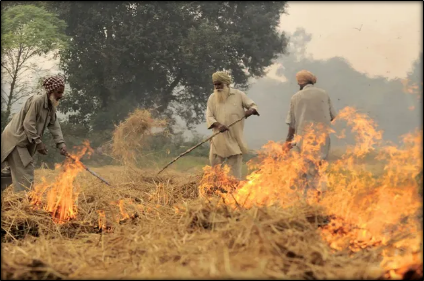
Stubble burning is the deliberate burning of crop residue after harvesting, particularly paddy straw in northwestern India. It contributes to seasonal air pollution, damages soil health and exposes the structural weaknesses of India’s agricultural and environmental governance.
Significance
Developments relevant to the 2025–26 stubble-burning cycle and the upcoming 2026 harvest season.
1. Officially reported decline in farm fires
The Commission for Air Quality Management (CAQM) reported that Punjab recorded 5,114 fire incidents in 2025, a 90% decline from 2022, while Haryana recorded 662 incidents, a decline of 81% over the same period. These are encouraging official figures, but they must be interpreted alongside the limitations of satellite-based detection.
2. Measurement gaps have become a major concern
A September 2026 report highlighted discrepancies between satellite-based assessments and ground verification, prompting CAQM and the National Remote Sensing Centre (NRSC) of ISRO to re-examine the burnt-area assessment protocol during the upcoming Kharif season.
3. Policy is shifting towards a combination of incentives and enforcement
The government has expanded support for crop-residue machinery, custom hiring centres and alternative uses of paddy straw. CAQM has also directed authorities to improve machinery access, promote industrial utilisation of residue and strengthen accountability for enforcement failures.
Causes and structural dimensions of the problem:
1. Environmental and public-health dimension
- Seasonal deterioration of air quality: Stubble burning releases fine particulate matter, carbon monoxide and other pollutants that can worsen air quality across northwestern India. Its contribution to Delhi’s pollution varies with the scale of burning, meteorological conditions, transport of pollutants and emissions from other sources.
- Transboundary movement of pollution: Smoke can travel beyond the location of burning, making crop-residue management a regional environmental governance challenge rather than merely a local agricultural issue.
2. Agricultural and technological dimension
- Dependence on combine harvesters: Mechanised harvesting improves efficiency but leaves standing stubble and substantial quantities of loose straw, increasing the cost and difficulty of preparing fields for the next crop.
- Narrow sowing window: The delay in paddy transplantation has pushed harvesting towards late October and November, leaving many farmers with approximately 10–15 days to clear residue and prepare for wheat sowing, as described in the article.
3. Legal and groundwater-management dimension
- Punjab Preservation of Subsoil Water Act, 2009: The legislation sought to conserve groundwater by regulating the timing of paddy cultivation. Delayed transplantation helps align water-intensive paddy cultivation with monsoon availability, but it also postpones harvesting and compresses the period available for residue management.
- Unintended policy consequences: The case illustrates how a policy designed to address one environmental problem can aggravate another when complementary measures are not introduced. Groundwater conservation and air-pollution control must therefore be planned together.
4. Economic and institutional dimension
- Assured procurement of rice and wheat: The article highlights the strong procurement support for paddy and wheat in Punjab and Haryana. This reduces market uncertainty and encourages farmers to continue cultivating these crops rather than diversify into alternatives.
- Subsidised electricity: Free or highly subsidised agricultural power lowers the private cost of pumping groundwater, weakening incentives to shift away from water-intensive crops.
Technical solutions: In-situ and ex-situ residue management
1. In-situ management — treating residue in the field
- Happy Seeder and Super Seeder: These machines enable wheat sowing in fields containing paddy residue, reducing the need to burn it.
- Mulching and incorporation: Retaining or incorporating residue can return organic matter to the soil and support moisture conservation, depending on soil conditions and management.
2. Ex-situ management — using residue outside the field
- Bioenergy production: Paddy straw can be converted into compressed biogas, bioethanol, biomass pellets and briquettes.
- Industrial utilisation: Thermal power plants and suitable industrial units can use processed biomass as a fuel or co-firing input, subject to technical and environmental requirements.
Government measures and regulatory framework
| Measure | Relevance to the issue |
| Crop Residue Management (CRM) Scheme | Provides financial assistance for residue-management machinery and supports custom hiring centres. |
| Commission for Air Quality Management (CAQM) | Coordinates crop-residue management and enforcement across the National Capital Region and adjoining areas. |
| ISRO-supported satellite monitoring | Enables the detection of active fires and assessment of burnt areas under the established monitoring protocol. |
| National Green Tribunal and Supreme Court interventions | Have addressed the legality and enforcement of restrictions and penalties associated with stubble burning. |
| State-level incentive programmes | Encourage machinery use, alternative crops, residue utilisation and community participation. |
Way Forward: A Comprehensive Strategy to Address Stubble Burning
1. Improve Satellite-Based Monitoring: Integrate polar-orbiting and geostationary satellite data with ground verification to accurately detect fires, estimate burnt areas and minimise under-reporting.
2. Promote Crop Diversification: Encourage farmers to shift towards pulses, oilseeds, maize and other agro-climatically suitable crops through remunerative prices, assured markets and procurement support.
3. Reform Agricultural Incentives: Gradually rationalise procurement policies and electricity subsidies that encourage water-intensive paddy cultivation while protecting farmers’ incomes during the transition.
4. Ensure Affordable Machinery Access: Expand custom hiring centres, cooperatives and farmer-producer organisations to provide timely and affordable access to Happy Seeders, Super Seeders and other crop-residue management machinery.
5. Develop Economically Viable Biomass Markets: Establish reliable supply chains and guaranteed procurement arrangements for paddy straw used in compressed biogas, bioethanol, biomass pellets and other industrial applications.
Conclusion
Stubble burning is a structural agricultural and environmental challenge, not merely a question of farmer compliance. Sustainable progress requires crop diversification, affordable residue management, viable biomass markets, credible monitoring and coordinated governance that protects both public health and farmers’ livelihoods.
| Important Current To Concept Attached To This Article: Crop Residue Management (CRM) Scheme |