
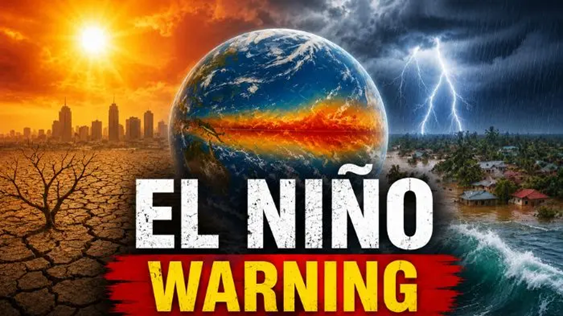
About El Niño
- The warm phase of the El Niño-Southern Oscillation (ENSO), occurring when sea surface temperatures (SST) in the central and eastern equatorial Pacific Ocean become unusually warm.
- Cycle: Develops every 2 to 7 years, lasts about 9 to 12 months, and fundamentally alters global wind systems and rainfall patterns.
El Nino 2026
- WMO Forecast: Estimated an 80-90% probability of El Niño persisting from June-August 2026 through at least November 2026.
- Ocean Monitoring: Subsurface waters exceeded average temperatures by 6°C, creating a vast heat reserve warming the ocean surface.
- Atmospheric Signals: The Southern Oscillation Index (SOI) shifted toward El Niño conditions, confirming a weakening of standard atmospheric circulation.
El Nino Effects on India and World
Effect on India
- Monsoon Suppression: Weakens the Southwest Monsoon by shifting the Walker Circulation eastward.
- Hydrological Deficit: Led to a 42% cumulative rainfall deficit by late June 2026, depleting reservoir levels.
- Thermal & Energy Stress: Raised temperatures above 45°C, reducing hydropower output and straining thermal grids as electricity demand exceeded 240 GW.
- Agrarian Distress: Weak monsoons reduce crop yields, drive food inflation, and lower rural incomes for the 45% of the workforce dependent on agriculture.
Global Impact
- Rainfall Changes: Heavier rainfall in southern South America, southern US, and the Horn of Africa; drier conditions in Australia, Indonesia, and Central America.
- Europe Heatwaves 2026: Record-breaking heat (up to 43.8°C) caused severe infrastructure stress and over 1,300 excess deaths.
- Agriculture and Food Security: Reduces crop productivity across India, China, Australia, Brazil, and Sub-Saharan Africa.
- Wildfires and Drought: Elevates severe drought and forest fire risks across Australia, Southeast Asia, and southern Africa.
- Flood and Disaster Risk: Increases risks of landslides, floods, and soil erosion in regions receiving above-normal precipitation.
- Urban Heat Stress: Intensifies the urban heat island effect, severely impacting vulnerable populations due to lack of nighttime thermal recovery.
- Water Resource Pressure: Lowers reservoir levels and groundwater recharge, escalating competition for scarce water.
- Marine Ecosystems: Alters fish migration, pushes cold-water species into deeper waters, and encourages harmful algal blooms.
- Compound Climate Disasters: Triggers simultaneous hazards (heatwaves, droughts, floods), creating cascading macroeconomic shocks.
El Nino Formation
- Weakening of Trade Winds: Easterly trade winds lose strength or reverse direction.
- Eastward Movement of Warm Water: Accumulated warm surface water flows back toward the central and eastern Pacific.
- Reduction in Upwelling: The rise of cold, nutrient-rich water along South America decreases.
- Increase in SST: The central and eastern Pacific experience abnormal warming.
- Shift in Convection Zone: The region of rising warm air and cloud formation moves eastward.
- Disturbance in Atmospheric Circulation: The Walker Circulation weakens or shifts entirely.
- Change in Pressure Systems: Pressure differences between the eastern and western Pacific reduce.
- Alteration of Jet Streams: The Pacific jet stream shifts its path, altering global mid-latitude weather.
El Nino and Indian Monsoon
- Weak Monsoon Winds: Reduces moisture transport toward the Indian landmass.
- Deficient Rainfall: Causes below-normal precipitation, especially during strong cycles.
- Increased Drought Risk: Elevates drought probabilities, notably in central and northwestern India.
- Rise in Temperature: Reduced cloud cover accelerates daytime heating and heatwaves.
- Agricultural Impact: Insufficient soil moisture severely declines crop yields and farmer incomes.
- Water Scarcity: Groundwater, rivers, and reservoirs receive inadequate recharge.
- Regional Variability: Isolated regions may still receive normal or excess rain due to localized atmospheric factors.
El Nino Management
- Early Warning Systems: WMO and regional agencies issue seasonal forecasts to aid timely governmental decision-making.
- Scientific Monitoring: Continuous tracking via the Oceanic Niño Index (ONI), SOI, satellite observations, and ocean buoys.
- Climate-Resilient Agriculture: Promoting millets, drip irrigation, AI-based weather advisories, and drought-tolerant crops.
- Water and Urban Management: Expanding rainwater harvesting, groundwater recharge, wetland restoration, and urban “cool roof” programs.
- International Coordination: Agencies like WMO, NOAA, and IMD systematically share forecasts and expertise for coordinated global preparedness.
Conclusion
As El Niño progressively exacerbates global climatic anomalies, safeguarding macroeconomic and food security demands a systemic shift from reactive disaster management to proactive climate resilience. Sovereign state apparatuses must urgently institutionalize predictive governance, climate-resilient agriculture, and sustainable resource optimization to mitigate cascading socioeconomic vulnerabilities.
| This Concept has been discussed in the following article: Drought Management and Climate Resilience in India: An Analytical Perspective |