
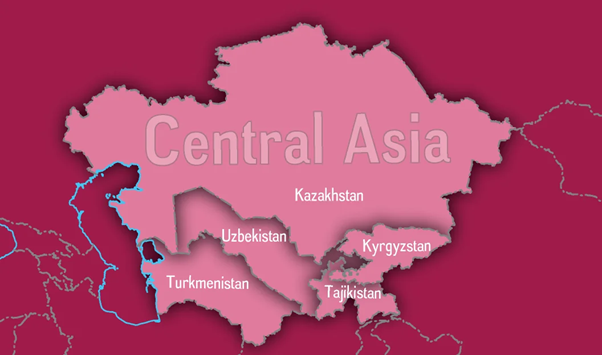
About Central Asia
- Central Asia is a landlocked region situated at the heart of the Eurasian continent, acting as a strategic bridge between Europe and Asia.
- Geographically, it extends from the Caspian Sea in the west to China’s Xinjiang region in the east, bounded by Russia to the north and Afghanistan and Iran to the south.
- In contemporary geopolitical usage, it comprises five former Soviet republics: Kazakhstan, Kyrgyzstan, Tajikistan, Turkmenistan, and Uzbekistan.
- Kazakhstan is the largest country in the region and the world’s largest landlocked country by area, while Uzbekistan is one of the world’s doubly landlocked countries (surrounded exclusively by other landlocked states).
Key Physical, Economic, and Geopolitical Features of Central Asia
- Physical Geography: Characterized by vast steppes, river valleys, the Caspian coastal zone, the Tian Shan and Pamir mountain ranges in the east and south-east, and the Karakum and Kyzylkum deserts in arid zones.
- Resource Endowment: Kazakhstan possesses rich reserves of oil, uranium, and minerals; Turkmenistan holds major natural gas reserves; Uzbekistan is rich in gold, uranium, natural gas, and cotton; and mountainous Kyrgyzstan and Tajikistan hold significant hydropower potential.
- Regional Groupings: Kazakhstan, Kyrgyzstan, Tajikistan, and Uzbekistan are full members of the Shanghai Cooperation Organisation (SCO), whereas Turkmenistan follows a policy of neutrality. In 2025, Uzbekistan proposed a formal Community of Central Asia to strengthen regional economic, security, and environmental cooperation.
- Water and Climate Dynamics: Upstream states (Kyrgyzstan and Tajikistan) control major river headwaters for hydropower, creating friction with downstream states (Uzbekistan, Turkmenistan, and Kazakhstan) reliant on water for irrigation. Excessive river diversion has caused severe water stress, exemplified by the Aral Sea crisis, while dry conditions led to hydropower-linked power rationing in Tajikistan in 2025.
Strategic Importance and India’s Relevance
- Great-Power Competition: The region is a focal point for Russia (historical, military, and economic ties), China (trade, energy pipelines, mining, and the Belt and Road Initiative), and Western nations (energy security and critical minerals).
- India’s Extended Neighbourhood: Central Asia is vital for India’s energy security, uranium imports, counter-terrorism, trade diversification, and regional stability linked to Afghanistan.
- Connectivity Initiatives: Lacking direct overland access due to Pakistan, India promotes alternative corridors including the Chabahar Port in Iran, the International North-South Transport Corridor (INSTC), air corridors, and multilateral engagement via the SCO and India–Central Asia summits.
Conclusion
Despite its landlocked geography, water stress, and political centralisation, Central Asia remains a pivotal geopolitical and economic crossroads in Eurasia. For India, deepening engagement through Iran, the Caspian region, and multilateral frameworks is essential to overcome geographical barriers and secure long-term energy, trade, and security interests.
| This concept has been mentioned in the following article – Shanghai Cooperation Organisation (SCO) Civilisational Dialogue Forum |