
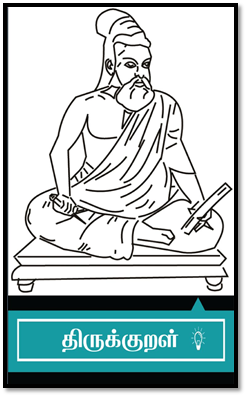
About Thirukkural
- It is a seminal work of ancient Tamil literature and philosophy, widely regarded as an influential treatise on ethics.
- It was authored by the poet-philosopher Thiruvalluvar, also known as “Valluvar,” more than two millennia ago (between 300 BCE and 500 BCE).
- Translating to “sacred verses” or “sacred couplets,” it consists of 1,330 couplets (kurals), each composed of seven words.
- The text is organized into 133 chapters, with each chapter containing 10 couplets.
Structural Divisions of Thirukkural
- The Book of Virtue (Dharma / Aram): Comprises 38 chapters focusing on morality and individual ethical values.
- The Book of Polity (Porul): Comprises 70 chapters dealing with materialism and socio-economic values.
- The Book of Love (Inbam): Comprises 25 chapters containing detailed teachings on love.
Key Themes and Philosophical Principles
- Universal Morality and Egalitarianism: Discourages social divisions based on religion, caste, creed, and race, asserting that morality, kindness, spirituality, charity, and love are indispensable for human well-being.
- Ethical Conduct: Warns that a life devoid of morality leads to misery, as individuals become dominated by jealousy, greed, wrath, and harshness.
- Concept of God: Delineated in the opening chapter, Kadavul Vazhthu (“The Praise of God”), God is conceptualized as “pure intelligence” and omniscient—embodying wisdom, compassion, morality, and love.
- Dimensions of Love (Inbam): Portrays love as a source of tranquil joy rather than mere passion, categorizing it into two forms: Kalaviyal (pre-marital love culminating in marriage without formal ceremony) and Karpiyal (traditional marital love).
Conclusion
Thirukkural stands as a timeless pillar of classical Tamil literature and universal ethical thought. By integrating personal virtue, socio-economic governance, and human relationships into concise couplets, it continues to offer enduring moral guidance across cultural and temporal boundaries.
| This concept has been mentioned in the following article:- Kashi Tamil Sangamam 5.0 |