
Context
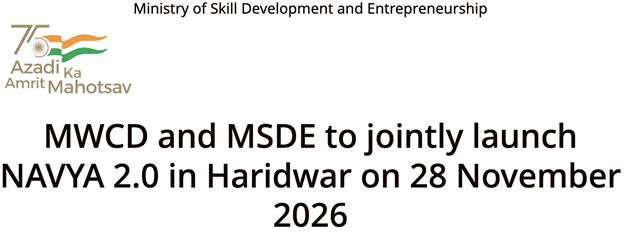
Recently, the Ministry of Women and Child Development (MWCD) and the Ministry of Skill Development and Entrepreneurship (MSDE) announced the joint launch of NAVYA 2.0 on 28 November 2026 at Haridwar, Uttarakhand.
About NAVYA
- Full Form: Nurturing Aspirations through Vocational Training for Young Women and Adolescent Girls.
- Nature: A joint inter-ministerial initiative of MWCD and MSDE that converges women and child development networks with the national skill development ecosystem.
- Core Objective: Moves beyond routine training to nurture aspirations, build confidence, enable informed career choices, and foster self-reliance and economic independence among adolescent girls and young women.
Evolution: NAVYA Pilot vs. NAVYA 2.0
| Parameter | NAVYA Pilot (Phase 1) | NAVYA 2.0 (Phase 2) |
| Launch Date & Venue | 24 June 2025; Sonbhadra, Uttar Pradesh | 28 November 2026; Haridwar, Uttarakhand |
| Geographical Coverage | 27 Aspirational Districts across 19 States | 100 districts across 24 States/UTs (focus on aspirational & hard-to-reach areas) |
| Eligible Age Group | 16–18 years | Widened to 16–25 years |
| Key Outcome / Shift | Trained ~1,200 adolescent girls in industry-relevant roles | Scales up outreach with structured district-level convergence and outcome-oriented support |
Major Highlights of NAVYA 2.0
- New-Age Skilling: Expands vocational training in non-traditional job roles (building on pilot trades like Drone Assembly, Solar PV Installation, and Fashion Design), alongside digital and financial literacy, apprenticeships, and entrepreneurship pathways.
- District-Level Governance: Introduces a structured Standard Operating Procedure (SOP) to ensure institutional convergence and coordinated district-level implementation.
- Digital Delivery (SIDH): Uses the Skill India Digital Hub (SIDH) for end-to-end candidate tracking (registration, attendance, training, and certification) and issuing digitally verifiable credentials.
- Concurrent Launch Initiatives: Includes inaugurating Saksham Anganwadi Centres and PM JANMAN Anganwadi Centres in Uttarakhand, alongside PMKVY certificate distribution.
Significance
- Inclusive Reach: Extends structured vocational opportunities to a wider demographic cohort in underserved and hard-to-reach regions.
- Market-Ready Portability: Digitally verifiable credentials strengthen accountability and help young women credibly demonstrate their competencies to employers.
- Institutional Synergy: Aligns social welfare outreach with industry demand, ensuring training translates into viable livelihoods.
Strategic Significance: Women-Led Development & Viksit Bharat
- By integrating young women from aspirational districts into modern, non-traditional economic sectors, NAVYA 2.0 operationalises India’s paradigm of women-led development.
- Transforming aspirations into productive employment directly advances the national vision of Viksit Bharat through equitable human capital growth.
Conclusion
Through inter-ministerial convergence, expanded regional and age-group coverage, and digital integration via SIDH, NAVYA 2.0 builds a scalable pathway for the socio-economic empowerment of India’s young women.
| Important CTC from this article : PM-JANMAN |