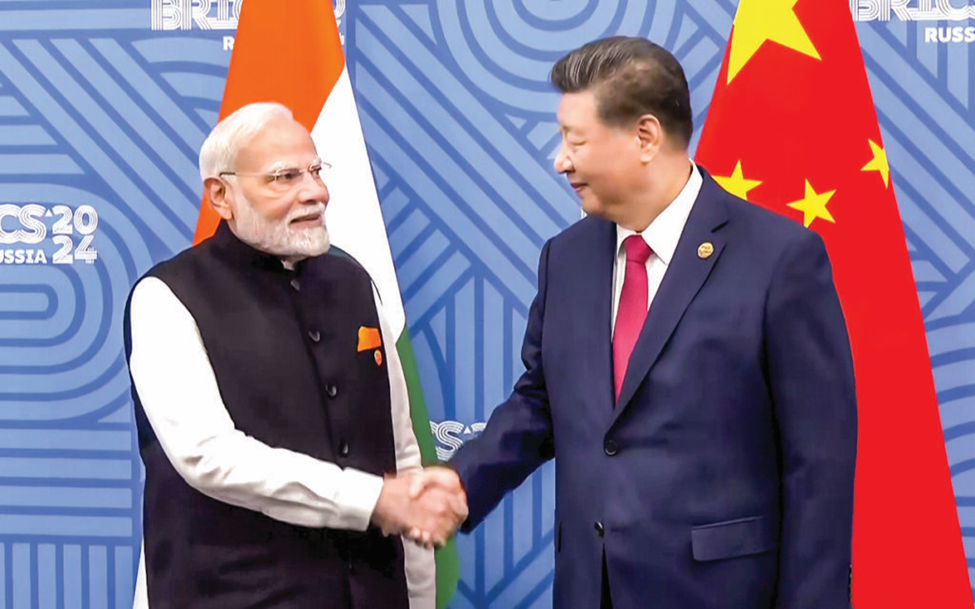
Why in the News?
China recently approved its 15th Five-Year Plan during the Fourth Plenary Session of the CPC. The plan emphasizes expanding global development partnerships — including with India — signaling renewed cooperation opportunities amidst a complex geopolitical environment.
Context: A Complex Relationship
- India and China: ancient civilizations + influential emerging powers
- Relationship characterized by:
- Border disputes & strategic mistrust
- Deep economic engagement
- People-to-people cultural exchanges
China’s Development Push: Why It Matters to India
15th Five-Year Plan Vision
- High-quality development, innovation & tech modernisation
- Open economy with global cooperation
- Alignment with initiatives like BRI & Global Development Initiative
China’s economic positioning influences regional geopolitics and global value chains — India must respond strategically.
Current Economic Engagement
- China is India’s largest trading partner
- 2024 bilateral trade: USD 138.46 billion
- India’s exports to China up by 11% (Jan–Oct 2024)
- Collaboration platforms: Canton Fair, CIISF, CIIE, BRICS–related mechanisms
Complementarities
| India | China |
| Strength in IT, pharma, services | World’s largest manufacturing hub |
| Young demography | Strong industrial ecosystem |
| Rising middle class | Massive consumer market |
Scope for balanced trade, supply chain resilience & tech cooperation.
Strategic Frameworks for Cooperation
1️⃣ Bilateral & People-to-People Relations
- Cultural appeal: yoga, Bollywood, Darjeeling tea
- Buddhist heritage → revived tourism & religious diplomacy
- 75 years of diplomatic ties (2025)
2️⃣ Multilateral Engagement
- BRICS | SCO | G20 → common voices on Global South priorities
- Climate change, health security, food systems — shared interests
3️⃣ Aviation & Tourism Revival
- Direct flights resumed (post-COVID phase)
- More exchanges encouraged for academics, students, business communities
Potential Sectors for Future Collaboration
| Sector | Opportunity |
| Trade & Investment | Correcting trade imbalance, deeper market access |
| Green Energy | Solar supply chain reshaping |
| Technology | AI, fintech, semiconductors (with strategic safeguards) |
| Infrastructure | Connectivity in South Asia & Indo-Pacific |
| Healthcare | Pharmaceuticals & medical research cooperation |
| Agriculture | Food security solutions |
Challenges & Areas of Contestation
- Border tensions (LAC: Ladakh, Arunachal Pradesh)
- India’s security concerns with China–Pakistan nexus
- Competition for influence in the Indian Ocean region
- Trade imbalance heavily in China’s favour
- Tech-security threats: 5G, cybersecurity, data privacy
Geopolitical trust deficit remains the biggest hurdle.
Way Forward: Principles for Engagement
| India’s Approach Should Focus On… | Why |
| Strategic autonomy | Avoid bloc politics |
| Economic diversification | Reduce dependency on China |
| Defensive realism | Secure borders & critical tech |
| Constructive regional diplomacy | Stability in Indo-Pacific |
Cooperation in economy → competition in geopolitics → Calibrated engagement
Conclusion
India–China relations embody a dual character — rivalry & cooperation. As both nations shape the Asian century, structured engagement rooted in fairness, reciprocity and respect for sovereignty is essential. A stable “dragon-elephant tango” can significantly influence global economic and strategic order.
Engagement without illusion, caution without hostility — the pragmatic path ahead.
Source: A new step in the dragon-elephant tango – The Hindu
India–China Relations
Introduction
India and China are two major Asian powers with significant geopolitical, economic, and strategic influence. While the early phase of bilateral ties was marked by friendship and cooperation, persistent border disputes and strategic distrust have strained relations over time. Both nations, however, remain connected through robust economic engagement and participation in numerous multilateral platforms.
Historical Evolution of Relations
Ancient & Cultural Linkages
- Buddhism facilitated people-to-people connectivity when it spread from India to China (1st century A.D.)
- Exchange of scholars and travellers like Fa-Xian, Xuan Zang, and Bodhidharma promoted knowledge and cultural exchange.
Era of National Movements
- Intellectual and political cooperation grew during the colonial period
- Kang Youwei’s stay in India (1890s), Tagore’s China visit (1924), Aid China Medical Mission led by Dr. Kotnis (1938)
Post-Independence Phase
- “Hindi-Chini Bhai-Bhai” spirit in the 1950s
- Gradual deterioration after the 1962 War → strategic mistrust
Timeline of Key Developments
| Year | Event |
| 1950 | Diplomatic relations established |
| 1954 | Panchsheel Agreement signed |
| 1962 | Sino-Indian border war |
| 1976 | Full diplomatic relations restored |
| 1984 | MFN status accorded |
| 1986 | China opposes Indian Statehood for Arunachal Pradesh |
| 1998 | India’s nuclear tests invite Chinese criticism |
| 2006 | Nathu La reopened for trade |
| 2017–22 | Doklam, Galwan & Tawang confrontations |
India–China Border Profile
- Total Length: 3,488 km
- Status: Undefined; LAC disagreements persist
- Terrain: Harsh, high-altitude, low infrastructure
- Border Guarding Force: ITBP
| State/UT | Length (km) |
| Jammu & Kashmir / Ladakh | 1,597 |
| Himachal Pradesh | 200 |
| Uttarakhand | 345 |
| Sikkim | 220 |
| Arunachal Pradesh | 1,126 |
Major Border Disputes
- McMahon Line Dispute: India accepts it, China rejects it
- Aksai Chin & Arunachal Pradesh remain core territorial contestations
Key Confrontations
- 1962 Sino-Indian War – over Aksai Chin & NEFA
- 1967 Nathu La clashes – India successfully pushes back PLA
- 2017 Doklam standoff – 73-day military face-off
- 2020 Galwan Valley clash – first fatalities since 1975
- 2022 Yangtse incident (Tawang) – hand-to-hand combat
Political & Diplomatic Engagement
Core Principles
- Guided by Panchsheel: sovereignty, non-aggression, peaceful coexistence etc.
Top-Level Diplomacy
- Informal Summits: Wuhan (2018), Chennai (2019)
- Over 30 dialogue mechanisms covering political, cultural, economic, consular & strategic areas.
Multilateral Cooperation
| Organization | Role of India–China Engagement |
| BRICS | Coordination on global governance reforms |
| SCO | Regional security and economic cooperation |
| G20 | Shared agenda on economic stability |
| AIIB | Infrastructure financing in Asia |
Economic Interdependence
Trade
- China = India’s largest trading partner
- Trade Deficit: USD 85.1 billion (FY 2024) — driven by:
- Import dominance of Chinese manufacturing
- Limited Indian market access in pharmaceuticals, IT, food products
Investments
- Bilateral investments remain limited
- Decline post-2020 due to security restrictions on Chinese investments in India
Dialogue Platforms
- JEG, SED for structured economic discussion
Sociocultural Relations
- Heritage linkages rooted in Buddhism
- Diaspora: Around 56,000 Indians in China
- Popularity of Bollywood films & Yoga
- Education Exchange Programme (2006) facilitates student movement
Military Engagement
- 1993 Agreement on peace & tranquillity along LAC
- “Hand-in-Hand” joint exercises for counter-terror cooperation
- CBMs exist but trust deficit persists
Recent Developments (2023–25)
- Partial disengagement in Depsang & Demchok
- Proposal to resume Kailash Mansarovar Yatra
- Joint plans to restore normalcy ahead of 75 years of relations in 2025
Major Challenges
| Challenge | Description |
| Territorial & Strategic | China’s Salami Slicing and Five-Finger Policy |
| Economic Dependency | Persistent high trade deficit |
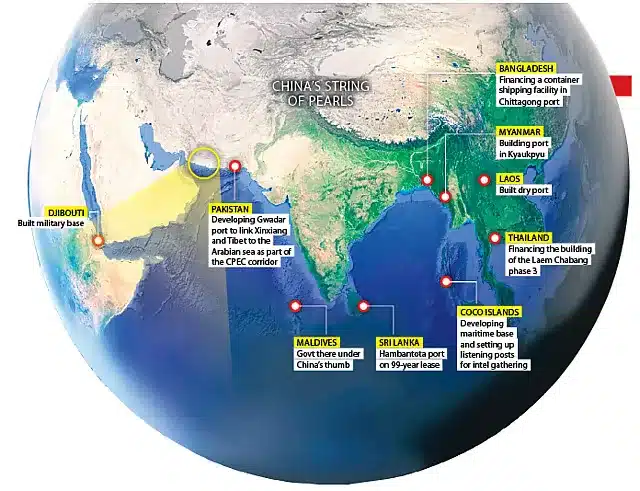
| Geostrategic Rivalry | China’s String of Pearls vs India’s strategic concerns |
| Water Security | Chinese hydropower projects on Brahmaputra |
| Indian Ocean Surveillance | Spy vessels like Yuan Wang-5 |
Way Forward
| Domain | Suggested Actions |
| Strategic Response | Enhance deterrence, border infrastructure (Vibrant Villages, Project Arunank) |
| Economic Measures | Strengthen Aatmanirbhar Bharat, diversify imports |
| Diplomatic Outreach | Leverage QUAD, I2U2, deeper regional ties |
| People-to-People Contact | Expand academic, tourism & cultural interactions |
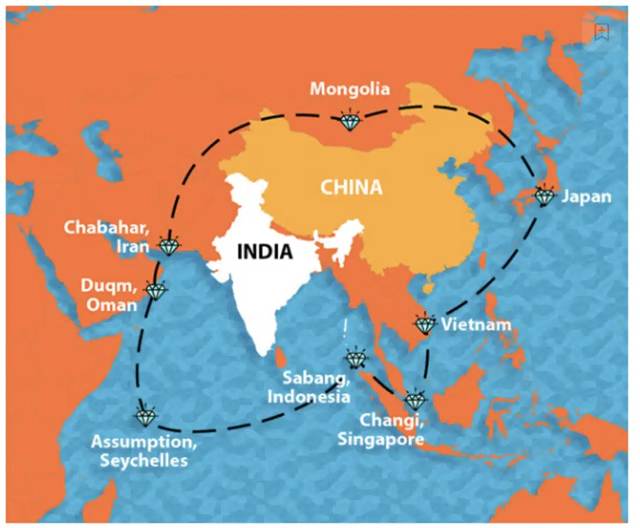
| Maritime Strategy | Continue Necklace of Diamonds as a counter to String of Pearls |
| Dialogue Mechanisms | Sustain crisis-management channels to avoid escalation |
Conclusion
India–China relations reflect a complex interplay of cooperation and rivalry. While strong economic and cultural connections continue, border tensions and geostrategic competition limit mutual trust. Going forward, managing competition through balanced diplomacy, robust national security, and diversified economic strength will be crucial for regional stability and peaceful coexistence.
UPSC CSE PYQ
| Year | Question |
| 2020 | “The India–China relationship has elements of cooperation as well as competition.” Discuss in the context of recent tensions on the LAC. |
| 2021 | Evaluate India’s position in the Indo-Pacific in view of increasing Chinese assertiveness. |
| 2022 | Critically examine the role of India in the emerging global order in the backdrop of COVID-19 and growing US-China tensions. |
| 2017 | “China is using its economic relations and positive trade surplus as tools to develop potential military power status in Asia.” In light of this, discuss its impact on India as her neighbour. |