Context
A proposal for a National Agri-photovoltaics Mission has been introduced to achieve a target of 10 GW capacity, aiming to resolve the “food vs. energy” land-use conflict as India strives for 300 GW of solar power by 2030.
1. Understanding Agri-photovoltaics (AgriPV)
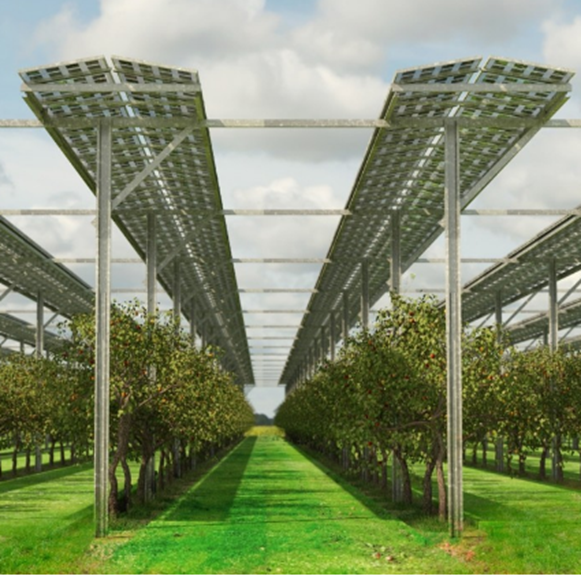
AgriPV (also known as Agrisolar or Dual-use Solar) is the simultaneous use of land for both solar energy generation and agricultural production.
Key Technical Features
- Elevated Mounting: Panels are fixed 2–3 meters high (standard elevation at least 2.1m) to allow movement of laborers and farm machinery (like tractors) beneath them.
- Optimal Tilting: Panels are often tilted at an angle (approx. 30°) or use manual/automated tracking to balance light for crops with energy capture.
- Bifacial Panels: Modern systems use panels that capture sunlight from both sides, often installed vertically to save space.
2. Synergies and Benefits
- Micro-climate Control: Partial shading reduces evapotranspiration, helping soil retain moisture longer (reducing irrigation needs by up to 29%).
- Yield Protection: Protects sensitive crops from heat stress, hail, and extreme weather.
- Water Conservation: Systems can incorporate rainwater harvesting, capturing up to 80% of rain falling on panels for irrigation/cleaning.
- Economic Stability: Provides a secondary, stable revenue stream for farmers (lease rent or selling surplus power to the grid).
3. Institutional & Policy Framework
- PM-KUSUM Scheme: The primary anchor.
- Component A: Decentralized ground-mounted plants (500 kW to 2 MW) on barren/fertile land.
- Component B & C: Standalone solar pumps and solarization of existing pumps.
- Nodal Agencies: Ministry of New and Renewable Energy (MNRE) and the National Solar Energy Federation of India (NSEFI).
- India Agrivoltaics Alliance (IAA): An initiative to integrate solar infrastructure with agricultural spaces.
4. Challenges and Regulatory Barriers
- High CAPEX: Installation costs are roughly 11% higher than traditional ground-mounted solar due to specialized elevated structures.
- Technical Suitability: Not all crops are “shade-tolerant.” Success depends on matching specific crops (e.g., leafy greens, tomatoes, onions) with panel density.
- Policy Gaps:
- Land Use Classification: Ambiguity in laws regarding whether AgriPV land is “agricultural” or “industrial,” affecting tax and subsidies.
- Yield Thresholds: Unlike Japan (which mandates 80% yield maintenance), India lacks standardized minimum agricultural yield thresholds.
- Grid Limitations: Rural areas often face intermittent grid connectivity, hindering the sale of surplus power back to DISCOMs.
5. Global Best Practices for Comparison
- Germany (DIN SPEC 91434): Requires at least 66% of original yield to be maintained; only 15% of arable land can be used for infrastructure.
- Japan: Requires specific panel heights and periodic reviews every 3 years to ensure agricultural productivity isn’t compromised.
6. Crops for Agri-photovoltaics (AgriPV) in India
| Crop Category | Suitable Crops | Reason for Suitability |
| Leafy Vegetables | Spinach (Palak), Lettuce, Fenugreek (Methi) | These are naturally shade-tolerant and require less direct intense sunlight to prevent wilting. |
| Root/Tuber Crops | Potato, Onion, Radish, Ginger, Turmeric | Shading keeps the soil cooler, which is beneficial for the growth of underground bulbs and tubers. |
| Fruit Vegetables | Tomato, Chilli, Brinjal (Eggplant) | These show resilience under partial shade, though yields must be monitored against light-saturation points. |
| Fodder Crops | Alfalfa, Napier Grass | High biomass production is possible with reduced water evaporation under panels. |
| Aromatic/Medicinal | Aloe Vera, Lemongrass, Mint | Many medicinal plants prefer the diffused light and stable micro-climate provided by solar structures. |
Consider the following statements regarding Agri-photovoltaics (AgriPV):

1. It involves simultaneous use of land for agriculture and solar energy generation.
2. Solar panels are installed at ground level to maximize energy efficiency.
3. It helps reduce evapotranspiration and conserve soil moisture.

Which of the statements given above is/are correct?
(a) 1 and 2 only
(b) 1 and 3 only
(c) 2 and 3 only
(d) 1, 2 and 3

Answer: B

Explanation:
1.	It involves simultaneous use of land for agriculture and solar energy generation. This is correct. AgriPV enables the co-location of farming and solar panels on the same piece of land.
2.	Solar panels are installed at ground level to maximize energy efficiency. This is incorrect. In AgriPV, solar panels are usually elevated (2-3 meters or more) above the ground. While ground-mounted systems exist, they are not typically called "AgriPV" if they prohibit agricultural activities, and the goal of elevation is specifically to allow farming underneath.
3.	It helps reduce evapotranspiration and conserve soil moisture. This is correct. The partial shading provided by solar panels reduces the intensity of direct sunlight, leading to lower evapotranspiration rates and increased water conservation in the soil.