Why in the News?
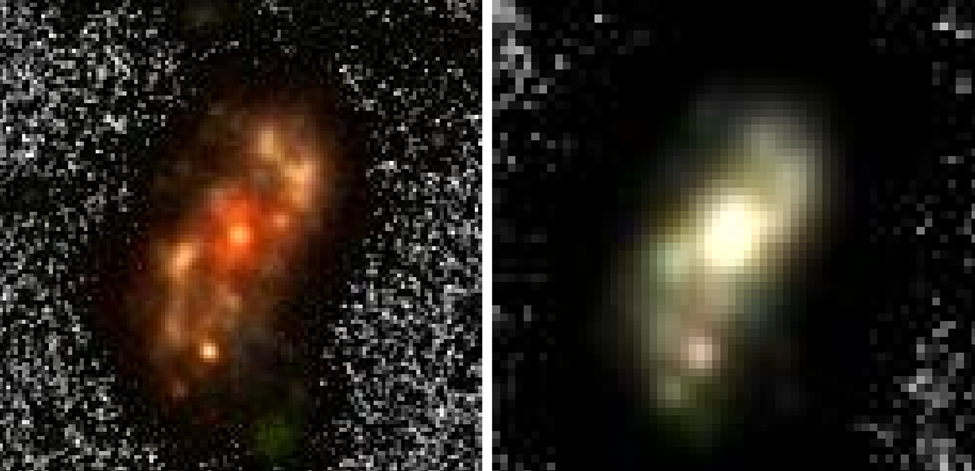
- Recently, Indian astronomers discovered an implausibly old and distant spiral galaxy, named Alaknanda, using observations from NASA’s James Webb Space Telescope (JWST).
- The discovery is notable because Alaknanda formed when the universe was only about 1.5 billion years old (around 10% of its current age), a period when existing galaxy formation models do not predict the presence of fully developed spiral galaxies.
Discovery and Research Background of Alaknanda
- Discovered by: A team of Indian astronomers at the National Centre for Radio Astrophysics (NCRA), Pune.
- Global context: Alaknanda is identified as the second farthest known spiral galaxy.
Location, Distance, and Cosmic Age of Alaknanda
- Distance from Earth: Approximately 12 billion light-years.
- Epoch of formation: Around 1.5 billion years after the Big Bang.
- Redshift: Approximately z ≈ 4, indicating that the galaxy is observed as it existed in the early universe due to the stretching of light to longer wavelengths.
- Evolutionary context: Alaknanda formed when the Milky Way itself was only about 10% of its present age.
Naming and Cultural Context of Alaknanda
- The galaxy is named Alaknanda after the Alaknanda River, a major Himalayan river and tributary of the Ganga.
- The naming also reflects its association with Mandakini, the Hindi name traditionally used for the Milky Way, which is itself a spiral galaxy.
- The name symbolically represents Alaknanda as a distant counterpart of the Milky Way.
Morphological Features of Alaknanda
- Diameter: Approximately 30,000 light-years.
- Overall structure: Alaknanda exhibits a textbook spiral morphology, indicating a highly ordered and dynamically stable system.
- Key structural components include:
- A prominent, rotating disk
- Two perfectly symmetrical spiral arms
- A bright and compact central bulge
- They are real physical features and not artefacts of data processing.
- Morphologically, Alaknanda appears remarkably similar to the Milky Way, making it a distant “sister galaxy.”
Why Alaknanda Challenges Existing Galaxy Formation Models
- Current cosmological simulations suggest that:
- The formation of stable rotating disks and well-defined spiral arms typically requires several billion years.
- Alaknanda contradicts this expectation by exhibiting:
- Structural maturity,
- Rotational stability, and
- Organised spiral arms,
within just 1.5 billion years after the Big Bang.
- This makes Alaknanda’s existence a significant puzzle and implies that the early universe may have been more evolved and orderly than previously believed.
Proposed Mechanisms for Early Spiral Formation
Astronomers propose two main explanations for the rapid formation of Alaknanda’s spiral structure:
- Cold Gas Accretion Model
- The galaxy may have grown steadily by accreting cold intergalactic gas.
- This gas settled into a stable, rotating disk, allowing density waves to form and maintain spiral arms.
- Galaxy Interaction or Minor Merger Model
- Alaknanda may have interacted with or merged with a smaller companion galaxy.
- Such interactions can induce spiral arms through gravitational disturbances.
- However, even this mechanism is generally thought to require more time than available in such a young universe.
Observational and Analytical Techniques
- The study primarily used photometric analysis, which reconstructs a galaxy’s overall energy distribution by measuring its brightness across multiple wavelengths.
- Using JWST photometric data, astronomers estimated:
- Redshift,
- Stellar mass, and
- Star formation history.
- The results are considered robust, as the redshift was independently determined using three consistent methods.
- Further confirmation is planned using:
- JWST Integral Field Unit (IFU) spectroscopy, and
- The Atacama Large Millimeter/submillimeter Array (ALMA) in Chile, to study gas dynamics and confirm spiral structure.
What is a Spiral Galaxy?
- Spiral galaxies are flattened, rotating systems composed of stars, gas, and dust, arranged in distinct spiral arms extending outward from a central region.
- They are often rich in hot, young, luminous stars, particularly along their spiral arms, which makes them visually striking.
Structure of Spiral Galaxies
- Central Bulge:
- A dense central region composed mainly of older, dimmer stars.
- Most bulges host a supermassive black hole, often millions to billions of times the Sun’s mass.
- Galactic Disk:
- A flat, rotating disk surrounding the bulge.
- The disk breaks into spiral arms rich in gas, dust, and young stars.
- Bar Structure:
- Present in nearly two-thirds of spiral galaxies, including the Milky Way.
- Bars influence gas inflow and star formation patterns.
Galaxies: Key Concepts
- Galaxies are vast, gravitationally bound systems composed of stars, planetary systems, interstellar gas, cosmic dust, dark matter, and typically a central supermassive black hole.
- Gravity binds these components together and controls the internal motion, structure, and long-term evolution of galaxies.
- Galaxies display a wide range of size and mass:
- Dwarf galaxies contain a few thousand to a few million stars and often exist as satellites of larger galaxies.
- Giant galaxies host hundreds of billions to trillions of stars and can span over one million light-years in diameter.
- A galaxy’s size and mass significantly influence its structural features, star formation history, and the nature of its gravitational interactions with neighbouring galaxies.
Classification of Galaxies
- Based on their morphology and appearance, galaxies are broadly classified into:
- Spiral galaxies: Characterised by a rotating disk, spiral arms, and a central bulge.
- Elliptical galaxies: Smooth, rounded systems with little gas and minimal star formation.
- Irregular galaxies: Lacking a definite shape, often formed due to gravitational interactions or mergers.
- This morphological classification is commonly represented by the Hubble sequence.
Galaxies in the Cosmic Web
- Galaxies are not randomly distributed in the universe but are organised into large-scale structures:
- Galaxy groups consist of up to about 100 galaxies bound together by gravity.
- Galaxy clusters are larger structures containing hundreds to thousands of galaxies, embedded in massive halos of dark matter.
- Superclusters are vast associations of galaxy clusters and groups.
- These superclusters are interconnected by filaments and separated by enormous empty regions called voids, together forming the cosmic web.
Key Processes in Galaxy Evolution
- Spiral Structures and Bars: Many mature spiral galaxies develop stellar bars extending from the galactic centre, and together with spiral arms, they redistribute angular momentum, regulate gas inflow, and control star formation activity.
- Galactic Collisions: When galaxies pass close to or collide, gravitational interactions compress gas clouds, often triggering intense bursts of star formation, known as starbursts.
- Galaxy Mergers: Repeated collisions can lead to galaxy mergers, forming larger systems, while major mergers may drastically alter galaxy morphology, transform spirals into ellipticals, and fuel central supermassive black holes.
- Galactic Cannibalism: Massive galaxies gradually absorb smaller satellite galaxies, incorporating their stars, gas, and dust into the larger galactic structure over time.
About Milky Way Galaxy

- The Milky Way is a large spiral galaxy with a diameter of more than 100,000 light-years.
- Earth is located on one of its spiral arms, approximately halfway between the galactic centre and the outer edge.
- The Milky Way is a member of the Local Group, which contains over 50 galaxies, including:
- The Andromeda Galaxy, and
- Numerous dwarf satellite galaxies.
- The Local Group lies close to the Virgo Cluster and forms part of the vast Laniakea Supercluster, a major component of the cosmic web.
- The Solar System completes one revolution around the Milky Way in approximately 240 million years, a period known as a galactic year.
With reference to the Alaknanda Galaxy, consider the following statements:
1. Alaknanda exhibits a well-defined spiral structure with a central bulge and symmetric spiral arms.
2. The presence of organised spiral arms in Alaknanda suggests that it is a dynamically mature galaxy.
3. The discovery of Alaknanda supports the view that early galaxies were uniformly chaotic and irregular in structure.
4. Alaknanda’s similarity to the Milky Way lies in both being spiral galaxies with ordered disk structures.

Which of the statements given above is/are incorrect?
(a) 3 only
(b) 2 and 3 only
(c) 3 and 4 only
(d) 1 and 4 only

Answer: (a) 3 only

Explanation:
Statement 1 is correct: Alaknanda shows a textbook spiral morphology with a central bulge and symmetric arms.
Statement 2 is correct: Such organised spiral arms indicate a dynamically mature and stable system.
Statement 3 is incorrect: Alaknanda challenges, rather than supports, the idea that early galaxies were uniformly chaotic and irregular.
Statement 4 is correct: Both Alaknanda and the Milky Way are spiral galaxies with ordered disk structures, making the comparison valid.