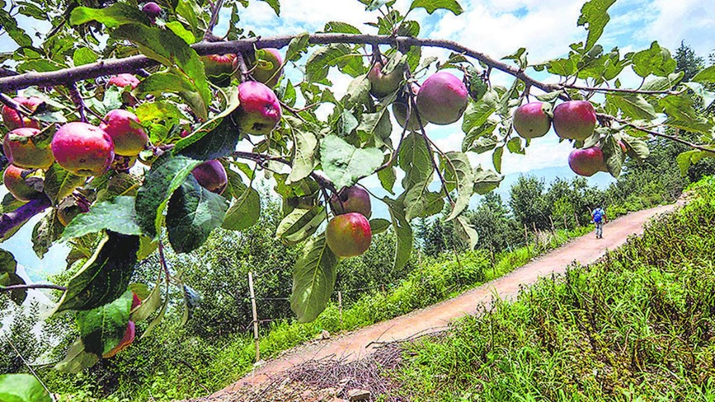
Why in the News?
- Apple growers in Himachal Pradesh have recently expressed grave concerns over the Central Government’s proposal to slash the import duty on New Zealand apples from 50% to 25%.
- They warned that cheaper imports could flood the market, erode domestic market share, depress prices, and deepen economic distress for of local orchardists, particularly small and marginal farmers, already grappling with climate change, rising input costs, labor shortages, and shrinking margins.
- The growers emphasized the risk of similar concessions being demanded by other major exporters like the United States, Chile, and Italy (which together account for over 40% of global apple exports).
- They urged restoration of import duty on apples to 100% as a protective measure and reconsideration of duty elimination on kiwi fruit.
Botanical and Historical Context of Apple
- Scientific Name: Malus pumila.
- The “Apple Revolution”: While indigenous varieties like Ambri exist, commercial cultivation was revolutionized in the early 20th century by Samuel Evans Stokes, an American who introduced the Red Delicious variety in Kotgarh, Himachal Pradesh
Overview of Apple
- Nature of Crop: Apple is a premier temperate fruit known for its nutritional value and long shelf life.
- Indian Context: While India does not fall within the traditional temperate zone, the Himalayan ranges provide the necessary high-altitude temperate climate required for its successful cultivation.
Ideal Climatic and Geographical Conditions of Apple
Apple cultivation is highly sensitive to environmental factors, requiring a specific balance of temperature and moisture:
- Temperature: During the active growth period, the average summer temperature should remain between 21°C and 24°C.
- Chilling Requirement: For proper flowering and fruit set, trees need approximately 1,000 to 1,500 hours of chilling (temperatures at or below 7°C) during the winter.
- Altitude: It is ideally grown at elevations ranging from 1,500 to 2,700 meters above mean sea level.
- Rainfall: A well-distributed rainfall of 1,000 mm to 1,250 mm throughout the growing season is optimal. Excessive rain during the flowering stage can result in poor fruit set.
- Soil Requirements: The crop thrives in well-drained, deep, loamy soils rich in organic matter. A soil pH of 5.5 to 6.5 is considered ideal.
- Proper aeration and drainage are crucial to avoid root rot, especially in hilly terrains where erosion is common. In India, farmers often amend soils with organic manure to enhance fertility in these regions.
Major Apple Producing States in India
India’s apple production is concentrated in the northern Himalayan belt, where topography and climate align with the crop’s biological needs.
- Jammu & Kashmir: The undisputed leader, contributing nearly 70–78% of India’s total output. It is famous for the Ambri (the only indigenous commercial variety) and high-quality Kashmiri apples, with primary hubs in Shopian, Baramulla, and Sopore.
- Himachal Pradesh: The second-largest producer (~25% share), often called the “Apple State.” Major hubs include Shimla (the “Apple Bowl”), Kullu, and Kinnaur.
- Annual Production: Typically yields around 5.5 to 6.5 lakh metric tonnes.
- Uttarakhand: Ranks third in production, with significant orchards in Uttarkashi (Harsil), Chamoli, and Nainital districts.
- Hills of Uttar Pradesh
- Emerging Regions: Small-scale and localized apple cultivation has expanded to Punjab, Sikkim, and several North-Eastern states, including Arunachal Pradesh (notably the Tawang region), Nagaland, Sikkim, and high-altitude areas of Meghalaya.
Global Apple Production
- Apple is the fourth most widely produced fruit globally, after orange, banana, and grape.
- China is the largest apple producer in the world, contributing a dominant share of global output.
- Leading Apple Exporters: Major apple-exporting countries include China, the United States, Chile, Italy, and New Zealand.
- India’s share in global apple production is around 2%, reflecting relatively low productivity compared to leading producers.
Import-Export Dynamics of Apple
India is a net importer of apples, primarily to meet off-season demand and the preferences of the growing middle class.
- Import Duty Policy: The standard Basic Customs Duty (BCD) has historically been 50%. Recently, the government removed the additional 20% retaliatory duty on U.S. apples, bringing it down to the parity level of 50%.
- Minimum Import Price (MIP): To protect domestic growers from predatory pricing, the government (via DGFT) imposed an MIP of ₹50 per kg on all apple imports (except those from Bhutan).
- New Zealand (2026-27): Under the new FTA, duties for New Zealand apples are proposed to be halved to 25% within specific quotas.
- Export Destination: India primarily exports to neighboring countries like Nepal, Bangladesh, and Bhutan.
Government Initiatives Supporting Apple Farming
The Government of India promotes apple cultivation through targeted schemes emphasizing productivity, infrastructure, and resilience. Major interventions include:
- Mission for Integrated Development of Horticulture (MIDH): The centrally sponsored MIDH scheme supports apple cultivation through financial assistance for high-density planting, orchard rejuvenation, nursery development, drip irrigation, and integrated pest and nutrient management, with special focus on Himalayan States.
- National Horticulture Mission (NHM): Implemented under MIDH, NHM promotes area expansion, productivity enhancement, and post-harvest infrastructure for apple-growing regions by funding cold storages, grading units, and pack houses.
- Rashtriya Krishi Vikas Yojana (RKVY): RKVY provides state-specific flexibility to fund apple-related projects such as orchard modernization, farm mechanization in hilly areas, and capacity building of apple growers.
- Pradhan Mantri Krishi Sinchayee Yojana (PMKSY): PMKSY supports apple orchards through micro-irrigation (drip and sprinkler systems), improving water-use efficiency in rain-dependent and hill slope plantations.
- Plant Protection and Quarantine (PPQ) Measures: The Government enforces strict phytosanitary standards on apple imports to prevent the entry of exotic pests and diseases, thereby safeguarding domestic orchards.
- Minimum Import Price (MIP) and Tariff Protection: Periodic use of MIP and maintenance of high customs duties on apples act as trade policy instruments to protect Indian apple growers from cheap imports and price volatility.
- High-Density Plantation Programme: The Government promotes dwarf and semi-dwarf rootstocks (e.g., M9, MM106) to increase productivity, reduce gestation period, and improve fruit quality, especially in Himachal Pradesh and Jammu & Kashmir.
- Operation Greens – TOP to TOTAL Expansion: Apple has been included under the expanded scope of Operation Greens, providing support for price stabilization, transport subsidies, and value-chain development during periods of market glut.
- Cold Chain and Post-Harvest Infrastructure Support: Financial incentives are provided for establishing cold storages, controlled atmosphere (CA) facilities, reefer transport, and sorting–grading units, reducing post-harvest losses in apple supply chains.
- Market Access and e-NAM Integration: Apple-producing mandis are gradually being linked to e-NAM (National Agriculture Market) to improve price discovery, transparency, and farmer access to wider markets.
- Research and Extension Support (ICAR): ICAR institutes, including the Central Institute of Temperate Horticulture (CITH), Srinagar, conduct research on climate-resilient apple varieties, pest management, and orchard technologies, supported by state horticulture departments.
- Crop Insurance under PMFBY: Apple growers are covered under the Pradhan Mantri Fasal Bima Yojana, offering financial protection against hailstorms, frost, unseasonal rainfall, and other climate-related risks.
Significance of Apple Farming in India
Apple farming, often termed the “Gold of the Himalayas,” is a socio-economic and ecological cornerstone for the North Indian hill states. Its significance is measured across three primary dimensions:
1. Economic Significance
- State GDP Contribution: In Himachal Pradesh, the apple economy is valued at nearly ₹5,500 crore, contributing approximately 10–13% to the State Gross Domestic Product (SGDP).
- Multiplier Effect: The industry sustains a vast ancillary network, including packaging (carton/tray manufacturing), cold chain logistics, and Controlled Atmosphere (CA) storage facilities.
- High Value-to-Volume Ratio: Compared to traditional field crops, apples provide significantly higher returns per unit of land, making it the most profitable horticultural activity in the temperate Himalayan belt.
2. Social & Livelihood Security
- Mass Employment: The sector provides direct and indirect livelihoods to over 3.5 million people in Jammu & Kashmir and roughly 1.5 lakh families, mostly small and marginal farmers with landholdings of one to two acres in Himachal Pradesh.
- Rural Prosperity: It has been the primary driver in raising the Human Development Index (HDI) in remote hilly districts (e.g., Shopian, Shimla) by providing stable income that supports better education and healthcare.
- Smallholder Empowerment: Apple cultivation is uniquely suited for small and marginal farmers (1–2 acres), as it thrives in hilly terrains where large-scale mechanized farming of cereals is not feasible.
3. Ecological & Environmental Value
- Soil & Water Conservation: As a perennial tree crop, apple orchards provide permanent vegetative cover, which stabilizes fragile mountain slopes and prevents soil erosion.
- Carbon Sequestration: Apple trees act as carbon sinks, absorbing carbon dioxide and mitigating the impact of climate change in the sensitive Himalayan ecosystem.
- Agro-forestry Potential: Orchards facilitate intercropping with legumes or medicinal plants, which improves soil fertility through nitrogen fixation and promotes local biodiversity.
With reference to apple cultivation in India, consider the following statements:
1. India lies entirely in the temperate climatic zone suitable for apple cultivation.
2. Apple cultivation in India is possible mainly due to high-altitude conditions provided by the Himalayan ranges.
3. Apples require winter chilling below 7°C for proper flowering and fruit setting.

Which of the statements given above are correct?
(a) 1 and 2 only
(b) 2 and 3 only
(c) 1 and 3 only
(d) 1, 2 and 3

Answer: (b) 2 and 3 only

Explanation:
● Statement 1 is incorrect because India does not fall under the classical temperate climatic zone. Apple cultivation in India is possible due to altitude-induced temperate conditions, not latitudinal temperate climate.
● Statement 2 is correct as the Himalayan mountain ranges create suitable low-temperature conditions at higher elevations, enabling apple cultivation.
● Statement 3 is correct because apple trees require winter chilling hours (below 7°C) for proper dormancy breaking, flowering, and fruit setting.