Context
The President of India recently announced new appointments and transfers for Governors across seven States and Lieutenant Governors (L-Gs) for two Union Territories. This reshuffle comes amidst significant political shifts, upcoming Assembly elections, and the resignation of high-profile officials like West Bengal Governor C.V. Ananda Bose.
I. Recent Appointments and Key Changes
The latest round of appointments highlights the constitutional power of the President to move and appoint heads of states:
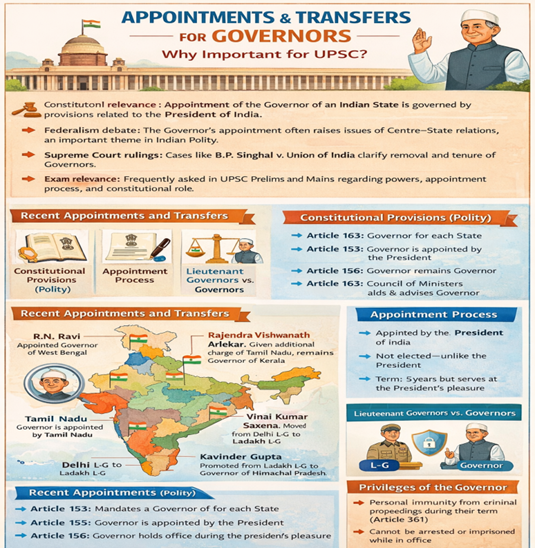
- West Bengal: R.N. Ravi (formerly Governor of Tamil Nadu) has been appointed as the new Governor.
- Tamil Nadu: Rajendra Vishwanath Arlekar (Governor of Kerala) has been given the additional charge of Tamil Nadu.
- Bihar: Lt. Gen. (Retd.) Syed Ata Hasnain has been appointed as the Governor, replacing Arif Mohammed Khan.
- Transfers: Shiv Pratap Shukla was moved from Himachal Pradesh to Telangana, and Jishnu Dev Varma was transferred from Telangana to Maharashtra.
- Union Territories: Vinai Kumar Saxena was moved from Delhi to Ladakh, while Kavinder Gupta was elevated from Ladakh L-G to Governor of Himachal Pradesh.
II. Static Linkages: The Office of the Governor
1. Constitutional Provisions (Polity)
- Article 153: Mandates that there shall be a Governor for each State. The 7th Constitutional Amendment Act of 1956 facilitated the appointment of the same person as a Governor for two or more States (relevant to the additional charge given for Tamil Nadu).
- Article 155: The Governor is appointed by the President by warrant under his hand and seal.
- Article 156: The Governor holds office during the pleasure of the President. The article also mentions a standard term of five years, but this is subject to the President’s pleasure.
- Article 163: There is a Council of Ministers with the Chief Minister at the head to aid and advise the Governor in the exercise of his functions, except in some conditions where discretion is allowed.
2. What is the Appointment Process for the Governor?
- The Governor of an Indian State is the constitutional head and chief executive of the state. The office has been inspired by the Canadian constitutional model.
- By convention, the Governor is usually appointed from outside the state to keep the office free from local political influences.
- Although the President of India appoints the Governor, it is generally expected that the Chief Minister of the concerned state is consulted to facilitate smooth functioning of the constitutional system.
- Unlike the President of India, the Governor is neither directly elected by the people nor indirectly elected by an electoral college.
- Instead, the Governor is appointed by the President through a warrant under his hand and seal. The Governor holds office at the pleasure of the President and may be removed at any time.
3. Key Conditions of the Governor’s Office
- Legislative Separation: The Governor cannot be a member of either House of Parliament or any House of a State Legislature. If a sitting member is appointed, they are deemed to have vacated their seat on the date they assume office.
- No Other Office of Profit: The Governor must not hold any other position of profit.
- Official Residence: The Governor is entitled to use the official residence (Raj Bhavan) without paying rent.
- Emoluments and Allowances: Parliament determines the salary, allowances, and privileges of the Governor. These cannot be reduced during their term.
- Shared Expenses: If one person acts as Governor for two or more states, the expenses and salaries are shared among the states as determined by the President.
- Immunity: The Governor enjoys immunity from criminal proceedings for personal acts during their term, and civil proceedings require two months’ notice.
- Qualification: Must be a citizen of India and Must have completed 35 years of age(Article 157).
4. Lieutenant Governors vs. Governors
- Governors: Act as the constitutional head of a State, bound by the aid and advice of the Council of Ministers (except in discretionary matters).
- Lieutenant Governors (L-Gs): Administer Union Territories (UTs) like Delhi, Ladakh, and Puducherry as representatives of the President. Their powers often differ based on whether the UT has a Legislative Assembly.
5. Privileges:
- Under Article 361 of the Constitution of India, the Governor of an Indian State enjoys personal immunity from legal liability for acts performed in the exercise of official powers.
- During the tenure of office, the Governor is immune from criminal proceedings, even for actions of a personal nature, and cannot be arrested or imprisoned.
- However, civil proceedings related to personal acts may be initiated during the term, provided a two-month prior notice is given.
Consider the following statements:

I. The 7th Constitutional Amendment Act of 1956 facilitated the appointment of the same person as a Governor for two or more States.

II. The Governor enjoys immunity from criminal proceedings for personal acts during their term.

Which of the statements given above is/are correct?
(a) 1 only
(b) 2 only
(c) Both 1 and 2
(d) Neither 1 nor 2

Answer: C

Explanation:
•  Statement I is correct: As per the static linkages of the Governor's office, the 7th Constitutional Amendment Act of 1956 made it possible to appoint the same person as a Governor for two or more states. This is reflected in the current context where Rajendra Vishwanath Arlekar has been given the additional charge of Tamil Nadu while serving as the Governor of Kerala.
•  Statement II is correct: Under the Constitution of India, a Governor enjoys personal immunity from legal liability for their official acts. Specifically, during their term of office, they are immune from any criminal proceedings, even for their personal acts. No process for the arrest or imprisonment of a Governor can be issued from any court during their term of office.