Context
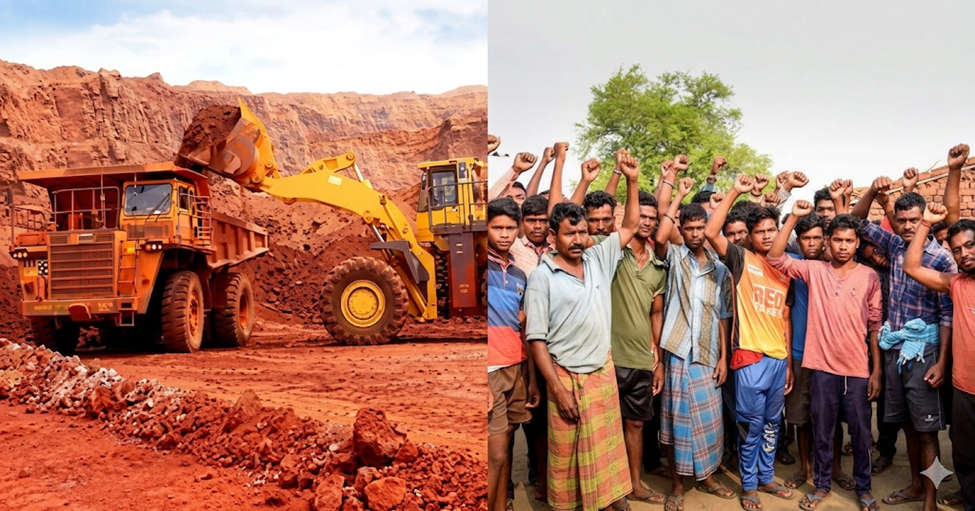
Recently, violent clashes broke out in Odisha’s Rayagada district as local tribal communities protested against the construction of a road leading to the proposed Sijimali bauxite mine. The residents of Kutamal village expressed deep concerns that the mining project, estimated to hold 311 million tones of bauxite, would deplete perennial water sources and severely impact their traditional livelihoods.
This incident highlights the ongoing tension between industrial development by companies like Vedanta Limited and the protection of tribal rights under the constitutional framework.
1. Bauxite: The Ore of Aluminum
- Composition: Bauxite is not a specific mineral, but a rock consisting mainly of hydrated aluminum oxides.
- Geological Formation: It is formed by the decomposition of a wide variety of rocks rich in aluminum silicates under tropical and sub-tropical conditions (lateralization process).
- Usage: It is the primary ore used to produce Alumina, which is then smelted to create Aluminum—a critical metal for the aerospace, construction, and packaging industries.
2. Bauxite Distribution in India
- India is home to significant bauxite reserves, estimated at approximately 650 million tonnes as of 2026. Production is dominated by a few key states, with the Eastern Ghats being the most productive region.
a. Odisha (The Leader)
- Share: Produces over 50% of India’s total output.
- Key Belts: The 300-km-long belt across Kalahandi and Koraput is the largest bauxite-bearing region in the country.
- Major Mines:Panchpatmali (Koraput): Often cited as Asia’s largest bauxite mine; it supplies the NALCO refinery at Damanjodi.
- Gandhamardan (Bargarh): A high-grade deposit of strategic importance.
- Kodingamali (Rayagada): A major site for OMC (Odisha Mining Corporation).
b. Gujarat
- Share: Second largest producer (~15-18%).
- Key Locations: The deposits are found in a belt between the Gulf of Kachchh and the Arabian Sea.
- Districts: Jamnagar (Kalyanpur), Devbhumi Dwarka, Junagadh, and Bhavnagar.
c. Jharkhand
- Key Locations: The Patlands of Lohardaga and Gumla are famous for high-grade bauxite.
- Districts: Lohardaga, Gumla, Latehar, and Ranchi.
d. Chhattisgarh & Madhya Pradesh
- Maikala Range: Deposits are abundant in the Maikala range covering Bilaspur and Durg (Chhattisgarh).
- Amarkantak Plateau: Spans across Shahdol and Mandla (MP) and Surguja (Chhattisgarh).
- Katni (MP): Known for specialized grades used in the refractory and chemical industries.
3. Top Bauxite Producing Countries
- Australia and Guinea are the world’s leading bauxite producers, together driving global supply, with China and Brazil also ranking among the top producers.
4. Constitutional and Legal Protections for Tribal Areas
- Fifth Schedule: Most bauxite-rich areas in Odisha fall under the Fifth Schedule of the Constitution, which provides for the administration and control of Scheduled Areas and Scheduled Tribes.
- PESA Act, 1996: The Provisions of the Panchayats (Extension to Scheduled Areas) Act mandates that the Gram Sabha must be consulted before making any decision on land acquisition or mining leases in these areas.
- Forest Rights Act (FRA), 2006: Recognizes the rights of forest-dwelling communities over forest land and resources, requiring their consent for diversion of forest land for non-forest purposes.
4. Environmental and Social Concerns
- Water Depletion: Bauxite cappings on hills act as natural aquifers that feed perennial streams; mining these caps can lead to the drying up of water sources.
- Displacement: Mining often leads to the involuntary displacement of tribal communities, resulting in the loss of cultural heritage and traditional economic structures.
- Ecological Impact: Open-cast mining leads to large-scale deforestation and loss of biodiversity in the Eastern Ghats region.
Q. With reference to Bauxite resources in India, consider the following statements:

1. Bauxite is primarily formed through the atmospheric weathering of rocks in tropical climates.
2. The state of Odisha possesses more than 50 percent of India’s total bauxite reserves.
3. Under the PESA Act 1996, the recommendation of the Gram Sabha is mandatory for granting mining leases for minor minerals in Scheduled Areas.

How many of the above statements are correct?
(a) Only one
(b) Only two
(c) All three
(d) None

Answer: (c) All three

Solution:
STATEMENT 1 IS CORRECT: Bauxite is formed by the chemical weathering of various rocks (like limestone or basalt) under hot and humid tropical conditions, leading to the leaching of silica and the accumulation of aluminum oxides.

STATEMENT 2 IS CORRECT: Odisha is the undisputed leader in bauxite resources in India, with the Eastern Ghats belt holding massive deposits.

STATEMENT 3 IS CORRECT: The Provisions of the Panchayats (Extension to Scheduled Areas) Act, 1996, explicitly requires the recommendation or consent of the Gram Sabha or the Panchayats at the appropriate level before granting a prospective license or mining lease for minor minerals in the Scheduled Areas. While bauxite is a major mineral, the principle of Gram Sabha consultation is a fundamental pillar of governance in these regions.