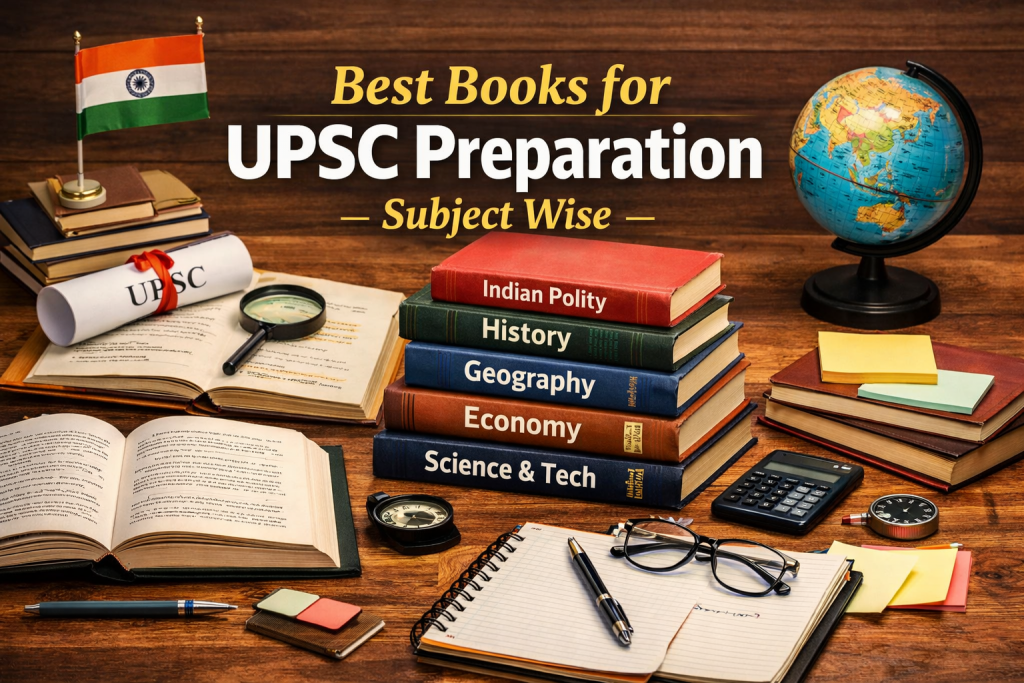
The UPSC Exam is all about proper strategy, dedication, and consistent effort in the right direction with authentic and reliable study material. With a vast syllabus and a changing pattern of examination, selecting the right books for UPSC preparation is a very difficult task for every aspirant. The more you read, the more confused you will become, and conversely, as little contained and generic books help in creating clarity and confidence.
In this post, we are sharing the best books for UPSC preparation (IAS, IPS & IFS) Preparation. These books cover both Prelims and Mains , which really help aspirants understand the concepts with analytical ability and improve their writing skills.
Why Choosing the Right Books for UPSC Is Important
The UPSC exam pattern is not memory-based; it examines how well aspirants have understood and their ability to apply the knowledge of multiple subjects, as well as think critically. Standard books help aspirants:
- Build strong conceptual foundations
- Avoid unnecessary information overload
- Maintain consistency throughout preparation
- Revise efficiently multiple times
- Align preparation with UPSC’s demand
Instead of consuming dozens, you should concentrate on a few high-quality books.
Best Books for UPSC Prelims and Mains (Subject-Wise)
Polity – Indian Constitution & Governance
UPSC Polity is one of the important and scoring subjects.
Recommended Books:
- Indian Polity by M. Laxmikanth
- Introduction to the Constitution of India by D.D. Basu (read selectively).
Why these books?
They have very simply and lucidly explained constitutional aspects in a structured way, which is (very) useful for Prelims as well as Mains.
History – Ancient, Medieval & Modern India
History’s questions are factual but analytical, more so in Mains.
Recommended Books:
- Ancient India by R.S. Sharma
- Medieval India by Satish Chandra
- India After Independence by Spectrum (Rajiv Ahir)
NCERTs (Class 6–12)
NCERTs are for freshers, and Spectrum is a must for modern history revision.
Geography – Physical, Indian & World Geography
Conceptual clarity and map work are also necessary in Geography.
Recommended Books:
- Certificate Physical and Human Geography – Goh Cheng Leong
- NCERT Geography (Class 6–12)
- Oxford School Atlas
Diagrams and maps that these books support well I have found geography answers improve dramatically with diagrammatical tools, as well as maps.
Indian Economy
The economy is very volatile and news-based.
Recommended Books:
- Indian Economy by Nitin Singhania
- NCERT Economics (Class 9–12)
- Economic Survey (selective reading)
emphasis to understand concepts such as Inflation, Growth, Fiscal policy and Budget.
Environment & Ecology
This topic is becoming increasingly relevant.
Recommended Books:
- Environment by Shankar IAS Academy
- NCERT Biology (Class 11 – 12) – pick the topics
The Shankar IAS book is a crisp, exam-focused book suitable for Prelims.
Science & Technology
The Science and Tech section has become more of an application area now.
Recommended Sources:
- NCERT Science (Class 6–10)
- Current affairs (science sections)
For new and recent details, don’t read advanced tech books. No requirements for you!
Best Books for UPSC Mains (Answer Writing Focus)
Ethics (GS Paper IV)
Ethics has a lot of say in enhancing the overall Mains score.
Recommended Books:
- Target IAS Ethics, Integrity , and Aptitude by Lexicon
- Ethics by Subba Rao (selective)
Keep solving case studies along with theory.
Essay Paper
We want to clarify and structure essay writing for you.
Recommended Books:
- Essay Writing for Civil Services by Arihant Textbooks- Need for IAS Preparation.
- Essays by previous UPSC toppers
You get better at reading and writing good essays (which enhances your content depth).
Best Books for UPSC Optional Subjects
Optional subjects differ according to the background of the candidate. But you must also select standard books (recommended by toppers).
Tips for Optional Selection:
- Choose interest over trend
- Check syllabus overlap with GS
- Ensure the availability of study material
Role of Current Affairs in UPSC Preparation
Only UPSC books are not enough to crack it! Current affairs is the bridge between static knowledge and its practical application in the real world.
Recommended Sources:
- Daily newspaper (Your Opinion & Analysis)
- Monthly current affairs magazines
- Government reports and summaries
Relate static to current for Mains answers.
How to Read UPSC Books Effectively
Only purchasing the best books for UPSC is not sufficient. Follow this approach:
- Read many times, not many books
- Make short notes for revision
- Practice answer writing alongside reading
- Revise regularly before mock tests
This source-driven approach is also followed by many IAS aspirants who are studying with the help of Rice IAS , as well as Self-study formats. This strategy helps in maintaining focus and preventing burnout and confusion.
Common Mistakes Aspirants Make While Choosing Books
1. Collecting too many books
2. Ignoring NCERTs
3. Reading without revision
4. Following random online sources
5. Changing books frequently
Stick to standard books and revise them thoroughly.
Summary
Selecting the right books to buy for UPSC preparation is probably one of the most essential things an IAS aspirant should do. Book lists are important, and reliable books can contribute to strong basics, better analytical skills, and efficient answer-writing. With regular revision, current affairs incorporation, and constant practice, these books become the bible of your UPSC preparation.
UPSC aspirants should always understand that success in upsc does not depend on the number of books you have read, but upon how much you have applied your mind through a few books. And many dedicated candidates combine their individual study with the guidance and mentorship program, and institutes like RICE IAS are one such name that pops up when it comes to offering exam-centric academic support for IAS coaching in Kolkata.