Context
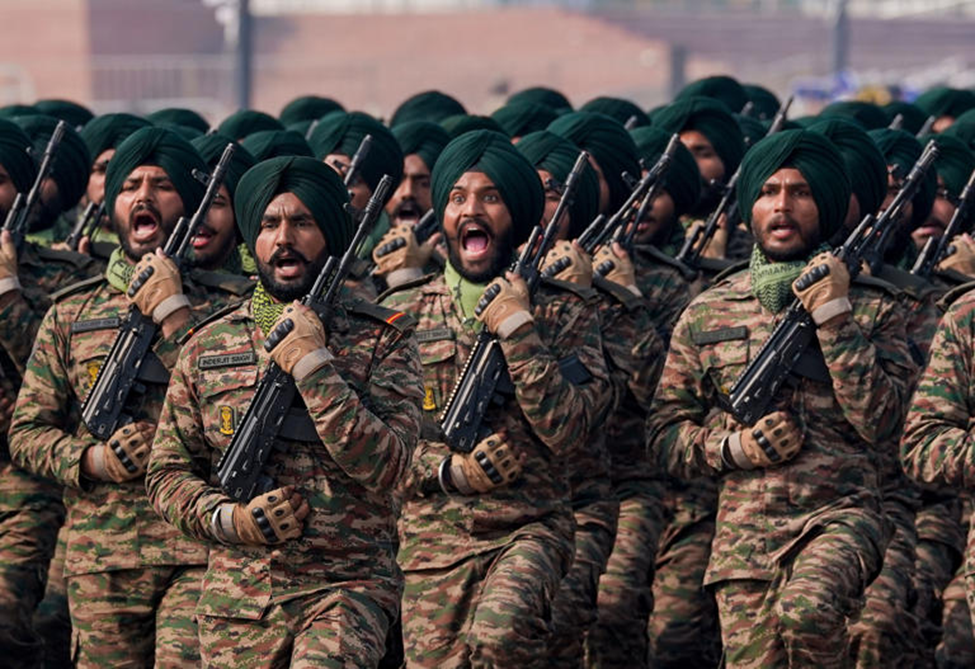
Recently, the Indian Army’s newly raised Bhairav Light Commando Battalion made its historic debut during the 77th Republic Day Parade (2026) at Kartavya Path and the Army Day Parade in Jaipur.
It was announced officially by the Chief of Army Staff on July 26, 2025 (Kargil Vijay Diwas), these units represent a pivotal shift in India’s land warfare doctrine, moving toward lean, technology-driven, and agile formations capable of handling “grey-zone” conflicts and modern hybrid threats.
Key Features of Bhairav Battalion
1. Mission and Mandate
- The Bridge Force: The Bhairav units are designed to fill the operational gap between Regular Infantry (large ground-holding units) and Para Special Forces (elite strategic assets).
- Tactical Focus: Their primary role is to handle fast-breaking, tactical situations that require immediate, high-impact responses rather than long-term strategic planning.
- “Fight Tonight” Philosophy: This mantra underscores their readiness to deploy within hours at short notice, bypassing the long mobilization times typical of larger conventional formations.
2. Structure and Composition
- Compact Size: Unlike a standard infantry battalion of ~800 soldiers, a Bhairav Battalion is a “lean and mean” unit comprising approximately 250 personnel.
- Multi-Arm Integration: The battalion follows a “composite” model, drawing personnel from various wings including Infantry, Artillery, Air Defence, Signals, and Combat Support Arms. This allows a single unit to possess eyes-in-the-sky (drones) and firepower (missiles) simultaneously.
- Command: Each battalion is led by a Colonel-rank officer with 7–8 supporting officers.
3. Recruitment and Tactical Ethos
- Sons of the Soil: A key strategy, particularly in desert and mountain sectors, involves recruiting personnel from the local regions they are tasked to protect. This ensures the force has innate knowledge of the local terrain, climate, and language.
- Cultural Identity: Named after Lord Bhairav (the fierce protector form of Shiva), the units embody the “Sant Sipahi” (Saint-Soldier) ethos—calm and disciplined, yet devastatingly fierce in battle.
- Motto: Their motto is “Abhayam Bhairav” (Fearless Protector).
4. Technological Edge
- Hybrid Warfare: Specially trained for multi-domain operations involving drone surveillance, electronic disruption, and small-team tactical maneuvers.
- Advanced Equipment: They are equipped with Ashni drones, loitering munitions, Javelin Anti-Tank Guided Missiles (ATGMs), and modern CQB (Close Quarter Battle) carbines.
- Signature Camouflage: Commandos apply black or red oil-based face paint designed to disrupt AI-based sensors and infrared surveillance during nocturnal or stealth operations.
Deployment Strategy
The Indian Army plans to raise a total of 25 Bhairav Battalions. As of early 2026, 15 units are already operational or in advanced stages of training. They are primarily stationed in sensitive border zones:
- Northern Command: Jammu, Kashmir, and Ladakh (Srinagar, Nagrota, Leh).
- Western Command: Rajasthan sector.
- Eastern Command: Sensitive border areas in Northeast India.





Q. With reference to the 'Bhairav Light Commando Battalion' of the Indian Army, recently seen in the news, consider the following statements:
I.	It is a new class of combat units designed to bridge the operational gap between regular Infantry and Para Special Forces.
II.	A Bhairav Battalion is significantly larger in manpower than a standard infantry battalion to ensure ground-holding dominance.
III.	These units follow a "Sons of the Soil" recruitment strategy to leverage local terrain expertise.

Which of the statements given above is/are correct?
(a) I only
(b) I and III only
(c) II and III only
(d) I, II and III

Correct Answer: (b)
Explanation:
STATEMENT I IS CORRECT: The Bhairav Battalion is specifically designed as a "bridge" between the large conventional infantry and the elite Para Special Forces.
STATEMENT II IS INCORRECT: A Bhairav Battalion is much smaller (approx. 250 soldiers) compared to a standard infantry battalion (approx. 800 soldiers), making it a "lean and agile" force.
STATEMENT III IS CORRECT: The "Sons of the Soil" concept is a core part of their recruitment to ensure soldiers have an innate understanding of the local geography and culture.