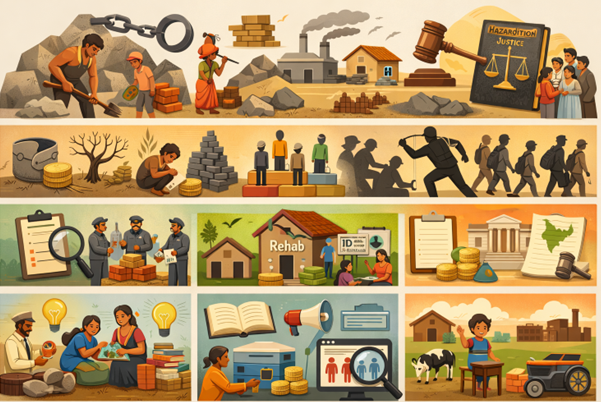
After Reading This Article You Can Solve This UPSC Mains Model Question:
Critically analyse the constitutional and legal framework for the eradication of bonded labour in India. Suggest measures to strengthen implementation and rehabilitation mechanisms. (250 words, GS-2 Social Justice)
Context
2026 marks 50 years of the Bonded Labour System (Abolition) Act, 1976. While “traditional” feudal bondage (like Kamaiya or Vettichakiri) has declined, new forms have emerged in the informal economy.
About Bonded Labour:
Bonded labour (also called debt bondage/Bandhua Mazdoori) is a form of modern slavery where a person (or family) is forced to work to repay a loan or debt under exploitative terms, often for nominal or no wages, and cannot freely leave the work until the debt is extinguished.
Key features:
- Debt and labour tied; work done in lieu of repayment
- Loss of freedom to change employer, move freely, or refuse work
- Debt often inflated with interest, trapping labourers (sometimes generationally)
Key Legal Framework on Bonded Labour
1. Constitutional Provisions
- Article 23: Explicitly prohibits “begar” (forced labour without payment) and other similar forms of forced labour.
- Article 21: Interpreted by the SC to include the Right to Live with Dignity; bonded labour is a violation of this fundamental right.
- Article 24: Prohibits the employment of children in hazardous factories/mines.
- Directive Principles (DPSP):
- Article 39: Directs the State to prevent the abuse of workers’ health and strength.
- Article 42: Mandates just and humane conditions of work.
2. Legal Framework
- Bonded Labour System (Abolition) Act, 1976: Formally ends the bonded labour system.
- Debt Extinguishment: All existing bonded debts are legally discharged/cancelled.
- Enforcement: Grants the District Magistrate (DM) the power to identify, release, and rehabilitate victims.
- Bharatiya Nyaya Sanhita (BNS), 2023: Section 143: Criminalizes trafficking and unlawful compulsory labour (replaces older IPC sections).
- SC/ST (Prevention of Atrocities) Act, 1989: Provides enhanced protection and penalties as most victims are from marginalized communities.
3. Recent Judicial Interpretations (2026)
- Kerala High Court Ruling: Clarified that preventing an employee from resigning or withholding their salary to force continued service constitutes Bonded Labour under Article 23.
4. International Obligations
- ILO Conventions: India has ratified Convention No. 29 (suppressing all forced labour), No. 105 (prohibiting forced labour for economic/political purposes), and No. 182 (eliminating debt bondage for children).
- SDG Target 8.7: Commits India to end modern slavery, forced labour, and human trafficking by 2030.
- UDHR Article 4: Aligns with the UN declaration that prohibits holding any individual in slavery or servitude.
Reasons for Bonded Labour
1. Economic Factors
- Poverty & Indebtedness: Extreme poverty forces families to take “bridge loans” for health emergencies, weddings, or funerals.
- Lack of Formal Credit: Marginalized groups lack collateral, making them dependent on predatory local moneylenders/landlords.
- Informalization: Over 90% of India’s workforce is in the informal sector (brick kilns, stone quarries, agriculture) where labour laws are poorly enforced.
2. Socio-Cultural Factors
- Caste Hierarchy: Bondage is deeply rooted in the caste system; 80–90% of victims belong to SC/ST or OBC communities.
- Illiteracy: Lack of education prevents workers from understanding contract terms or their legal rights under the 1976 Act.
3. Administrative & Legal Gaps
- Poor Identification: Bonded labour has shifted from “traditional feudalism” to “hidden commercial bondage,” making it harder for authorities to detect.
- Dysfunctional Vigilance Committees: District-level committees, mandated by law to monitor bondage, often remain inactive or underfunded.
- Low Conviction Rates: Despite rescues, employers are rarely prosecuted under the BNS (2023) or the 1976 Act, leading to a lack of deterrence.
4. Modern Triggers
- Climate Vulnerability: Agricultural distress due to erratic weather (like the 2025-26 droughts) drives distressed migration, where workers fall into the debt-traps of labour contractors.
Government Initiatives
- Central Sector Scheme for Rehabilitation (2021):
- Financial assistance: ₹1 lakh for adult males, ₹2 lakh for women and children, and ₹3 lakh for extreme cases (transgender, sexual exploitation).
- Creation of a Rehabilitation Fund (corpus of ₹10 lakh) at the district level for immediate relief.
- Standard Operating Procedure (SOP): States like Karnataka and Tamil Nadu have developed SOPs for faster identification and rescue.
- International Alignment: India has ratified ILO Convention 182 (Worst Forms of Child Labour) and is committed to SDG 8.7 (ending modern slavery by 2030).
- Labour Codes (2020/2025): The Code on Wages and Social Security Code aim to formalize contracts and ensure universal minimum wages, removing the economic vacuum that leads to debt-bondage.
- Convergence with Other Schemes
- MGNREGA: Guaranteed 100 days of work to prevent re-entry into debt.
- PM-Awas Yojana: Priority allotment of housing for rescued families.
- Samagra Shiksha Abhiyan: Rescued child labourers are mainstreamed into formal schools.
Way Forward
To move from “legal abolition” to “practical eradication” by the SDG 8.7 target of 2030, a multi-dimensional strategy is required:
1. Strengthened Governance & Enforcement
- Active Vigilance Committees: Ensure statutory district-level committees meet quarterly (as mandated) to proactively identify hidden bondage in newer sectors like shopping malls, call centers, and massage parlors.
- Summary Trials: Strict adherence to Section 21 of the 1976 Act and BNS 2023 to conclude trials within three months to create a credible deterrent for employers.
2. Comprehensive Rehabilitation
- Digital Integration: Link the e-Shram portal with the Bonded Labour Rehabilitation Scheme to track rescued workers and ensure they don’t slip back into the debt cycle during migration.
- Immediate Relief Transparency: Solve the “Implementation Gap” by automating the transfer of the ₹30,000 immediate relief through Direct Benefit Transfer (DBT) within 24 hours of rescue.
3. Preventive & Structural Reforms
- Financial Inclusion: Promote Micro-credit facilities and SHGs (Self-Help Groups) in vulnerable districts (e.g., Bolangir, Kalahandi) to provide alternatives to predatory local moneylenders.
- Social Awareness: Conduct grassroots legal literacy camps (like the NSS initiatives in 2026) to educate workers on their right to “Release Certificates,” which legally extinguish all their bonded debts.
4. Inter-State Coordination
- Migration Governance: Establish a Centralized Tracking System for interstate migrant workers to monitor those moving from “source” states (Bihar, Odisha) to “destination” industries (brick kilns in Punjab, cattle farms in Tamil Nadu).
Conclusion
Fifty years after the 1976 Act, eradicating bonded labour requires shifting from mere rescue to holistic rehabilitation. Strengthening district vigilance, ensuring timely DBT relief, and strictly enforcing the BNS 2023 are vital to breaking the debt-poverty cycle and achieving SDG 8.7.