Context
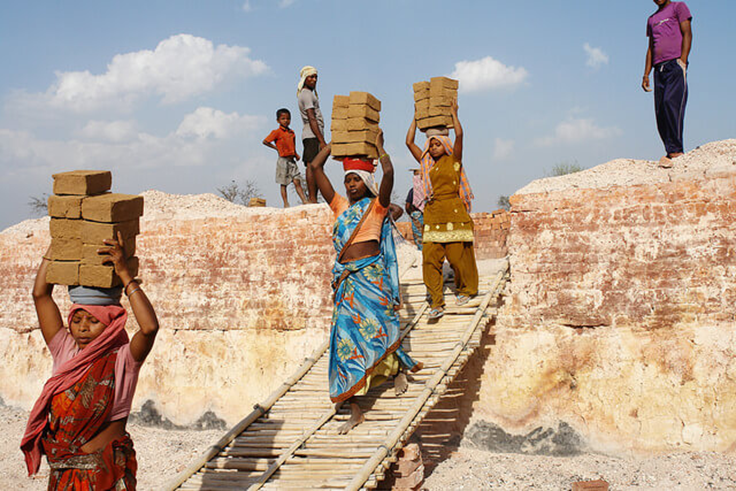
Recently, India observed Bonded Labour Abolition Day, marking 50 years of the Bonded Labour System (Abolition) Act, 1976. While states like West Bengal and Tamil Nadu held awareness drives, reports revealed that modern debt bondage still persists, highlighted by the rescue of a family from a brick kiln in Nadia trapped in second-generation bondage for 17 years, pointing to serious gaps in identification and rehabilitation.
About Bonded Labour System (Abolition) Act, 1976
The Bonded Labour System (Abolition) Act, 1976, was enacted to give effect to Article 23 of the Constitution, which prohibits “begar” and other similar forms of forced labour.
1. Constitutional Basis
- Article 23: Explicitly prohibits traffic in human beings, begar (forced labour without payment), and other similar forms of forced labour.
- Article 21: The Supreme Court has interpreted the right to life to include the right to live with human dignity, which is fundamentally violated by bondage.
- Directive Principles: Article 42 (humane conditions of work) and Article 46 (protection of SCs/STs from exploitation) provide the guiding philosophy for this Act.
2. Key Definitions and Features
- Bonded Labour System: A system of forced or partly forced labour where a debtor enters into an agreement with the creditor in consideration of an advance, a customary obligation, or an obligation devolving by succession.
- Automatic Discharge of Debt: On the commencement of the Act, every bonded labourer stands freed and discharged from any obligation to render bonded labour, and all bonded debts are deemed extinguished.
- Restoration of Property: Any property of the bonded labourer taken by the creditor as security must be restored to the labourer.
- Punishment: The Act provides for imprisonment for a term which may extend to three years and a fine for anyone who compels a person to render bonded labour or advances a bonded debt.
3. Institutional Mechanism
- Vigilance Committees: The Act mandates the constitution of Vigilance Committees at the District and Sub-Divisional levels.
- These committees consist of the District/Sub-Divisional Magistrate, persons belonging to SC/ST, social workers, and representatives of financial institutions.
- Their role is to advise the Magistrate on implementation and provide for the economic and social rehabilitation of freed labourers.
- Executive Powers: The District Magistrate (DM) is the primary authority responsible for the identification, release, and rehabilitation of bonded labourers.
4. Rehabilitation Framework
- Central Sector Scheme: This scheme provides financial assistance for rehabilitation.
- Adult Males: Eligible for ₹1 lakh.
- Special Categories: Women, children, and transgenders are eligible for higher assistance (up to ₹3 lakh).
- Release Certificate: This document, issued by the DM, is the legal proof required for the victim to claim statutory benefits and protection from creditors.
Q. With reference to the Bonded Labour System (Abolition) Act, 1976, consider the following statements:

1. Under the Act, a bonded debt is not extinguished but is converted into a formal loan to be repaid through the Public Distribution System (PDS).

2. The District Magistrate is empowered to perform the functions of a Judicial Magistrate for the trial of offences under the Act.

3. Vigilance Committees at the District level must include representatives from the Scheduled Castes or Scheduled Tribes.

How many of the above statements are correct?

A) Only one
B) Only two
C) All three
D) None

Correct Answer: B (Only two)

Explanation
•	STATEMENT 1 INCORRECT: The Act explicitly states that upon its commencement, all bonded debts are extinguished, and no suit or other proceeding shall lie in any civil court for the recovery of such debt.
•	STATEMENT 2 CORRECT: The Act allows the State Government to confer the powers of a Judicial Magistrate of the first or second class on a District Magistrate for the trial of offences under the Act.
•	STATEMENT 3 CORRECT: The composition of the Vigilance Committee specifically requires the inclusion of persons belonging to Scheduled Castes or Scheduled Tribes residing in the district.