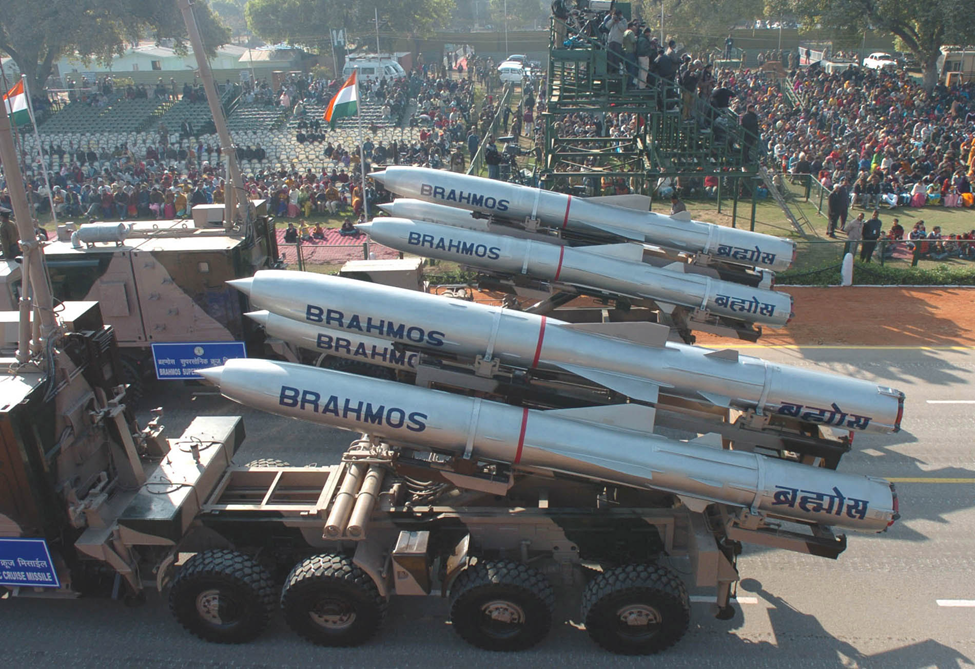
Institutional Genesis and Diplomatic Framework
- Collaborative Entity: Established in 1998 via an Inter-Governmental Agreement between India (DRDO) and Russia (NPO Mashinostroyenia).
- Organizational Structure: A Joint Venture (BrahMos Aerospace) with an equity split of 50.5% (India) and 49.5% (Russia).
- Nomenclature: A portmanteau symbolizing strategic cooperation, derived from the rivers Brahmaputra and Moskva.
Technical Architecture and Propulsion
- Classification: A medium-range Supersonic Cruise Missile capable of being launched from multiple platforms (Universal compatibility).
- Propulsion Mechanics: Operates on a Two-Stage propulsion system:
- First Stage: Solid propellant booster for initial acceleration to supersonic velocity.
- Second Stage: Liquid Ramjet engine sustaining cruise speeds of Mach 2.8 to 3.0.
- Operational Principle: Functions on the “Fire and Forget” mechanism, utilizing advanced embedded software for autonomous guidance.
Strategic Capabilities and Stealth Features
- Flight Trajectory: Capable of “Sea-Skimming” (low-altitude flight) to evade enemy radar and air defense systems.
- Stealth Profile: Designed with a low Radar Cross Section (RCS) and high maneuverability, making interception difficult.
- Payload: Delivers conventional warheads (200–300 kg) with high kinetic energy and pinpoint accuracy.
Operational Triad (Deployment)
- The system is fully inducted across the Indian Armed Forces, creating a multi-dimensional deterrence capability:
- Land Systems: Deployed via Mobile Autonomous Launchers (MAL); upgraded variants possess a strike range extended to 400 km.
Naval Systems:
- Surface: Capable of engaging targets beyond the radar horizon.
- Sub-Surface: Vertically launched from submarine pressure hulls (50m depth) via a Transport Launch Canister.
- Aerial Systems: integrated with the Sukhoi-30 MKI for deep-strike capabilities; future integration planned for LCA Tejas.
Future Trajectory and Modernization
- BrahMos-NG (Next Generation):
- Concept: A miniaturized, lightweight version designed for diverse platform integration (including torpedo tubes).
- Performance: Enhanced speed (Mach 3.5) with a reduced radar signature.
BrahMos-II (Hypersonic):
- Concept: A Hypersonic Cruise Missile (HCM) leveraging Scramjet technology (inspired by Russia’s Tsirkon missile).
- Performance: Projected velocity of Mach 7 with a range exceeding 480 km, aimed at reinforcing dominance in the Indian Ocean Region (IOR)