Context
Recently, the renowned molecular biologist Prof. Bonnie Bassler, while delivering a lecture at the Indian Institute of Science (IISc) in Bengaluru, highlighted how bacteria use a “chemical language” to coordinate collective behavior.
This phenomenon, known as Quorum Sensing, is being hailed as a critical frontier in medical science, particularly for developing “anti-quorum sensing” therapies. These therapies aim to disrupt bacterial communication to treat infections like Cholera without the use of traditional antibiotics, thereby providing a potential solution to the global crisis of Anti-Microbial Resistance (AMR).
More About Bacterial Communication (Quorum Sensing)
1. What is Quorum Sensing?
- Definition: It is a process of cell-to-cell communication that allows bacteria to share information about their population density and adjust their gene expression accordingly.
- Collective Behavior: It enables single-celled organisms to act like a multicellular entity. This ensures that energy-expensive processes (like toxin production) are only performed when there are enough bacteria present to successfully overwhelm a host’s immune system.
2. The Mechanism of Communication
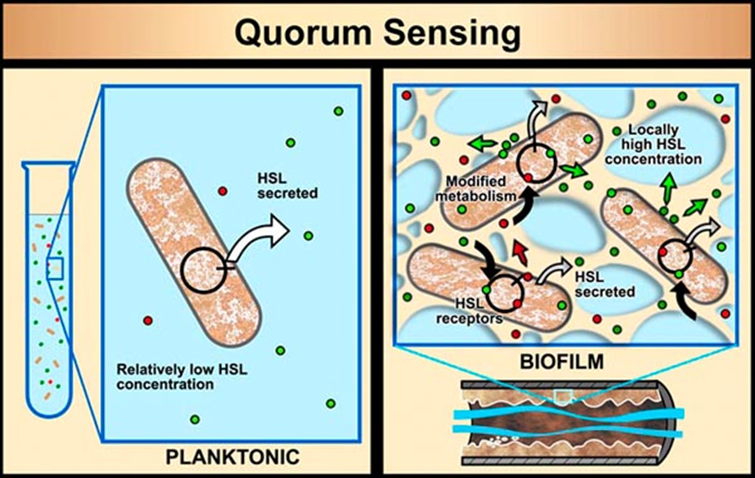
Bacterial communication relies on the production and detection of signaling molecules called Autoinducers. The process follows four distinct stages:
- Production: Bacteria continuously produce a low level of autoinducer molecules.
- Accumulation: As the bacterial population grows, the concentration of these molecules in the environment increases.
- Detection: Once the concentration reaches a specific threshold (a “quorum”), the molecules bind to receptors on or inside the bacterial cells.
- Response: This binding triggers a synchronized change in gene expression across the entire population.
3. Key Traits Controlled by Quorum Sensing
- Virulence: The release of toxins (e.g., Vibrio cholerae).
- Biofilm Formation: Creating sticky, protective layers on surfaces like medical implants or teeth, which makes them highly resistant to antibiotics.
- Bioluminescence: Producing light in response to high density (e.g., Vibrio fischeri in a symbiotic relationship with the Hawaiian bobtail squid).
4. Quorum Quenching: The Future of Medicine
- Concept: Instead of killing bacteria (as antibiotics do), Quorum Quenching focuses on “silencing” them by disrupting their communication.
Q. Which one of the following terms best describes the phenomenon of 'Quorum Sensing' in microbial populations?

(a) A method of asexual reproduction where bacteria divide at a constant rate to maintain a threshold population.

(b) A density-dependent chemical communication system used by bacteria to coordinate collective behavior.

(c) The process by which bacteria sense and move toward higher concentrations of nutrients in their environment.

(d) A survival mechanism where bacteria enter a state of dormancy to resist extreme environmental stress.

Correct Answer: (b)

Explanation
Quorum sensing is defined by two main features: it is density-dependent (it only triggers when a "quorum" or specific number of bacteria is reached) and it involves chemical signaling (autoinducers) to coordinate collective behaviors like biofilm formation or toxin release.