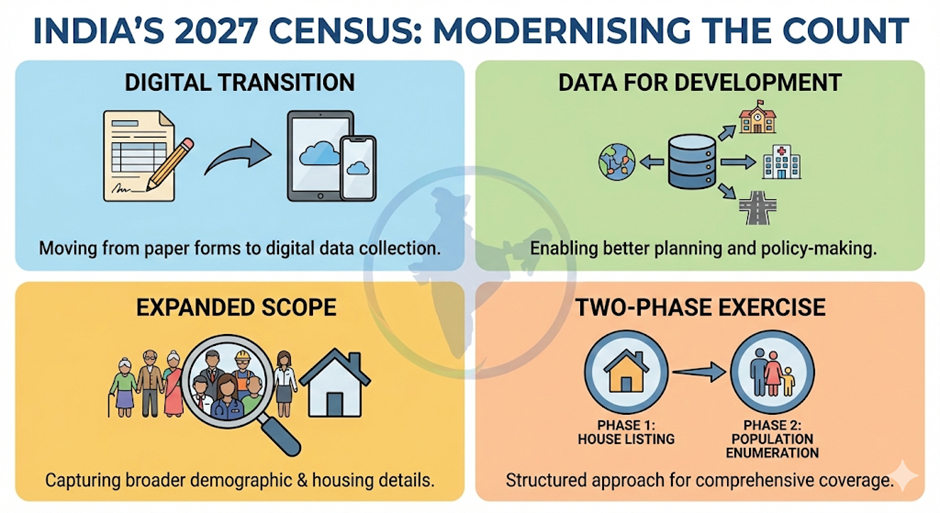
The Union Cabinet recently approved the proposal to conduct the Census of India 2027 with an allocated budget of ₹11,718.24 crore. This exercise marks a significant shift in India’s enumeration history, introducing digital methodologies and expanding the scope of data collection.
What Makes Census 2027 Unique?
- First Digital Census: The 2027 Census will transition from paper-based enumeration to a fully digital format. Data collection will be executed via mobile applications and a dedicated portal named Census Management and Monitoring System (CMMS) for real-time monitoring.
- Caste Enumeration: For the first time in independent India, the Census will enumerate caste data beyond the Scheduled Castes (SCs) and Scheduled Tribes (STs). The last comprehensive caste census was conducted in 1931.
The Operational Roadmap
The exercise will be conducted in two distinct phases:
- Phase I (House Listing): Scheduled to commence on April 1, 2026 (Duration: 5–6 months). Focuses on housing characteristics and amenities.
- Phase II (Population Enumeration): Scheduled for February 2027, culminating by March 1, 2027. Focuses on demographic and socio-economic details.
Reference Dates:
- March 1, 2027: For the majority of India.
- October 1, 2026: For snow-bound and hilly regions (e.g., J&K, Ladakh, Himachal Pradesh).
The Constitutional & Legal Backbone
- Legal Framework: Conducted under the Census Act, 1948 and the Census Rules, 1990.
- Nodal Agency: The exercise is helmed by the Office of the Registrar General and Census Commissioner, under the Ministry of Home Affairs (MHA).
- Constitutional Provision: Article 246 empowers the Parliament to legislate on the Census. It is listed as Entry 69 in the Union List (Seventh Schedule).
- Historical Timeline:
- 1872: First non-synchronous census under Lord Mayo.
- 1881: First synchronous (decennial) census under Lord Ripon.
Q. With respect to the operational timeline and legal framework of the Census, consider the following statements:
- The Census is conducted under the provisions of the Census Act, 1948.
- The reference date for population enumeration is uniformly March 1, 2027, for the entire country including hilly regions.
Which of the statements given above is/are correct?
(a) 1 only
(b) 2 only
(c) Both 1 and 2
(d) Neither 1 nor 2
Sol .A
Statement 1 is correct: The legal basis for conducting the Census of India is the Census Act, 1948, which is administered by the Ministry of Home Affairs.
Statement 2 is incorrect: The reference date is not uniform. While March 1, 2027, is the reference date for most of the country, an earlier reference date of October 1, 2026, is set for inaccessible, snow-bound, or difficult areas (like parts of Ladakh, J&K, Himachal Pradesh, and Uttarakhand).