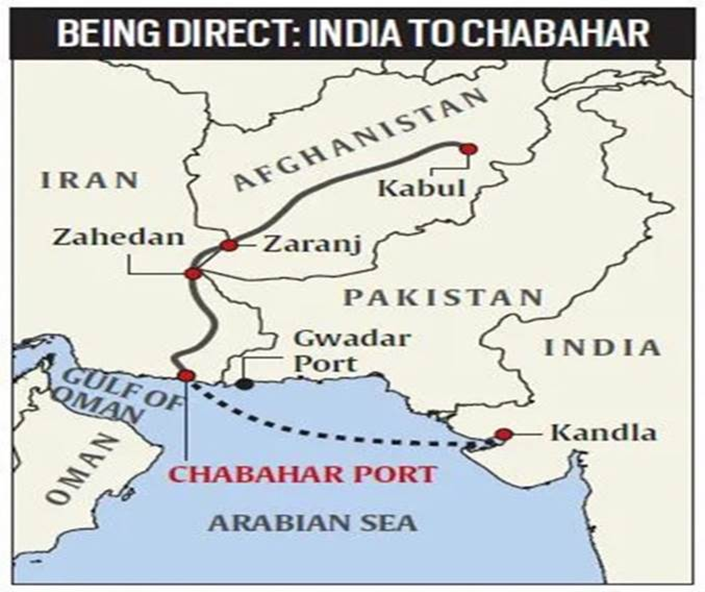
Context
The government recently told Parliament that it has completely paid up its commitment of $120 million for the Chabahar port, well before the U.S. sanctions waiver runs out in April 2026.
Further, the Ministry of External Affairs (MEA) said the U.S. has extended a conditional sanctions waiver for the Chabahar project until April 26, 2026, following India–U.S. discussions, and added that India remains engaged with all stakeholders amid uncertainty over any further extension.
About the Chabahar Port Project
- In January 2015, India Ports Global Limited (IPGL) was incorporated under the Companies Act, 2013 for the development of ports overseas.
- April 2016: India, Iran, and Afghanistan signed a trilateral agreement to develop Chabahar Port.
- December 2017: The first phase of Shahid Beheshti Port was inaugurated after rapid development by India’s Shipping Ministry.
- In December 2018, IPGL took over part of the operations at Shahid Beheshti Port.
- Two years later, Afghan exports to India passed through the port for the first time. India received four such consignments that year.
Key Geographic and Operational Features
- Location: Situated in the Gulf of Oman, it provides direct access to the Indian Ocean, bypassing the sensitive Strait of Hormuz choke point.
- Structure: The port consists of two separate complexes: Shahid Beheshti and Shahid Kalantari, each featuring five berths.
- Infrastructure: It is a deep-sea port capable of handling massive cargo ships that cannot be accommodated at other Iranian ports like Bandar Abbas.
Strategic Significance
- Alternative trade route: Provides India an alternative trade route to Afghanistan and Central Asia, bypassing Pakistan.
- Regional Connectivity: Enhances India’s connectivity to Central Asia, Russia, and Europe via the International North–South Transport Corridor (INSTC).
- INSTC is a multi-modal transportation route linking the Indian Ocean and the Persian Gulf to the Caspian Sea via Iran and onward to northern Europe via St. Petersburg in Russia.
- Counterbalance: Acts as a counterbalance to Gwadar Port (Pakistan) developed with Chinese assistance.
- Energy security: The port facilitates India’s access to regional energy reserves and secures a stable supply chain by enabling direct investment in Iran’s energy infrastructure
With reference to the Chabahar Port, consider the following statements:
I.   Chabahar Port is Iran’s only oceanic port with direct access to the Indian Ocean.
II.  India operates the Shahid Beheshti terminal at Chabahar through India Ports Global Limited (IPGL).
III. The port provides India a direct land route to Afghanistan and Central Asia bypassing Pakistan.
IV. The project is part of the International North–South Transport Corridor (INSTC).

Which of the statements given above are correct?
(a) I, II and III only
(b) I, II and IV only
(c) I, III and IV only
(d) I, II, III and IV

Correct Answer: D
Explanation:
Statement I is correct: Chabahar is Iran’s only oceanic port, located on the Gulf of Oman, giving it direct access to the Indian Ocean.
Statement II is correct: India operates the Shahid Beheshti Terminal through India Ports Global Limited (IPGL) under an agreement with Iran.
Statement III is Correct: Chabahar provides India a direct connectivity route to Afghanistan and Central Asia, bypassing Pakistan, which is strategically significant.
Statement IV is correct: The port is a key component of the International North–South Transport Corridor (INSTC), linking India with Central Asia, Russia, and Europe.