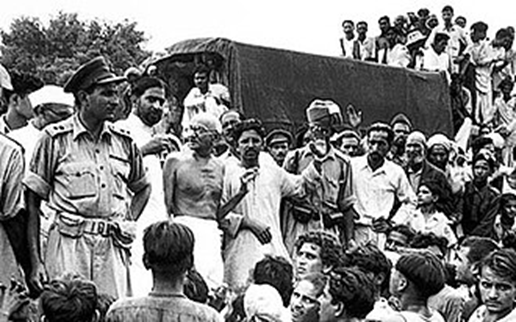
Why in the News?
- Recently, national discourse has revisited the symbolic “Blue” through an analysis of its historical and social evolution in India.
- While the Champaran Satyagraha of 1917 used the indigo-blue of exploitation as a catalyst for India’s first successful Civil Disobedience, the color was later redefined by Dr. B.R. Ambedkar.
- In the All India Scheduled Castes Federation (1942), Ambedkar adopted blue—the color of the vast, non-discriminatory sky—as a symbol of equality and universal rights.
Overview of Champaran Satyagraha (1917)
The Champaran Satyagraha of 1917 arose from the exploitation of indigo farmers in northwestern Bihar under the Tinkathia system. Mahatma Gandhi, at the request of Rajendra Prasad, intervened in response to the severe economic distress of the farmers, which was further worsened by the decline of indigo factories.
Tinkathia System – Background of Champaran Satyagraha
- The Tinkathia system was a system of forced indigo cultivation in Champaran, Bihar, where tenants (ryots) had to grow indigo on 3 Kathas per bigha of their land for European planters.
- Indigo Cultivation: Indigo had been cultivated in Champaran since the late 18th century, becoming the region’s primary cash crop by 1850, surpassing sugar in importance.
- Historical Land Allocation: In 1860, tenants were required to cultivate 5 Kathas per bigha; reduced to 3 Kathas per bigha by 1867, hence called Tinkathia.
- Exploitation by Factory Owners: Owners often took short-term leases from Bettiah Raj and deceived landlords to maximize profits. Tenants bore all losses while factory owners earned large profits.
- Indigo Agreements & Payments: Tenants had to grow indigo on factory-selected land for several years. Fixed price per bigha was paid if the crop was good; reduced payment or fines if yield was poor or cultivation failed. Heavy penalties (damages) worsened tenants’ economic distress.
- Financial Burden: Ryots unable to pay fines were issued handnotes and mortgage bonds at an annual interest rate of 12%, deepening their economic hardship.
Reasons Behind the Champaran Satyagraha
Short Code:





The Champaran Satyagraha of 1917 arose due to the widespread exploitation of indigo farmers (ryots) under the Tinkathia system, compounded by economic and social oppression. Key causes include:
- Dissatisfaction over Indigo Cultivation: Ryots were unhappy with low remuneration and harassment by factory workers.
- Earlier Protests: In 1867, tenants of the Lalsariya factory protested; in 1907-08, unrest occurred in Sathi and Bettiah due to worsening conditions.
- Pressure on Best Land: Planters forced ryots to grow indigo on the most fertile lands, reducing space for food crops.
- Fixed Prices Based on Land Area: Payment was based on land area, not crop yield, leading to unfair compensation.
- Economic and Social Exploitation: Ryots faced financial distress, debt traps, and social oppression, fueling mass dissatisfaction.
Key Role of Mahatma Gandhi in Champaran Satyagraha
Mahatma Gandhi played a pivotal role through nonviolent protest and direct engagement with the peasants.
- Initial Contact with Local Leaders (1916): Brajkishore Prasad and Rajkumar Shukla approached Gandhi at the Lucknow session regarding the peasants’ plight.
- Resolution by Congress: Brajkishore Prasad introduced a resolution on the peasants’ suffering, passed unanimously. Gandhi insisted on personal verification.
- First Visit to Muzaffarpur: Gandhi visited Muzaffarpur, informing the Tirhut Division Commissioner of his intention to investigate with government cooperation.
- Clarification of Intent: Gandhi aimed to assess indigo cultivation grievances as requested by the local populace. Officials feared unrest.
- Notice to Leave: Authorities issued a notice under Section 144, Criminal Procedure Code, demanding he leave Champaran.
- Defiance and Trial: Gandhi arrived on 15 April 1917, refusing to leave; on 18 April 1917, he appeared for trial without defense, declaring readiness to face imprisonment.
- Withdrawal of Case: The Lieutenant Governor, citing insufficient evidence, ordered withdrawal of the case and permitted Gandhi to conduct his inquiry.
Prominent Leaders and Activities in the Champaran Satyagraha
- Gandhi conducted investigations across Motihari and Bettiah, supported by: Rajendra Prasad, Brajkishore Prasad, Mazharul Haq, J.B. Kriplani and Ramnavami Prasad
- Thousands of ryots participated, expressing grievances about the Tinkathia system.
- Opposition from Planters: Bihar Planters’ Association opposed the inquiry, claiming it could incite unrest.
- Concerns of European Officials: Fear of a potential anti-European movement.
- Government Intervention: Government instructed Gandhi to submit a preliminary report.
- Submission of Report: On 13 May 1917, Gandhi submitted his preliminary findings highlighting exploitation and hardships faced by the peasants.
British Reaction and the Champaran Agrarian Act
- The British government initially ignored Gandhi’s involvement but had to act due to growing peasant discontent and Gandhi’s leadership.
- Committee of Inquiry: The Lieutenant Governor set up a Committee of Inquiry to examine agrarian conditions in Champaran, appointing Gandhi as a member.
- Findings & Recommendations (4 October 1917):
- Abolition of Tinkathia system.
- Partial refund of Tawan (one-fourth or 25%) to ryots who had paid the factories.
- Stop realization of abwab (illegal cesses).
- Indigo cultivation to be voluntary, maximum term of three years, and ryots to choose their own fields.
- Government Action: The British accepted most recommendations, resulting in the Champaran Agrarian Act of 1918 and the official abolition of Tinkathia system.
Importance of Champaran Satyagraha
- First Civil Disobedience Movement: It was the first peasant movement to attract nationwide attention, mobilizing Indian masses against British exploitation.
- Introduction of Satyagraha: Gandhi demonstrated a new method of nonviolent resistance, using moral force instead of physical confrontation.
- Gandhi’s Entry into Freedom Struggle: Champaran established Gandhi as a national leader and Satyagraha as a political tool.
- Bridging Peasants and Intelligentsia: For the first time, peasants and middle-class leaders worked together, linking agrarian issues to the national freedom struggle.
- Partial Resolution, Major Impact: While not all grievances were fully resolved, it showed that British authority could be challenged, inspiring later movements.
- Training Ground for Future Movements: The strategies tested in Champaran influenced later movements in Ahmedabad (mill workers) and Kheda (peasants), eventually shaping mass nationwide protests post-1919.
Q. With reference to the Champaran Satyagraha of 1917, consider the following statements:
1.	It was launched to protest against the exploitation of indigo farmers under the Tinkathia system.
2.	The movement was triggered by the decline of indigo profitability in the world market due to synthetic dyes.
3.	Mahatma Gandhi intervened at the request of Rajendra Prasad to investigate the peasants’ grievances.
4.	The Champaran Agrarian Act of 1918 was passed before Gandhi’s intervention.

Which of the statements given above is/are correct?
(a) 1 and 2 only
(b) 1 and 3 only
(c) 2 and 4 only
(d) 1, 2 and 3 only

Answer: (b) 1 and 3 only

Explanation:
Statement 1 is Correct: The Satyagraha began due to the forced cultivation of indigo under the Tinkathia system, which caused economic hardship to the ryots.
Statement 2 is Incorrect: While synthetic indigo affected profits, the immediate cause of the movement was peasant exploitation, not global market changes.
Statement 3 is Correct: Gandhi intervened at the request of Rajendra Prasad and Rajkumar Shukla to address the grievances of indigo farmers.
Statement 4 is Incorrect: The Champaran Agrarian Act of 1918 was passed after Gandhi’s successful intervention, abolishing the Tinkathia system.
Practice Today’s MCQs
Short Code: