Context
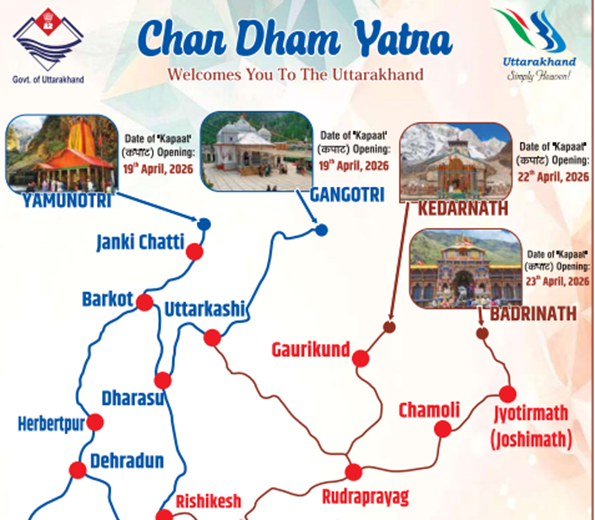
The sacred Char Dham Yatra in Uttarakhand has recently been scheduled to commence from April 19, 2026, marking the beginning of one of the most significant pilgrimages in Hinduism.
The Char Dham Yatra is one of the most sacred Hindu pilgrimages in India, located in the Garhwal region of Uttarakhand. It consists of four holy sites nestled in the Himalayas, traditionally visited in a specific clockwise direction (Parikrama).
1. About Char Dham:
The 4 Dham (Char Dham) refers to two sets of sacred Hindu pilgrimages. The primary Bada Char Dham (nationwide) includes Badrinath (North), Puri (East), Rameswaram (South), and Dwarka (West), established to promote national unity. The Chota Char Dham (Himalayas) features Yamunotri, Gangotri, Kedarnath, and Badrinath, usually visited from May to October.
2. The Four Sacred Sites
- Yamunotri: Dedicated to Goddess Yamuna. It is the first stop and the source of the Yamuna River. Pilgrims often cook rice in the Surya Kund (hot springs) as Prasad.
- Gangotri: Dedicated to Goddess Ganga. Located on the banks of the Bhagirathi River, it marks the place where the Ganges is said to have descended from heaven.
- Kedarnath: One of the 12 Jyotirlingas dedicated to Lord Shiva. Located in Rudraprayag district of Uttarakhand at an altitude of 3584 m near the Mandakini River, is a sacred abode of Lord Shiva and one of the 12 Jyotirlingas.
- Badrinath: Badrinath Temple, situated at 3415 m in the Garhwal Himalayas along the Alaknanda River, is a major Char Dham shrine dedicated to Lord Vishnu (Badri form). Linked to his penance under the Badri tree, it houses a meditative shaligram idol, was revived by Adi Shankaracharya in the 9th century.
3. Winter Char Dham Circuit
During winter (typically November to April/May), the high-altitude Char Dham deities in Uttarakhand are moved to lower altitudes to allow for continued worship.
- Kedarnath moves to Omkareshwar Temple in Ukhimath.
- Badrinath moves to Yogadhayan Badri in Pandukeshwar/Joshimath.
- Gangotri moves to Mukhba village.
- Yamunotri moves to Kharsali (Khushimath).
4. Panch Prayag
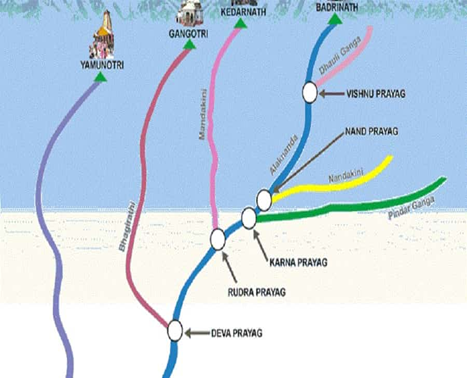
The Panch Prayag refers to five sacred river confluences in the Garhwal Himalayas of Uttarakhand, India, where tributaries meet the Alaknanda River before it becomes the Ganga at Devprayag. These sites—Vishnuprayag, Nandaprayag, Karnaprayag, Rudraprayag, and Devprayag.
- Vishnuprayag: Confluence of Dhauliganga and Alaknanda; linked to sage Narada and a Vishnu temple.
- Nandaprayag: Meeting of Alaknanda and Nandakini; associated with King Nanda’s yajna.
- Karnaprayag: Confluence of Alaknanda and Pindar; linked to Karna’s penance.
- Rudraprayag: Meeting of Alaknanda and Mandakini; associated with Lord Shiva.
- Devprayag: Confluence of Alaknanda and Bhagirathi forming the Ganga; the most sacred.
With reference to Panch Prayag, consider the following statements:
1. All five confluences involve the Alaknanda River.
2. Rudraprayag is the meeting point of Mandakini and Bhagirathi rivers.
3. Karnaprayag is associated with Karna from the Mahabharata.

Which of the statements given above is/are correct?
(a) 1 and 3 only
(b) 2 and 3 only
(c) 1 only
(d) 1, 2 and 3

Answer: A

Explanation:
Statement 1 is Correct: The Alaknanda River is the common thread in all five confluences. It originates from the Satopanth Glacier and flows through each "Prayag," meeting a different tributary at every stage until it finally meets the Bhagirathi to form the Ganga.

Statement 2 is Incorrect: Rudraprayag is the meeting point of the Alaknanda and the Mandakini (which flows from Kedarnath). The meeting point of the Bhagirathi and the Alaknanda is actually Devprayag, which is the final of the five prayags where the river officially becomes the Ganga.

Statement 3 is Correct: Karnaprayag is where the Alaknanda meets the Pindar River. Local tradition and mythology hold that this is the place where Karna of the Mahabharata meditated to please Surya (the Sun God) and received his indestructible armor (Kavacha) and earrings (Kundala).