LINK: https://www.thehindu.com/opinion/op-ed/chiles-lesson-for-indias-coal-conundrum/article70363013.ece
Why in the News
- Recently, concerns regarding India’s progress in phasing out coal were highlighted by country’s drop of 13 places to the 23rd position in the Climate Change Performance Index, which was released during COP30 in Brazil in November 2025. The urgent need for a coal exit plan is stressed, and the successful experience of Chile in tackling its coal dependence is being considered a crucial lesson for India.
Background or Context
- Coal presents a significant conundrum for India. The continued reliance on coal is resulting in the loss of lives and livelihoods due to runaway global warming and air pollution.
- Conversely, its immediate phaseout presents a trade-off, potentially causing the loss of jobs and jeopardising the supply of low-cost electricity in some States.
- This socio-ecological calculus requires a focused and systematic approach toward decarbonisation.
India’s Energy Conundrum and Comparative Status
India’s Energy Profile
India’s energy dependency remains heavily skewed towards coal, despite significant gains being made in cleaner sources:
- Dominance of Coal: Coal accounts for over half the source of total energy use.
- Renewables Share: While the share of renewables in total installed power capacity is one half (following the doubling of clean energy capacity during 2021-25), only one-fifth of electricity was actually generated using them in 2024.
- Electricity Generation: Coal continues to contribute a dominant 75% of electricity generation, and India is currently increasing domestic production of coal.
Chile’s Successful Transition
In sharp contrast, Chile successfully accelerated its energy transition through decisive policy actions, making it an apt case study:
- Coal Reduction: Coal’s share of Chile’s electricity generation was significantly reduced, falling from 43.6% to 17.5% during 2016-24.
- Renewables Dominance: Today, renewables (especially wind and solar) constitute over 60% of country’s power mix.
- Policy Drivers: The transition was driven by decisive governmental actions, including the introduction of a 2014 tax of $5 a tonne of carbon emissions, imposition of stringent emission standards on coal plants (raising compliance costs by 30%), and the use of competitive auctions to favour wind and solar power.
- Grid Stability: Energy storage systems were aggressively built out to stabilise the grid, and a commitment was made to phase out all coal by 2040.
Policy Trade-offs and Socio-Ecological Calculus
Benefits of Coal Phaseout (The ‘No Regrets’ Policy)
Coal phaseout constitutes a “no regrets” policy as it is part of averting massive damages linked to climate change and health crises:
- Economic Damage Aversion: It is estimated that by 2100, climate change would significantly sap 3%-10% of India’s GDP through heat stress and declining labour productivity.
- Health Benefits: Coal phaseout is part of stopping massive health damage; one estimate suggests a one GW increase in coal-fired capacity corresponds to a 14% increase in infant mortality rates in districts near the plant site.
India’s Complexity vs. Chile’s Facilitation
While Chile’s transition offers a model, India’s coal dependence presents a more complex challenge:
- Scale and Workforce: Coal occupies a smaller share of Chile’s energy compared to India, meaning fewer plants needed to be shut down and a smaller dependent workforce needed to be managed.
- Economic Alternatives: Chile had already begun developing alternative industries, particularly in renewables, creating pathways to absorb displaced workers and capital.
- Social Risks: India’s deeper coal dependence and limited economic alternatives in coal regions mean that many districts in Jharkhand, Chhattisgarh, Odisha, and West Bengal could face severe social risks from abrupt closures.
- Political Environment: Chile’s transition was enabled by a political environment that allowed swift, market reforms following the privatisation of key sectors.
Way Forward: A Systematic Decarbonisation Road Map
The central thrust of the transition must be on decarbonisation, requiring a systematic, multi-pronged strategy:
- Phasing out Coal and Enhancing Renewables
- Plant Removal: A systematic removal of the oldest and most polluting plants is necessary, coupled with the cancellation of new coal approvals.
- Replacement Strategy: Coal output must be replaced with firm renewable power backed by storage systems.
- Timelines: Specific timelines for plant retirements and closures must be established; TERI has suggested that India could phase out coal power entirely by 2050 to meet its net zero goals.
- Efficiency: In the transition phase, there should be an incremental scaling down of coal coupled with improved efficiency and eventual decommissioning.
- Market Reforms and Incentives
- Market Disincentives: Regulation and markets must be reformed to disincentivise coal, for example, through the implementation of carbon pricing mechanisms and the removal of coal subsidies.
- Procurement Rules: Clean dispatch rules and power procurement contracts must be established to actively favour renewables over coal.
- Just Transition and Worker Support
- Reskilling and Livelihoods: Robust support for workers must be provided through reskilling programs and the creation of alternative livelihoods, drawing directly from Chile’s successful experience.
- Dedicated Funding: A dedicated transition fund, such as the proposed “Green Energy Transition India Fund” suggested by the Inter-Ministerial Committee, is essential for social protection.
- Financing the Transition
- Blended Finance Model: Financing should utilise a blended model of public and private capital, where government support is strategically directed toward community welfare and workforce reskilling.
- Private Investment: Private investors should be encouraged to lead the expansion of clean energy infrastructure.
- Strategic Use of Corpus: The District Mineral Foundation corpus can be strategically used to foster entrepreneurship and economic diversification in coal-dependent regions.
Conclusion
- Chile’s experience was reported to demonstrate that coal-dependent economies can accelerate transition through market incentives, regulatory tightening, and investment in renewables and storage; however, India’s larger scale of coal dependence and limited economic alternatives in coal regions were reported to make transition more complex.
- Therefore, phaseout of coal was recommended to be made top political priority, supported by timelines for retirements, market reforms, financing for social protection, and learning from Chile while adapting measures to India’s socio-economic realities.
Indian Coal Sector
The coal sector remains the foundational pillar of India’s energy architecture, supplying 55% of total energy needs and generating 72-74% of electricity across the nation. As the world’s second-largest coal consumer and the fifth-largest global coal reserve holder, India stands at a critical juncture where the imperative to sustain economic growth must be balanced with environmental stewardship and climate commitments.
- The coal sector is undergoing transformational change, driven by commercial liberalisation, technological innovation, and a strategic commitment to Atmanirbhar Bharat (self-reliant India).
- With ambitious production targets of 1.5 billion tonnes by 2030 and a vision of Viksit Bharat 2047 (developed India by 2047), the coal sector is transitioning from traditional state-monopoly control to a competitive, diversified, and sustainability-conscious industry that balances energy sovereignty with environmental responsibility.
Concept, Types, Location, and Reserves
Coal is defined as a sedimentary rock of organic origin, comprising fossilised plant remains and formed over millions of years through geological processes of heat and pressure. In the Indian context, coal serves as:
- Primary Energy Source: A non-renewable fossil fuel powering base-load electricity generation and supplying thermal energy to industrial processes.
- Raw Material: Essential for steel, cement, fertiliser, and chemicals production.
- Strategic Resource: Critical to national energy security, economic development, and industrial competitiveness.
The coal sector encompasses the entire value chain: exploration, mining, beneficiation (washing), transportation, trading, and end-use applications across power (contributing to over 70% of electricity), steel, and industrial sectors.
In India, its commercial exploitation began in 1774 at the Raniganj Coalfield.
Nodal ministry: Ministry of Coal
Key Bodies: Coal Controller’s Organisation (CCO), CMPDI, DGMS, IBM
Concept, Types, Location, and Reserves
Coal is defined as a sedimentary rock of organic origin, comprising fossilised plant remains and formed over millions of years through geological processes of heat and pressure. In the Indian context, coal serves as:
- Primary Energy Source: A non-renewable fossil fuel powering base-load electricity generation and supplying thermal energy to industrial processes.
- Raw Material: Essential for steel, cement, fertiliser, and chemicals production.
- Strategic Resource: Critical to national energy security, economic development, and industrial competitiveness.
The coal sector encompasses the entire value chain: exploration, mining, beneficiation (washing), transportation, trading, and end-use applications across power (contributing to over 70% of electricity), steel, and industrial sectors.
In India, its commercial exploitation began in 1774 at the Raniganj Coalfield.
Nodal ministry: Ministry of Coal
Key Bodies: Coal Controller’s Organisation (CCO), CMPDI, DGMS, IBM
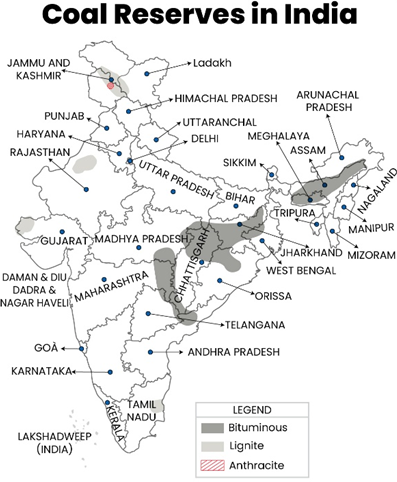
Types of Coal in India
Indian coal is predominantly of the Gondwana type (older and superior quality) and Tertiary type (younger). The classification is based on carbon content, moisture, and calorific value:
| Coal Type | Carbon Content | Calorific Value | Key Characteristics | Primary Location |
| Anthracite | 80-95% | Highest | Best quality, hard, black, lustrous. Very small quantity in India. | Jammu & Kashmir |
| Bituminous | 60-80% | High | Most widely available in India, high heating value, used for electricity and steel. | Jharkhand (Jharia), West Bengal (Raniganj), Odisha, Chhattisgarh |
| Lignite | 40-55% | Low | Brown coal, low energy, high moisture content, typically used for power generation. | Tamil Nadu (Neyveli), Rajasthan, Gujarat |
| Peat | <40% | Lowest | First stage of coal formation, high moisture content. | Confined to specific areas (e.g., Kashmir Valley) |
Major Coalfields and Reserves
India holds the fourth-largest coal reserves globally. The deposits are mainly concentrated in the eastern and south-central parts of the country.
- Gondwana Coalfields (Approx. 98% of total reserves): Found in the river valleys of Damodar, Mahanadi, Son, and Godavari.
- Jharkhand: Jharia (storehouse of best coking coal), Bokaro, Dhanbad, Ramgarh.
- Odisha: Talcher (one of Asia’s largest coalfields), Ib Valley.
- Chhattisgarh: Korba, Singrauli (extends into MP).
- Madhya Pradesh: Singrauli, Sohagpur.
- Telangana/Andhra Pradesh: Singareni Collieries.
- Tertiary Coalfields (Younger, high sulfur content): Found primarily in the North-East and South.
- Assam: Makum, Ledo.
- Meghalaya: Garo, Khasi, and Jaintia hills.
- Tamil Nadu: Neyveli (largest lignite reserves).
Evolution and Historical Development (The Flow)
The sector’s history spans from colonial exploitation to planned state monopoly, culminating in the current liberalized, auction-based regime.
| Phase | Period | Key Events & Policies | Impact on the Sector |
| Phase I: Early Commercial Mining | 1774–1853 | 1774: Commercial mining begins in Raniganj Coalfield. 1853: Introduction of steam locomotives. | Sluggish growth initially. Railway expansion was the critical catalyst for scaling up production and consumption. |
| Phase II: Rapid Expansion | 1853–1945 | Production reached approx. 18 MT by 1920. 1945: Singareni Collieries Company Limited (SCCL) established. | Expansion was driven by railways and industrialisation (steel, power). Lack of regulation led to unscientific mining and poor worker safety. |
| Phase III: Nationalisation & State Monopoly | 1945–1973 | 1956: National Coal Development Corporation (NCDC) established. 1971-72: Coking Coal Nationalisation leading to the formation of Bharat Coking Coal Limited (BCCL). 1973: Complete Nationalisation via the Coal Mines (Nationalisation) Act, 1973. | Driven by the need for scientific development, worker welfare, and securing strategic resources. Established the state monopoly under the Ministry of Coal, leading to the formation of CIL in 1975. |
| Phase IV: Captive & Competitive Reforms | 1993–2014 | 1993: Act amended to allow ‘captive mining’ for private end-use plants (power, steel). 2014: Supreme Court cancels 204 coal blocks (Coalgate verdict). | First major crack in the monopoly. The 2014 SC judgment forced the pivot to transparency and a new legal framework for resource allocation. |
| Phase V: Commercial Liberalisation Era | 2015 Onwards | 2015: Coal Mines (Special Provisions) Act enacted (transparent auction mechanism). 2020: Launch of Commercial Coal Mining with 100% private participation and zero end-use restrictions. | Phase of full liberalisation aimed at achieving self-reliance (Atmanirbhar Bharat). Focus on competition, technological efficiency, and meeting the 1.5 BT production target by 2030. |
Constitutional and Regulatory Framework
Constitutional Provisions
- Entry 53, Union List (List I): The Constitution of India vests exclusive legislative and regulatory authority over coal mining in the Central Government through Entry 53 of the Union List, empowering Parliament to regulate coal mining as an industry crucial for national defence and war purposes.
- Entry 23, Concurrent List (List II): While states have some powers to regulate mines and mineral development, these are subordinate to central authority.
- State-Level Coordination: States retain roles in environmental approval, land administration, and regulatory compliance through their pollution control boards and forest departments.
Key Legislative Acts Governing Coal
The Indian coal sector operates under a robust legal framework rooted in the Constitution.
| Act | Core Mandate | Key Provisions | Relevance |
| The Mines Act, 1952 | Ensures the health, safety, and welfare of persons employed in mines. | Governs working hours, conditions, and safety protocols in all mining operations. Enforced by the Directorate General of Mines Safety (DGMS). | Currently Active and Essential: The primary law for ensuring miner safety. |
| The Mines and Minerals (Development and Regulation) Act, 1957 (MMDR Act) | The Principal Law for the regulation of mines and mineral development across India. | Empowers the Central Government (Union List, Entry 54) to frame policy, grant mining concessions, and determine the rate of royalty. Its amendments introduced the auction mechanism for non-coal minerals. | Currently Active and Foundational: Defines the regulatory power of the Union over all minerals, including coal. |
| The Coal Bearing Areas (Acquisition and Development) Act, 1957 (CBA Act) | Empowers the Central Government to prospect for coal and acquire land containing or likely to contain coal deposits. | Provides the legal basis for the systematic and large-scale acquisition of land necessary for public sector coal mining projects (primarily CIL’s operations). | Currently Active: Used for land acquisition processes for public sector mining expansion. |
| The Coal Mines (Nationalisation) Act, 1973 (CMN Act) | Established the exclusive state monopoly over commercial coal mining in India. | Nationalised all remaining private coal mines, creating the legal structure for the formation of Coal India Limited (CIL) and its subsidiaries (like BCCL). Later amended to allow captive mining. | Historically Significant: The law that defined the sector for over four decades. Its provisions regarding monopoly have been effectively overridden by the 2015 and 2020 reforms. |
| The Coal Mines (Special Provisions) Act, 2015 (CMSP Act) | Provided the transparent mechanism for the re-allocation of coal blocks cancelled by the 2014 Supreme Court judgment. | Mandated the allocation of cancelled blocks through competitive bidding (auction). Crucial for restoring continuity of supply after the crisis. | Currently Active: Forms the legal basis for the modern transparent auction mechanism for coal block allocation. |
| The Mineral Laws (Amendment) Act, 2020 | Amended the MMDR Act and CMSP Act to facilitate commercial mining for all private entities. | Removed the restriction of mining only for “specified end-uses,” allowing any private company to mine and sell coal commercially in the open market. | Currently Active and Transformational: The key legislative driver for the full liberalisation of the coal sector. |
Present Status of the Indian Coal Sector
Production and Consumption
India is pushing for self-reliance (Aatmanirbhar Bharat) in coal to reduce imports.
- Total Coal Production (FY 2024-25 – Provisional): India surpassed 1 Billion Tonnes (BT), showing a positive growth of nearly 5% over the previous year.
- Largest Producer: Coal India Limited (CIL) accounts for approximately 80% of domestic production.
- Consumption: The Power Sector is the largest consumer (over 75%), followed by steel, cement, and other industrial consumers.
- Imports: India still imports coking coal (for the steel industry) and a significant amount of non-coking coal (to bridge the gap in domestic supply).
Key Strategic Developments
- First Mile Connectivity (FMC): Major push for setting up mechanized coal handling plants (CHPs) and silos at pitheads, and transport via conveyors/railway sidings, reducing road transport and environmental pollution.
- Coal Gasification: Government target of 100 MT of coal gasification by 2030, converting coal into cleaner fuels like Syngas, Methanol, and Ammonia.
Significance of Indian Coal Sector
Energy Security Pillar Coal serves as the bedrock of India’s energy security matrix, ensuring reliable and affordable power to all economic sectors. Supplies 55% of total primary energy in India, making it the largest energy source.
Generates 72-74% of total electricity, underpinning the nation’s power security. Provides consistent base-load power generation, offering stability against variable renewable energy supply.
Industrial and Manufacturing Backbone
The coal sector is indispensable for key industrial sectors:
- Steel Production:
- Over 90% of steel plants depend on coking coal as a critical raw material for iron ore reduction in blast furnaces.
- India’s steel capacity of over 100 MT annually relies heavily on coal-based processes.
- Much of this coking coal demand is met through imports due to limited domestic high-grade coking coal availability.
- Power Generation:
- Coal-fired power plants contribute 205 GW of India’s 428 GW installed capacity, providing the most substantial portion of reliable electricity.
- These plants operate at high capacity factors, ensuring predictable and affordable power supply.
- Cement, Chemicals, and Other Industries:
- Coal serves as fuel for cement kiln operations, fertiliser production, and numerous chemical industries.
Economic Development Driver
The coal sector catalyses broader economic growth through:
- Infrastructure Investment: Over 60 coal-linked infrastructure projects under PM-Gati Shakti enhance transportation networks and reduce logistics costs.
- Technology Transfer: Commercial mining has attracted private sector expertise in mining technology and operational efficiency.
- Regional Development: Coal mining supports economic development in resource-rich regions, particularly in eastern and central India.
Pathway to Self-Reliance (Atmanirbhar Bharat)
Coal sector reforms are central to India’s self-reliance agenda:
- Reducing import bills (approximately ₹176,000 crore in 2023 for coal imports).
- Boosting domestic production to substitute imports and retain economic value within India.
- Creating technological and operational independence in coal resource management.
Challenges of the Indian Coal Sector
The Indian coal sector faces a complex intersection of operational, environmental, and socio-economic challenges that require strategic intervention to ensure sustainable energy security and industrial growth.
- Air Pollution & Climate Change: Coal combustion is responsible for over 60% of India’s industrial CO₂ emissions and is a major contributor to local air pollution, posing a severe health hazard.
- Just Transition: A major dilemma is ensuring a “Just Transition” for the millions of people in coal mining districts whose livelihoods are tied to the sector, as India phases down coal in line with its Net-Zero by 2070 commitment.
- Social Displacement: Mining-induced displacement and land acquisition often affect vulnerable communities, particularly tribal populations in the central and eastern regions, (eg. states like Jharkhand and Chhattisgarh) leading to social conflict and delays.
- Logistics Bottlenecks: Around 65% of coal is transported via railways. Limited wagon availability and last-mile connectivity gaps often lead to delays and increased transportation costs. The First Mile Connectivity (FMC) initiative is a key government focus to address this.
- Low Productivity: Productivity in CIL mines is often low compared to global benchmarks, indicating the need for greater mechanization and efficiency.
- Coal Quality: The high ash content of domestic coal reduces efficiency in power plants and increases the burden of Ash Disposal.
- Import Dependency: In 2023, India imported a substantial volume of coal, totaling 176 million tonnes (MT). This high dependency is primarily driven by the insufficient domestic supply of high-quality coking coal, which is crucial for the steel industry. A significant portion of these imports, specifically 26.2 MT, was sourced from Russia.
Government Policies and Initiatives in the Indian Coal Sector
Key policies aimed at liberalizing the coal sector, boosting production, ensuring environmental sustainability, and optimizing coal usage in the power sector as follows:
| Policy/Initiative | Impact |
| Commercial Mining Policy | Enabled 100% private participation (FDI automatic route) with zero end-use restrictions. Allocation is done through a transparent auction system (CMSP Act, 2015), maximizing revenue and competition. |
| SHAKTI Policy (2017) (Scheme for Harnessing and Allocating Koala (Coal) Transparently in India) | Allocates coal linkages to new/expanded private power plants based on competitive bidding (e-auction for discount on power tariff). Crucial for resolving fuel supply uncertainty and ensuring affordable electricity for consumers. |
| First Mile Connectivity (FMC) Projects | Aims to replace road transport from mine pitheads with conveyor belts and mechanized loading systems (silos). Targets a reduction in (Particulate Matter) emissions and logistics costs (by up to 30%). |
| Coal Gasification | Government target of 100 MT of coal gasification by 2030. Converts coal into cleaner products like Syngas, Methanol, and Ammonia, reducing reliance on direct combustion. |
| Mission Coking Coal | Focuses on exploration and enhanced production from CIL and private players. Aims to increase domestic coking coal production to 140 MT by 2030. |
| District Mineral Foundation (DMF) | Statutory body funded by mandatory contributions (levies) from all miners. Funds are used for the welfare and socio-economic development of mining-affected areas. |
| Single-Window Clearance Portal | Provides a unified platform for securing all statutory clearances, including environmental and forest approvals, reducing bureaucratic delays and accelerating project execution. |
Way Forward
The Indian coal sector is at a complex intersection of energy demand and climate action. The path forward must be one of Responsible Transition, balancing economic necessity with environmental sustainability.
- Clean Coal Technologies: Aggressively deploying technologies like Coal Gasification and Carbon Capture, Utilization, and Storage (CCUS) to mitigate emissions from existing thermal power plants.
- Enhancing Domestic Production: Continued focus on commercial mining to reduce costly non-coking coal imports, thus boosting the ‘Atmanirbhar Bharat’ (Self-Reliant India) initiative.
- Accelerated Logistics: Expediting the PM-Gati Shakti rail and multimodal infrastructure projects to eliminate evacuation bottlenecks and reduce the cost of coal delivery.
- Dedicated Just Transition Fund: Creating a substantial, dedicated fund to finance the reskilling of coal workers, regional economic diversification, and the environmental remediation of abandoned mine sites.
- Renewables Integration: Utilizing coal-based power plants not just for base load, but also for flexible generation to balance the intermittency of solar and wind energy.
- Industry 4.0 technologies : Implement Industry 4.0 technologies such as the Internet of Things (IoT), AI-based data analytics, and drone surveillance in mining operations to enhance safety, improve resource utilization, and boost overall productivity.
- Policy Clarity Provide long-term policy clarity on the future role and retirement schedule of coal-based power plants to guide investment decisions for both coal mining and renewable energy sectors.
- Compensation Mechanisms Ensure compensation mechanisms are in place for power plants that undertake the costly retrofits for flexible operation and suffer efficiency losses during part-load running.
Conclusion
- Coal is the ‘fuel of transition’ for India. The transformation involves leveraging enhanced domestic production and modern, clean-up technologies (Gasification, CCUS) in the short term, while simultaneously building robust, flexible infrastructure and a human-centric Just Transition plan to prepare for a decarbonized future.
- The success of India’s Net-Zero by 2070 target hinges on this controlled, strategic, and socially responsible shift.
UPSC MAINS PYQs
- Despite India being one of the countries of Gondwanaland, its mining industry contributes much less to its Gross Domestic Product (GDP) in percentage. Discuss. (2021)
- “In Spite of adverse environmental impact, coal mining is still inevitable for development”. Discuss. (2017)