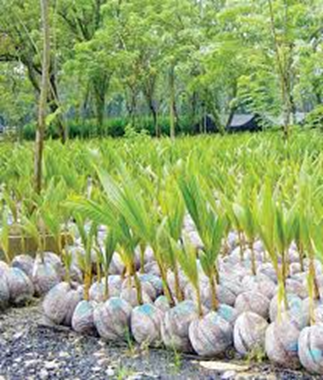
Context
- Recently, a scientific study highlights that the future of coconut cultivation depends more on sustainability practices than simply increasing productivity, due to climate change, soil degradation, water stress, and market risks.
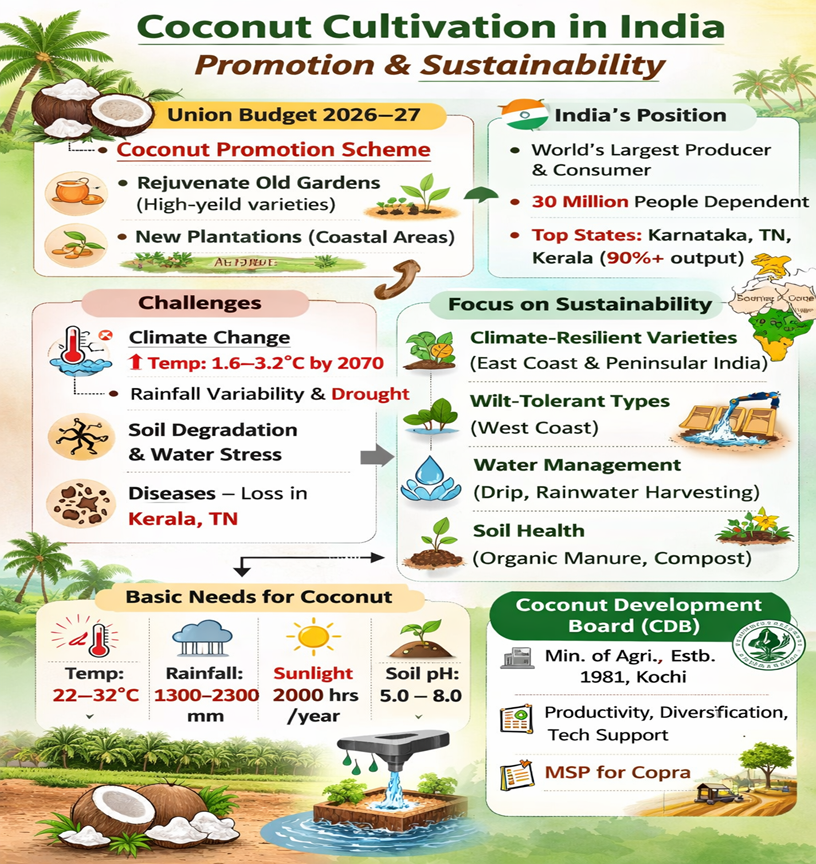
- The Union Budget 2026–27 announced a Coconut Promotion Scheme to boost productivity by rejuvenating old, unproductive gardens with high-yield varieties and promoting new coastal plantations.
- The Coconut Development Board is already running a similar scheme that has rejuvenated old gardens and expanded coconut cultivation into non-traditional regions like Gujarat and Assam, helping partly offset disease-related losses in Kerala and Tamil Nadu.
1. Key Aspects of Coconut Promotion Scheme
- Primary Objective: To improve productivity by rejuvenating old, low-yielding gardens and establishing new plantations..
- Shift in Focus: The scheme must move beyond just distributing high-yield seedlings.
- Priority Areas:
- Development and mass multiplication of climate-resilient varieties for farms along the east coast and in peninsular regions.
- Development of wilt-tolerant varieties for coconut-growing regions along the west coast.
2. Challenges to Productivity and Sustainability
- Climate Change:
- Research projects that temperatures in regions with plantations may rise by 1.6-2.1°C by 2050 and up to 3.2°C by 2070.
- Increased temperatures and significant changes in rainfall patterns will increase moisture deficit and intensify drought stress.
- Geographical Vulnerability:
- Parts of interior peninsular India, including Karnataka and Andhra Pradesh, along with southern Tamil Nadu and the east coast, could be less suitable for coconut cultivation due to climate change and diseases.
- Disease Impact:
- Widespread destruction of coconut palms in Kerala and Tamil Nadu has been caused by diseases.
3. Basic of Coconut
I. Production Status and Ranking
- Global Position: India is the largest producer and consumer of coconuts in the world.
- Livelihood: Approximately 30 million people and nearly 10 million farmers in India depend on coconut cultivation for their livelihoods.
- Major Producing States: As of 2023-2024Karnataka is the top coconut-producing state in India, accounting for over 28% of the total, followed closely by Tamil Nadu and Kerala, with these three southern states contributing over 90% of the national output.
- Expansion: Cultivation is expanding to non-traditional areas, including the North-Eastern states (Assam and Tripura) and coastal regions of Odisha and West Bengal.
II. Climatic and Geographical Requirements
- Nature of Crop: It is essentially a tropical plant, typically grown between 20°N and 20°S latitudes.
- Temperature: It requires an ideal mean annual temperature of 22°C-32°C Reproductive growth is hindered if temperatures fall below 10°C.
- Rainfall: A well-distributed annual rainfall of 1300 mm to 2300 mm is preferred. In areas with uneven rainfall, irrigation is essential.
- Sunlight: The palm requires plenty of sunlight (roughly 2000 hours of sunshine annually) and does not thrive in heavily shaded or cloudy regions.
- Soil: It can grow in diverse soil types including laterite, coastal sandy, alluvial, and saline soils. A pH range of 5.0 to 8.0 is tolerable, provided there is proper drainage.
III. Institutional and Regulatory Framework
- Coconut Development Board (CDB): It is a statutory body established in 1981 under the Ministry of Agriculture and Farmers Welfare. Its headquarters is located in Kochi, Kerala.
- Mandate: The CDB focuses on integrated development, productivity increase, product diversification, and providing technical advice to the coconut industry.
- Minimum Support Price (MSP): The government fixes the MSP for Milling Copra and Ball Copra.
With reference to coconut cultivation and its status in India, consider the following statements:

I. India is currently the largest producer and consumers of coconuts globally.

II. The Coconut Development Board is a statutory body headquartered in Chennai, Tamil Nadu.

III. The Union Budget 2026-27 has proposed a scheme to replace senile and unproductive trees with high-yielding varieties.

How many of the statements given above is/are correct?
(a) Only one
(b) Only two
(c) All three
(d) None

Answer: B

Explanation:
•  Statement I is correct. India is currently the world's largest producer and consumer of coconuts. While other countries like Indonesia and the Philippines are major players, India's domestic prices for tender coconut and copra remain higher than prevailing international prices.
•  Statement II is incorrect. While the article mentions that the Coconut Development Board (CDB) is already implementing schemes to rejuvenate old gardens, it does not state that it is headquartered in Chennai. (Note: The CDB is a statutory body, but its headquarters is actually located in Kochi, Kerala, not Chennai).
•  Statement III is correct. The Union Budget 2026–27 explicitly introduced the Coconut Promotion Scheme to rejuvenate old plantations with high-yielding saplings.