Why in the News?
- On December 23, 2025, Air Marshal Ashutosh Dixit, Chief of Integrated Defence Staff, highlighted that critical minerals are vital for national security, defence capabilities, and technological sovereignty.
- He stressed that global supply chains of critical minerals are highly concentrated and increasingly subject to export controls and geopolitical pressures, making excessive import dependence a strategic vulnerability.
- Recent initiatives include the identification of critical minerals, the National Critical Mineral Mission, and government efforts to strengthen the value chain from extraction to recycling.
- These remarks were made at the discussion ‘Minerals that Matter: Geopolitics, Sovereignty and Value Chains’, emphasising India’s need for self-reliant defence manufacturing and resilient mineral supply chains.
What Are Critical Minerals?
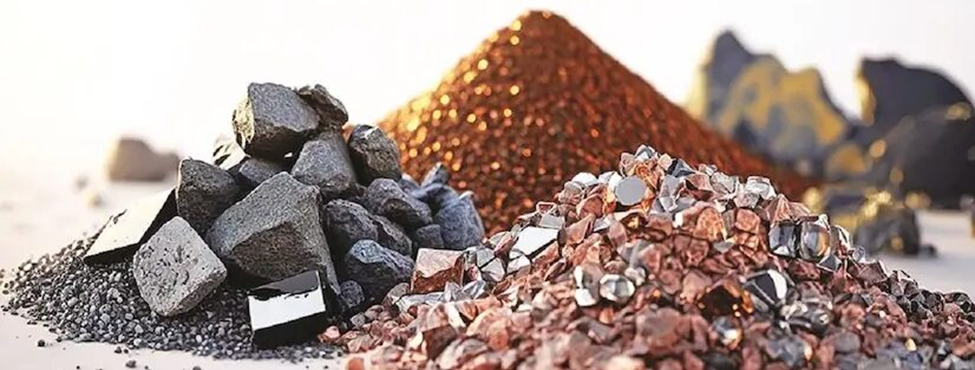
Critical minerals are minerals that are strategically and economically essential for a country, and whose scarcity, limited geographic distribution, or dependence on imports can create supply chain vulnerabilities.
Applications and Availability of Key Critical Minerals in India
| Mineral | Major Applications | Availability in India |
| Lithium | EV batteries, rechargeable batteries, lubricants, glass, ceramics | Salal-Haimana, J&K |
| Cobalt | EV batteries, aerospace, corrosion-resistant alloys | Not available; fully imported |
| Graphite | Batteries, fuel cells, EVs | 9 million tonnes reserves |
| Rare Earth Elements | Permanent magnets, electronics, defence, renewable energy | Monazite in beach sands (55–65% REO) |
| Titanium | Aircraft, spacecraft, missiles, metal alloys | Coastal districts: Tamil Nadu, Andhra Pradesh, Odisha, Kerala, Gujarat, Maharashtra |
| Vanadium | Steel alloys, military armor, nuclear components | 24.63 million tonnes ore reserves (2015) |
| Tungsten | Cutting tools, rockets, missiles, superalloys | Not available; imported |
| Gallium | Semiconductors, LEDs, specialized thermometers | By-product of alumina refining |
| Copper | Electrical wiring, solar panels, automotive | Domestic production meets 4% of demand; imports required |
| Phosphorus | Fertilizers, detergents, food additives | Rajasthan, Jharkhand, MP |
Note: Most critical minerals like Beryllium, Germanium, Indium, Rhenium, Selenium, Tantalum, Tellurium are not available domestically and fully imported.
Importance for India
- Reduces Import Dependence:
- India is fully dependent on imports for minerals such as Beryllium, Germanium, Indium, and Cobalt, making domestic production and exploration crucial.
- Supports Strategic Autonomy and Resource Planning:
- Ensures self-reliance in defense, high-tech industries, and green energy sectors.
- Example: Identification of Lithium reserves in Salal-Haimana, Jammu & Kashmir, and REEs from Indian beach sands, to reduce reliance on global suppliers like China.
- Economic and Technological Security: Secure access to critical minerals enables India to manufacture EVs, solar panels, and defense equipment without external disruptions.
Five Pillars of the Critical Minerals Value Chain
- Geoscience and Exploration
- Geological mapping by the Geological Survey of India (GSI) identifies regions with Obvious Geological Potential (OGP) for minerals like Gold, Tin, Rare Earth Elements (REEs), Cobalt, Nickel, and Tungsten.
- Mines and Minerals (Development and Regulation) Amendment Act, 2021 allows private participation in exploration, supported by the National Mineral Exploration Trust (NMET).
- Mineral Extraction
- Extraction is done via surface and underground mining, involving drilling, blasting, excavation, and transport for processing.
- Intermediate Processing
- Focuses on environmentally sustainable refining technologies.
- Advanced methods like vapor metallurgy are promoted to process critical minerals with minimal ecological impact.
- Advanced Manufacturing
- Processed metals are used to manufacture high-tech products:
- Permanent magnets for EV motors and wind turbines
- Electronics, telecom, solar PV modules, batteries
- White goods like ACs and LEDs
- Processed metals are used to manufacture high-tech products:
- Recycling
- End-of-life recycling of electronics, batteries, and solar panels can recover significant mineral content.
- Recycling is expected to become a major source of minerals by 2040, reducing reliance on primary extraction.
Key Initiatives for Critical Minerals in India
1. Planning and Assessment
- NITI Aayog (2011): Identified 12 strategic minerals including Tin, Cobalt, Lithium, Gallium, and Tungsten.
- Ministry of Mines (2011): Set up a steering committee to evaluate rare earths and energy-critical minerals, covering production, consumption, and reserves.
- CEEW Study: Identified 13 critical minerals by 2030, including Rhenium, Beryllium, Heavy REEs, Germanium, Graphite, Tantalum, Zirconium, and Silicon.
- Geological Survey of India & Atomic Mineral Division: Developed a strategic plan for Rare Earth Element (REE) exploration.
- Centre for Socio-Economic Progress (CSEP, 2023): Assessed 43 non-fuel minerals for criticality based on economic importance and supply risk.
2. Policy and Regulatory Measures
- Mines and Minerals (Development and Regulation) Amendment Act, 2021: Enables private and public sector participation in exploration and mining of critical minerals.
- National Mineral Policy, 2019: Promotes sustainable mining, domestic exploration, and beneficiation of critical minerals.
- Union Budget 2024-25: Eliminated customs duties on most critical minerals to boost domestic availability.
3. Exploration and Domestic Production
- Geological Survey of India (GSI): Conducting extensive exploration for lithium, rare earths, and other critical minerals.
- Lithium Discovery (2023): Significant deposits identified in Reasi, Jammu & Kashmir.
- Strategic Mineral Reserves: Plans underway to establish reserves for critical minerals like Lithium and Cobalt.
4. International Collaborations and Trade
- Khanij Bidesh India Limited (KABIL, 2019): A joint venture under Ministry of Mines to acquire critical mineral assets globally.
- KABIL has partnerships with countries like Argentina, Australia, and others.
- Minerals Security Partnership (MSP, 2023): India joined this US-led initiative to ensure a stable and secure global critical minerals supply chain.
National Critical Mineral Mission (NCMM)
- Genesis: Announced in the Union Budget 2024-25 to strengthen India’s critical mineral ecosystem.
- Key Objective: To secure India’s critical mineral supply chain by ensuring availability from both domestic and international sources.
- Scope and Coverage: Encompasses the entire critical mineral value chain, including:
- Exploration and mining
- Beneficiation and processing
- Recovery from end-of-life products
Key Features of National Critical Mineral Mission (NCMM)
- Provides financial incentives for exploration and recovery of minerals from overburden and tailings.
- Introduces a fast-track regulatory approval process for critical mineral mining projects.
- Promotes acquisition of critical mineral assets abroad by Indian PSUs and private companies.
- Facilitates enhanced trade with resource-rich countries.
- Plans for stockpiling of critical minerals within India.
- Supports the creation of mineral processing parks.
- Includes offshore mining, targeting polymetallic nodules containing Cobalt, REEs, and other minerals.
Governance of National Critical Mineral Mission (NCMM)
- Activities will be coordinated by the Empowered Committee on Critical Minerals, with the Ministry of Mines as the administrative authority.
Committee on Critical Minerals
- Chaired by Dr. Veena Kumari Dermal, Ministry of Mines.
- Objective: Identify minerals critical for India, considering availability, monopoly, frontier technology applications, substitutability, supply risk, and recycling.
- Methodology:
- Studied critical mineral strategies of other nations (USA, Australia, Canada, Japan, South Korea, UK).
- Conducted inter-ministerial consultations with ministries like Power, New & Renewable Energy, and Atomic Energy.
- Performed statistical assessment of substitutability, cross-cutting indices, and import reliance.
- Outcome: 30 minerals identified as most critical, including 2 fertilizer minerals.
Recommendations
- Establish a National Institute for Critical Minerals similar to Australia’s CSIRO.
- Set up a Centre of Excellence for Critical Minerals (CECM) under the Ministry of Mines.
- Focus on discovering next-generation mineral deposits, periodic updating of the critical minerals list, and formulating a national critical mineral strategy.
Q. With reference to Critical Minerals in India, consider the following statements:
1. Critical minerals are essential for strategic sectors such as defense, renewable energy, and high-tech industries.
2. India is completely self-sufficient in all critical minerals and does not depend on imports.
3. The National Critical Mineral Mission (NCMM) aims to secure critical minerals across the entire value chain, including exploration, processing, and recycling.

Which of the statements given above is/are correct?
(a) 1 and 2 only
(b) 1 and 3 only
(c) 2 and 3 only
(d) 1, 2 and 3

Answer: (b) 1 and 3 only

Explanation:
Statement 1 is correct: Critical minerals are vital for sectors like defense, EVs, renewable energy, aerospace, and high-tech manufacturing, making them strategically important.
Statement 2 is incorrect: India is not fully self-sufficient and imports minerals like Beryllium, Cobalt, Indium, and Germanium.
Statement 3 is correct: The NCMM covers the full value chain of critical minerals, including exploration, mining, beneficiation, processing, manufacturing, and recycling to strengthen supply security.