Why in the News
Recently, the Government of India launched the Model Youth Gram Sabha (MYGS) initiative to strengthen civic education and participatory democracy among students. The programme, launched in collaboration with the Ministry of Panchayati Raj, Ministry of Education, Ministry of Tribal Affairs, and the Aspirational Bharat Collaborative, seeks to transform schools and colleges into spaces where students can experience grassroots governance through simulated Gram Sabha sessions.
Gram Sabha – Overview
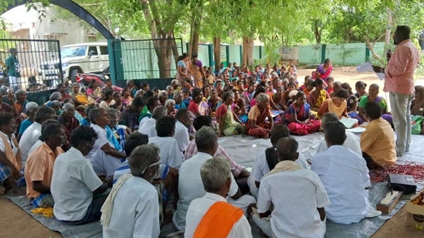
- Article 243(b) defines the Gram Sabha as a body comprising persons registered in the electoral rolls of a village under a Panchayat’s jurisdiction.Introduced through the 73rd Constitutional Amendment Act, 1992, it institutionalised participatory democracy.
- It marks a shift from representative democracy to direct democracy, empowering citizens to shape local governance.
- The Gram Sabha is a permanent body, while the Gram Panchayat is an elected executive institution with a five-year term.
- However, despite its constitutional status, the Gram Sabha often remains underutilised and overlooked in civic discussions and education.
- To achieve the vision of a people-led Viksit Bharat, grassroots democracy must be made aspirational and accessible to the youth, positioning local leadership as a meaningful and respected pursuit.
Composition and Meetings
- Comprises all registered voters within a village.
- Meetings are generally convened 2 to 4 times a year, commonly on Republic Day (26 January), Labour Day (1 May), Independence Day (15 August), and Gandhi Jayanti (2 October).
- The Sarpanch (Pradhan) chairs the meetings; in his or her absence, the Up-Sarpanch or an elected member presides.
- If 10% of members or at least 50 persons demand a meeting, the Sarpanch must convene it. If not, members may hold it independently.
Functions of the Gram Sabha
Defined under Article 243A, the Gram Sabha performs various socio-economic and governance functions, including:
- Planning and Development: Approves village plans and monitors resource utilisation.
- Budget Oversight: Reviews and sanctions the Gram Panchayat’s budget, audit, and welfare schemes.
- Social Welfare: Promotes health, education, and social awareness initiatives.
- Resource Management: Manages natural resources and infrastructure like wells, sanitation, and roads.
- Accountability: Monitors the Gram Panchayat’s functioning, ensuring transparency and ethical governance.
- Forest Rights: Recognises individual and community forest rights under relevant laws.
- Dispute Resolution: Addresses local conflicts and grievances.
Challenges
Despite its central role in grassroots democracy, the Gram Sabha faces several implementation challenges:
- Irregular Meetings: Often held only to meet formal requirements.
- Low Participation of Women and Marginalised Groups: Restricts inclusive decision-making.
- Weak Implementation: Decisions made in meetings are frequently ignored by local authorities.
- Limited Awareness: Many villagers and Panchayat members lack knowledge about Gram Sabha powers.
- Lack of Legal Clarity: State Panchayat Acts in many regions do not clearly define its powers or enforcement mechanisms.
Significance
The Gram Sabha embodies the essence of participatory democracy by ensuring that governance begins with the people.
- Promotes Transparency and Accountability: Scrutinises the work and budget of the Gram Panchayat.
- Empowers Villagers: Gives every voter a voice in local decision-making.
- Encourages Decentralised Governance: Strengthens self-reliance and community development.
- Promotes Social Inclusion: Ensures equal representation across all sections of society.
- Facilitates Conflict Resolution: Provides a platform for resolving minor local disputes peacefully.
The Model Youth Gram Sabha – A Pathbreaking Initiative (2025)
- Objective: To bridge the civic awareness gap by simulating real Gram Sabha processes within schools.
- Collaborating Ministries: Ministry of Panchayati Raj, Ministry of Education, Ministry of Tribal Affairs, and the Aspirational Bharat Collaborative.
- Approach: Students enact roles such as Sarpanch, ward members, engineers, and health workers to debate budgets, development priorities, and village welfare plans.
- Outcome: Encourages hands-on learning about governance, accountability, and participatory decision-making.
- Phase 1 Implementation:
- Conducted across 1,000+ schools in 28 States and 8 Union Territories.
- Includes 600+ Jawahar Navodaya Vidyalayas, 200 Eklavya Model Residential Schools, and select Zilla Parishad schools.
- Training: 126 master trainers and 1,238 teachers trained across 24 States and UTs.
- Pilot Successes: Simulations held in JNV Baghpat (Uttar Pradesh) and EMRS Alwar (Rajasthan); a major event in Bundi district saw participation from 300 students.
- Phase 2 Goal: To expand the programme to all State-run schools, embedding democratic practice in education nationwide.
Impact on Youth and Governance – MYGS
- Civic Empowerment: Transforms theoretical civics into experiential learning.
- Leadership Development: Encourages early leadership skills such as debate, consensus-building, and public administration.
- Behavioural Change: Promotes civic engagement as a habit rather than an obligation.
- Democratic Deepening: Future policymakers and citizens gain practical understanding of local governance, ensuring stronger decentralisation.
When students begin to view the village assembly as equally significant as Parliament, democracy evolves from symbolism to lived practice.
Ensuring Sustainability and Inclusion – MYGS
For MYGS to yield long-term results, the following measures are essential:
- Strengthening teacher training for effective facilitation.
- Using local languages and village-based data for contextual learning.
- Ensuring inclusive participation of girls and marginalised communities.
- Monitoring outcomes such as increased real-life participation in Gram Sabha meetings.
Difference Between Gram Sabha and Gram Panchayat
| Parameter | Gram Sabha | Gram Panchayat |
| Nature | Permanent body comprising all registered voters of a village | Elected executive body with a five-year term |
| Membership | All adult voters | Elected representatives (Sarpanch and ward members) |
| Function | Approves and monitors Panchayat’s decisions and plans | Implements approved plans and schemes |
| Decision Authority | Final authority on village decisions | Acts under guidance of Gram Sabha |
| Meetings | Held 2–4 times annually | Conducted regularly for execution purposes |
73rd Constitutional Amendment Act, 1992 – Overview
- Enacted in 1992 and came into effect on 24 April 1993.
- Granted constitutional status to Panchayati Raj Institutions (PRIs), ensuring democratic decentralization at the village level.
- Added Part IX to the Constitution, titled ‘The Panchayats’, covering Articles 243 to 243O.
- Introduced the Eleventh Schedule, listing 29 subjects under the jurisdiction of Panchayats.
- Mandated a three-tier system – Gram Panchayat (village), Panchayat Samiti (block), and Zilla Parishad (district).
- Provided for direct elections to all seats in every Panchayat.
- Ensured reservation of seats for Scheduled Castes, Scheduled Tribes, and women (not less than one-third).
- Stipulated a five-year tenure for Panchayats.
- Established the State Election Commission and State Finance Commission for supervision and financial review of PRIs.