Why in the News?
- Recently, the Defence Acquisition Council (DAC), chaired by Defence Minister Rajnath Singh, accorded Acceptance of Necessity (AoN) for capital acquisition proposals amounting to approximately ₹79,000 crore.
- This major clearance aims to modernize the Indian Army, Navy, and Air Force through the procurement of advanced technologies, including Loiter Munition Systems, Astra Mk-II missiles, and High Altitude Long Endurance (HALE) drones.
- Significantly, these approvals prioritize indigenous design and manufacturing, aligning with the broader “Atmanirbhar Bharat” initiative to reduce dependency on foreign imports.
Overview of Defence Acquisition Council
The Defence Acquisition Council (DAC) is the highest decision-making body within the Ministry of Defence (MoD) tasked with deciding on new policies and capital acquisitions for the three services—Army, Navy, and Air Force—and the Indian Coast Guard.
- Establishment: The DAC was formed in 2001 based on the recommendations of the Group of Ministers (GoM) on “Reforming the National Security System” following the Kargil War (1999).
- Primary Objective: To ensure the expeditious procurement of approved military requirements by optimizing the use of allocated budgetary resources within prescribed timeframes.
- Significance: It serves as a single-window clearance system to eliminate bureaucratic delays and ensure transparency in high-value defence deals.
Composition of the DAC
The council is a multi-disciplinary body representing the civilian leadership, military command, and administrative wings of the government.
- Chairman: The Union Minister of Defence.
- Key Members:
- Minister of State for Defence.
- Chief of Defence Staff (CDS): Acting as the principal military advisor.
- Service Chiefs: Chiefs of the Army (COAS), Navy (CNS), and Air Force (CAS).
- Administrative Secretaries: Defence Secretary, Secretary (Defence Production), Secretary (DRDO), and Secretary (Defence Finance).
- Member Secretary: Deputy Chief of Integrated Defence Staff (PP&FD).
Major Functions and Responsibilities of DAC
The DAC oversees the entire lifecycle of a procurement proposal before it reaches the final contract stage.
- Acceptance of Necessity (AoN): This is the first formal step in the procurement process. Granting an AoN signifies that the government has officially accepted the requirement for specific equipment.
- Categorization: The DAC decides the procurement route for proposals:
- ‘Buy’: Direct purchase from Indian or global vendors.
- ‘Buy & Make’: Initial purchase followed by indigenous production or technology transfer.
- ‘Make’: Fully indigenous research, development, and production.
- Long-Term Planning: It provides in-principle approval for the 15-year Long Term Integrated Perspective Plan (LTIPP), ensuring a roadmap for future military capabilities.
- Offset Provisions: For acquisition proposals exceeding ₹300 crore, the DAC takes decisions regarding “offsets” (requiring foreign suppliers to invest a portion of the contract value back into the Indian defence industry).
- Policy & Trials: It looks into single-vendor clearance issues and oversees the evaluation of field trials for new equipment.
Recent DAC Approvals
- Indian Army:
- Loiter Munition Systems: Enable precision strikes against tactical targets.
- Low Level Light Weight Radars: Enhance detection of small, low-flying UAVs.
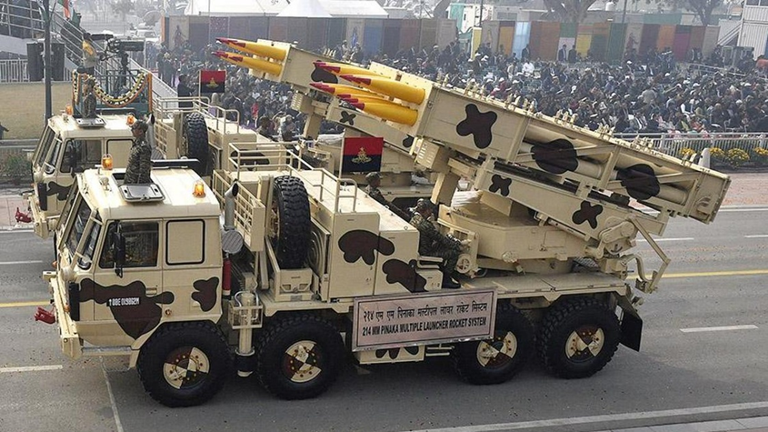
- Long Range Guided Rocket Ammunition (Pinaka MRLS): Improve range and accuracy for high-value targets.
- Integrated Drone Detection and Interdiction System (IDD&IS Mk-II): Strengthen protection of critical assets.
- Indian Navy:
- Bollard Pull (BP) Tugs: Assist ships and submarines in berthing and maneuvering.
- High Frequency Software Defined Radio (HF SDR) Manpack: Secure long-range communication for operations.
- High Altitude Long Endurance (HALE) RPAS (leased): Provide persistent ISR for maritime domain awareness.
- Indian Air Force:
- Automatic Take-off and Landing Recording System: Enhances aerospace safety.
- Astra Mk-II BVR Missiles: Extend aerial strike capability.
- Full Mission Simulators (LCA Tejas): Improve cost-effective and safe pilot training.
- SPICE-1000 Long-Range Guidance Kits: Boost precision strike capability.
With reference to the Defence Acquisition Council (DAC), consider the following statements:
1. The DAC is chaired by the Defence Minister and is the highest decision-making body for defence procurement in India.
2. It provides in-principle approval for the 15-year Long Term Integrated Perspective Plan (LTIPP) for the three services.
3. DAC categorizes procurement into ‘Buy’, ‘Buy & Make’, and ‘Make’ and decides on offset provisions for contracts exceeding ₹300 crore.
4. The DAC directly oversees the operational deployment of weapons and equipment after procurement.

Which of the statements given above is/are NOT correct?
(a) 1 and 2 only
(b) 3 and 4 only
(c) 4 only
(d) 2 and 4 only

Answer: (c) 4 only

Explanation:
Statement 1 is correct: The DAC is chaired by the Defence Minister and is the apex decision-making body for capital acquisitions for the Army, Navy, Air Force, and Coast Guard.
Statement 2 is correct: DAC gives in-principle approval to the 15-year Long Term Integrated Perspective Plan (LTIPP) to ensure long-term capability planning.
Statement 3 is correct: DAC categorizes procurement proposals into ‘Buy’, ‘Buy & Make’, and ‘Make’ and decides on offset obligations for proposals above ₹300 crore.
Statement 4 is incorrect: DAC is not responsible for operational deployment; its role is limited to procurement approval, planning, and policy decisions, while the armed forces handle deployment and operational use.