Why in the News?
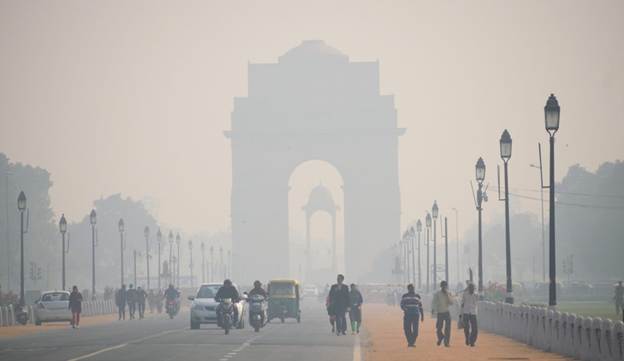
Delhi continues to face severe air pollution every winter, with the Air Quality Index (AQI) frequently crossing the “severe” mark. Schools often close, flights get delayed, and citizens are forced to use masks. The chronic public health impact makes this a persistent concern. Recent expert commentary highlights the need for long-term, coordinated solutions rather than temporary, seasonal measures.
Overview of the Problem
Delhi’s air pollution is multi-dimensional, arising from a combination of natural and human factors:
| Dimension | Key Points |
| Geographical & Meteorological | Basin-like formation flanked by Aravalli hills restricts airflow; high-pressure systems from October to January trap pollutants; winter temperature inversion traps pollutants near the ground. |
| Anthropogenic | Diesel trucks, ageing buses, two-wheelers, industries, construction debris, and open waste burning contribute significantly. |
| Seasonal / Cultural | Crop stubble burning in Punjab & Haryana; fireworks during Diwali celebrations. |
| Policy & Enforcement | Weak enforcement of pollution norms, outdated technology in factories, neglect of dust-control measures. |
Key Takeaway: Delhi’s air pollution is a chronic public health crisis, not just a seasonal inconvenience.
Causes of Delhi’s Air Pollution
- Vehicular Emissions
- 3.3 crore registered vehicles in Delhi.
- Diesel vehicles and ageing public transport contribute significantly to PM2.5 and nitrogen oxide emissions.
- Industrial & Power Sector Pollution
- Factories and power plants in neighboring states emit sulfur dioxide and other pollutants.
- Outdated technology and insufficient emission filters worsen the problem.
- Agricultural Practices
- Stubble burning in Punjab and Haryana causes transboundary pollution.
- Economic constraints limit adoption of alternatives; government support is insufficient.
- Seasonal & Cultural Events
- Firecrackers during Diwali.
- Open waste burning in residential areas.
- Natural & Meteorological Factors
- Winter inversion traps pollutants near the surface.
- Basin-like geography limits natural dispersion.
- Policy & Governance Gaps
- Fragmented responsibilities across Delhi, Haryana, Uttar Pradesh, Rajasthan.
- Enforcement of BS-VI norms is patchy.
- Rapid urbanization increases construction dust and traffic emissions.
Impacts of Air Pollution
Health Impacts
- Respiratory: asthma, bronchitis, COPD
- Cardiovascular: heart attacks, strokes
- Neurological: cognitive decline, depression, anxiety
- Chronic inflammation & autoimmune disorders: arthritis, lupus, multiple sclerosis
Economic Impacts
- India loses ~1.36% of GDP (~₹36.8 billion) annually due to health costs, reduced productivity, and premature deaths.
Social & Behavioral Impacts
- Migration of families to escape pollution
- Psychological stress and lifestyle disruptions
Global Examples & Measures
| City | Measures Taken | Results |
| London | Ultra Low Emission Zone (ULEZ), incentivizing electric vehicles | Reduced traffic emissions |
| Los Angeles | Strict vehicle emission standards, fuel technology upgrades, regional coordination | Improved air quality |
| Beijing | Multi-year action plan, relocation of polluting industries, real-time monitoring | 35% drop in PM2.5 over 5 years |
Lesson for Delhi: Requires sustained, science-driven, regional strategy rather than ad-hoc measures.
Suggested Solutions for Delhi
1. Structural & Policy Measures
- Unified Airshed Management Plan: Coordination among Delhi, Haryana, Uttar Pradesh, Rajasthan.
- Real-time Monitoring & Public Dashboards: Transparency to build public trust.
- Regulation of Industrial & Construction Emissions: Dust-control norms, updated emission standards.
- Waste Management: Ban open burning, promote composting, incentivize bio-decomposers.
2. Technological & Mobility Measures
- Promote electric vehicles (EVs) and expand public transport.
- Electrify private and public transport fleets.
- Enforce stricter fuel-burning vehicle emission norms.
3. Agricultural & Rural Measures
- Support Happy Seeders and bio-decomposers to manage stubble burning.
- Offer subsidies and mechanized alternatives to farmers.
4. Behavioral & Community Engagement
- Awareness campaigns to promote shared responsibility.
- Citizen participation in monitoring and clean initiatives.
Key Insights
- Complexity: Delhi’s pollution is a “wicked problem”—cross-cutting, multi-stakeholder, and hard to solve.
- Policy Integration: Requires alignment between Centre, state governments, and local authorities.
- Health-Economic Link: Strong correlation between pollution, GDP loss, healthcare costs, and social stress.
- Global Comparisons: Lessons from cities like London, Los Angeles, and Beijing can guide policy formulation.
- Citizen & Technology Role: Effective solutions require the combination of policy, technology, and behavioral engagement.
Conclusion
Delhi’s air pollution is not merely seasonal but a chronic, structural problem. Addressing it requires science-based, coordinated, and sustained action across governance, technology, agriculture, and society. With urgent, comprehensive measures, Delhi can improve public health and serve as a model for other polluted cities worldwide.
Source: Delhi’s air, a ‘wicked problem’ in need of bold solutions – The Hindu
UPSC CSE PYQ
| Year | Question |
| 2020 | What are the features of the National Clean Air Programme (NCAP) initiated by the government of India? |
| 2019 | What is meant by air pollution? Discuss the major sources of air pollution in India and suggest suitable measures to control it. |
| 2021 | Describe the key points of the revised Global Air Quality Guidelines (AQGs) recently released by the World Health Organization (WHO). How are these different from its last update in 2005? What changes in India’s National Clean Air Programme are required to achieve the revised standards? |