After Reading This Article You Can Solve This UPSC Mains Model Question:
India’s demographic challenge is shifting from population explosion to population ageing. Examine in the context of declining fertility rates. 150 Word (GS-1 Society)
Context
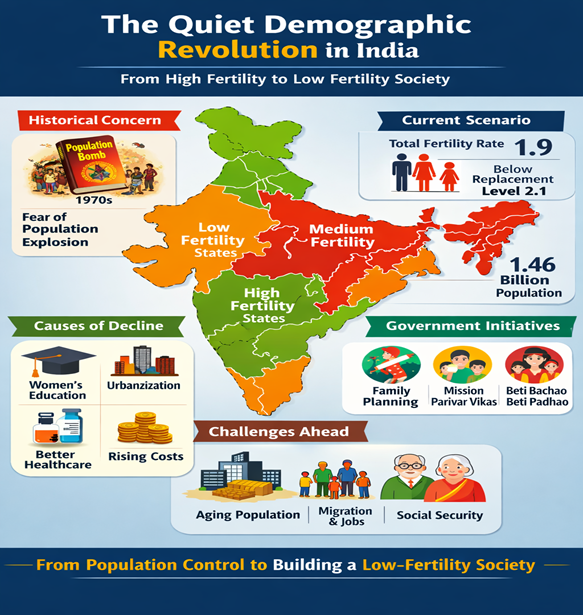
The “quiet demographic revolution” in India refers to the rapid and decisive transition from high to low fertility, moving the nation into a phase where the challenge is no longer “population explosion” but managing a “fragmented transition.”
Historical background
The Malthusian Era: Fear of the “Population Explosion”
1. The Core Logic: “Geometric vs. Arithmetic”
Based on Thomas Malthus’s 1798 theory, Indian planners feared a “Positive Check” (famine, war, or disease) if growth wasn’t halted.
- Population: Grows Geometrically (2, 4, 8, 16…).
- Food Supply: Grows Arithmetically (1, 2, 3, 4…).
- Result: A “Malthusian Catastrophe” where the population exceeds the “Carrying Capacity” of the land.
2. Why India Panicked
- The “Great Leap”: Between 1951 and 1981, India’s population nearly doubled (from 361 million to 683 million).
- Falling Mortality: Modern medicine and vaccines reduced death rates, but birth rates remained high.
- Resource Strain: The “Ship-to-Mouth” existence (relying on US wheat imports) made every extra birth seem like a threat to national security.
3. Policy Manifestation: “The Red Triangle”
- Global First: In 1952, India became the first country to launch a National Family Planning Programme.
- The Shift to Coercion: By the mid-1970s, frustration with slow progress led to the Emergency (1975-77).
- Target-driven approach.
- Mass forced vasectomies.
- Population was treated as a “Liability” to be liquidated.
4. The Turning Point
The Malthusian fear subsided due to two “Revolutions”:
- The Green Revolution: Proved that food supply could also grow exponentially through technology, defying Malthus.
- The Democratic Transition: Proved that as literacy (especially female) rose, fertility fell naturally without state force.
Present Situation
Based on the latest SRS (Sample Registration System) Statistical Report:
- National TFR: Has officially dipped to 1.9, well below the replacement level of 2.1.
- Total Population: Estimated at 1.47 Billion. While fertility is down, the population continues to grow due to “Population Momentum” (a large base of young people entering reproductive age).
- Replacement Achievement: 31 out of 36 States/UTs have now achieved replacement-level fertility. Even Rural India has hit the 2.1 mark for the first time in history.
Regional Fertility Patterns: The Faultline
India is currently split into two distinct demographic realities:
- The “Post-Transition” South & West: States like Kerala, Tamil Nadu, and Karnataka have TFRs ranging from 1.3 to 1.7. This is below the replacement level (2.1) and comparable to parts of Europe.
- The “Late-Transition” North & East: States like Bihar and Uttar Pradesh remain the outliers with TFRs between 2.4 and 2.9. While they are declining faster than ever before, they still contribute the bulk of India’s population growth.
Cause of Fertility Decline
I. Primary Socio-Economic Drivers
- Female Literacy & Education: Increased schooling for girls delays the age of marriage and expands their awareness of reproductive rights.
- Economic Cost of Child-Rearing (“Quantity to Quality”): Parents now prefer investing heavily in the education and health of one or two children rather than having many.
- Urbanization & Housing: Small urban apartments and the rising cost of living in cities like Bengaluru or Mumbai make large families impractical.
- Labor Force Participation: As more women enter the workforce, the “opportunity cost” of having children rises, leading to delayed parenthood.
II. Health & Technological Factors
- Reduced Infant Mortality (IMR): Historically, families had more children as “insurance” against high child mortality. As healthcare improved, the need for this insurance vanished.
- Modern Contraceptive Prevalence (mCPR): Improved access to a “basket of choices” (pills, injectables, IUCDs) through the public health system.
- The Infertility Paradox: In urban pockets, fertility is declining involuntarily due to lifestyle stress, late marriages, and environmental factors, pushing TFR in metros to ultra-low levels (1.1–1.2).
III. The “Aspiration” Shift
- Social Mobility: Families now view a smaller family as a status symbol of the middle class.
- Weakening of “Son Meta-Preference”: While still present, the absolute necessity of a male child is fading in many states as daughters become primary economic contributors.
Impact of fertility decline
1. Economic Impact
- The Demographic Dividend: Fewer children mean a lower “young-age dependency ratio”. This allows for higher per-capita investment in education and health (Quality over Quantity).
- The Labor Market Shift: In the long term, a shrinking youth base leads to labor shortages. Southern states are already experiencing this, leading to increased automation and reliance on migrant labor.
- Consumption Patterns: A shift toward the “Silver Economy.” Demand will move from baby products and schools to healthcare, insurance, and leisure for the elderly.
2. Social & Household Impact
- Women’s Empowerment: Lower fertility is strongly correlated with increased Female Labour Force Participation (FLFP). Women spend fewer years in child-rearing, allowing for career longevity.
- The Loneliness Crisis: With fewer children to provide traditional “old-age security,” social isolation among the elderly is rising, especially in urban “nuclear” setups.
3. Political & Federal Impact
- Delimitation Conflict: States that successfully reduced fertility (like Kerala and Tamil Nadu) face the risk of losing political representation in Parliament compared to states with higher fertility (like Bihar).
- Fiscal Pressure: Aging states face higher healthcare and pension bills with a shrinking tax-paying youth base, straining state exchequers.
4. Ecological Impact
- Resource Relief: Reduced population pressure leads to lower per-capita demand for water, land, and energy, aiding India’s Net Zero 2070 goals.
- Carbon Footprint: Conversely, as fertility drops and incomes rise, the per-capita carbon footprint typically increases due to higher consumption levels.
Government Initiatives
1. For High-Fertility Regions
- Mission Parivar Vikas (MPV): Now in its extended phase (2025-26), it targets 146 high-fertility districts in 7 states (UP, Bihar, RJ, MP, CG, JH, Assam).
- Goal: Reach a TFR of 2.1 in these specific pockets through “Awareness on Wheels” (SAARTHI) and door-to-door contraceptive delivery by ASHA workers.
- Antara & Chhaya: Introduction of new-age injectables and non-hormonal pills to expand the “Basket of Choice” for women, focusing on spacing births rather than just sterilization.
2. For the Aging Population
- Ayushman Bharat (AB-PMJAY 70+): As of 2024-25, the health cover of ₹5 lakh is extended to all senior citizens aged 70+, regardless of income. This is a massive shift toward universal geriatric health security.
- Atal Vayo Abhyuday Yojana (AVYAY): An umbrella scheme that includes:
- IPSrC: Setting up Senior Citizen Homes (especially for indigent and elderly women).
- Rashtriya Vayoshri Yojana: Free distribution of assisted-living devices (hearing aids, wheelchairs, dentures).
- Elderline (14567): A national toll-free helpline providing information, guidance, and emotional support to seniors across India.
3. Economic & Social Integration
- SAGE (Seniorcare Ageing Growth Engine): A portal to support startups creating products for the “Silver Economy” (geriatric tech, remote monitoring).
- SACRED Portal: A job-exchange platform specifically for “Senior Able Citizens” who want to remain productive post-retirement.
- Project Sanjivani: A recent initiative focusing on Medical Value Travel and wellness, positioning India as a global hub for geriatric rehabilitation.
Way Forward
I. Strategy for the “Silver Tsunami” (Aging)
- Geriatric Infrastructure: Mandate a “Geriatric Wing” in every district hospital and integrate elderly care into the primary healthcare (PHC) level.
- The Silver Economy: Incentivize startups through the SAGE initiative to develop assistive tech and remote monitoring for the “left-behind” elderly in rural areas.
- Flexible Retirement: Re-examine retirement ages in sectors like education and consultancy to utilize the “Silver Dividend” (experienced workforce).
II. Bridging the North-South Divide
- Migration Management Policy: Create a formal framework for “Inter-state Migration” to protect the rights of Northern workers in Southern states, ensuring social and linguistic integration.
- Skill Harmonization: Align vocational training in high-fertility states (UP/Bihar) with the specific labor demands of aging states (TN/Kerala).
III. Political & Economic Federalism
- Delimitation Reforms: Ensure the 2026/2031 delimitation exercise does not “punish” Southern states for successful population control. A weighted formula (population + performance in health/education) is essential.
- Fiscal Incentives: The Finance Commission must continue rewarding states that have achieved replacement-level fertility to maintain the fiscal balance.
IV. Gender & Reproductive Rights
- Focus on ‘Choice’ not ‘Targets’: Shift completely from female-centric sterilization to male participation in family planning and a wider basket of contraceptive choices.
- Support for Urban Parenthood: Address the ultra-low fertility in metros by improving childcare support and work-life balance to help couples who want children but cannot afford them.
Conclusion
India’s demographic future lies in managing a “Fragmented Transition.” By integrating the youthful North’s labor with the aging South’s capital, India can turn demographic divergence into a sustainable Viksit Bharat.