After Reading This Article You Can Solve This UPSC Mains PYQ 2020:
Discuss the recent measures initiated in disaster management by the Government of India departing from the earlier reactive approach.15 Marks (GS-3, Disaster Management)
Introduction
India has transitioned from a reactive to a proactive, mitigation-centric disaster management model. Guided by the DM Act 2005 and the Sendai Framework, it integrates technology and institutional decentralization to build a climate-resilient nation against increasing geophysical and hydrological hazards.
Institutional and Legal Framework
1. Statutory Foundation: The DM Act, 2005
- Mandate: Defines “disaster” and provides for the setup of specialized bodies at National, State, and District levels.
- Shift: Officially moved India from a relief-centric (Post-disaster) to a pro-active mitigation (Pre-disaster) approach.
2. Three-Tier Institutional Structure
| Level | Authority | Chairperson | Key Responsibility |
| National | NDMA | Prime Minister | Formulating national policies, plans, and guidelines. |
| State | SDMA | Chief Minister | Coordinating state-level implementation and funding. |
| District | DDMA | District Magistrate/ Collector | Frontline execution; preparing the District Disaster Management Plan. |
3. Executive & Operational Arms
- NEC (National Executive Committee): Chaired by the Union Home Secretary; assists NDMA in monitoring policy implementation.
- NDRF (National Disaster Response Force): A specialized multi-disciplinary force for proactive deployment during emergencies.
- NIDM (National Institute of Disaster Management): The nodal agency for capacity building, research, and human resource development.
4. Financial Framework (16th Finance Commission Updates)
- Risk Financing: Creation of the NDRM (National Disaster Risk Management Fund), split into:
- Response Fund (NDRF/SDRF): For immediate relief.
- Mitigation Fund (NDMF/SDMF): For long-term risk reduction (e.g., building embankments).
- 16th FC Shift: Funding is now increasingly linked to a Disaster Risk Index (DRI) rather than just historical expenditure.
5. Nodal Ministries for Specific Hazards
- Natural Disasters: Ministry of Home Affairs (MHA).
- Drought: Ministry of Agriculture.
- Chemical/Industrial: Ministry of Environment (MoEFCC).
- Biological: Ministry of Health (MoHFW).
- Rail Accidents: Ministry of Railways.
The 16th Finance Commission (2026-31) & Risk Financing
1. The Shift to Risk-Based Allocation
- Disaster Risk Index (DRI): For the first time, funds are allocated based on a state-specific risk profile rather than just past spending.
- The Formula: Allocation now accounts for Hazard (frequency/intensity), Exposure (population/assets in danger), and Vulnerability (socio-economic capacity).
- Objective: To ensure that states with high climate vulnerability (e.g., Odisha, Himachal Pradesh) receive proportionate support compared to larger, less-exposed states.
2. Structure of the Disaster Management Fund
Following the 15th FC’s precedent, the 16 FC maintains the division of the National Disaster Risk Management Fund (NDRMF) and State Disaster Risk Management Fund (SDRMF) into two functional components:
- Response Fund (80%):
- Response & Relief (70%): For immediate post-disaster assistance.
- Recovery & Reconstruction (30%): For building back after the event.
- Mitigation Fund (20%): Reserved strictly for pre-disaster structural and non-structural measures (e.g., sea walls, early warning systems).
Major Disaster Profiles & Mitigation Strategies
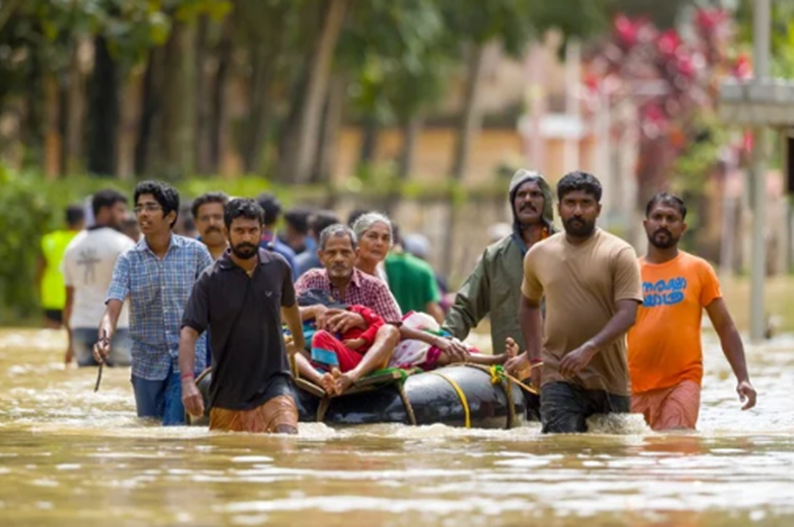
A. Hydrological: Floods & Urban Flooding
- Vulnerability: 12% of India’s landmass is flood-prone.
- 2026 Context: Recent cloudbursts in Kolkata and flash floods in Uttarakhand (August 2025) highlight the increasing frequency of “Compound Disasters.”
- Mitigation:
- Sponge City Concept: Increasing permeable surfaces to absorb rainwater.
- Bhuvan Portal: Using ISRO’s satellite data for real-time inundation mapping.
B. Geophysical: Earthquakes & Landslides
- Vulnerability: 59% of land is prone to earthquakes (Zone V – Himalayan Belt).
- Mitigation:
- Seismic Micro-zonation: Detailed mapping of urban areas (e.g., Delhi, Guwahati).
- Koti Banal Architecture: Reviving indigenous earthquake-resistant building techniques in the Himalayas.
C. Climatological: Heatwaves & Lightning
- The Challenge: Lightning is now the leading cause of natural hazard fatalities in India (36% of deaths).
- Mitigation:
- Sachet Portal / CAP: A Common Alert Protocol for geo-targeted SMS alerts.
- Heat Action Plans (HAPs): Implementing “Cool Roof” policies and “Green Corridors” to tackle Urban Heat Islands.
Global Frameworks: Sendai to CDRI
1. Sendai Framework for DRR (2015–2030)
The cornerstone of global disaster policy, Sendai shifted the focus from managing disasters to managing disaster risk.
- The 4 Priorities:
- Understanding disaster risk.
- Strengthening disaster risk governance.
- Investing in resilience (structural and non-structural).
- Enhancing preparedness for effective response and “Build Back Better” in recovery.
- The 7 Global Targets: Aims for substantial reductions in global mortality, number of affected people, economic losses, and damage to critical infrastructure by 2030.
2. Sustainable Development Goals (SDG) Integration
Disaster resilience is embedded in the 2030 Agenda:
- SDG 1 & 11: Protecting the poor from climate-related extremes and making cities resilient.
- SDG 13: Urgent action to combat climate change and its impacts.
3. Paris Agreement (COP21)
Recognizes “Loss and Damage” associated with climate change. India’s National Action Plan on Climate Change (NAPCC) aligns disaster mitigation with global carbon reduction and adaptation goals.
4. CDRI (Coalition for Disaster Resilient Infrastructure)
Launched by India at the UN Climate Action Summit (2019), this is a global partnership of governments and UN agencies.
- Focus: Ensuring that essential infrastructure (Power, Telecom, Transport, Health) can withstand climate shocks.
- Flagship Initiative: IRIS (Infrastructure for Resilient Island States), focusing on the specific vulnerabilities of Small Island Developing States (SIDS).
Challenges in the Disaster Management in India
1. Institutional & Coordination Gaps
- The “Last Mile” Deficit: While the NDMA and SDMAs are well-funded, the DDMAs (District level) often lack dedicated staff and technical expertise to execute complex plans.
- Data Silos: Lack of real-time data sharing between central agencies (IMD, CWC, ISRO) and local first responders leads to delayed “Actionable Intelligence.”
2. Financial Challenges (Post-16th FC)
- Funding Paradox: The 16th Finance Commission’s shift to a “total population” metric for risk exposure penalizes states like Odisha that have managed population growth but face high climate frequency.
- Underutilization of Mitigation Funds: States often prioritize Response/Relief over the 20% Mitigation Fund, treating disaster management as an emergency expense rather than a long-term investment.
3. Emerging Climate Hazards
- The “Silent Killers”: Heatwaves and Lightning now cause more annual deaths than cyclones, yet national classification and compensation mechanisms remain inconsistent.
- Urban Flooding: Rapid, unplanned urbanization and the destruction of “Sponge” ecosystems (wetlands) have turned cities like Bangalore and Chennai into high-risk zones.
4. Infrastructure & Technical Gaps
- Standardization: Lack of uniform Building Bye-laws and strict enforcement of BIS Seismic Codes makes urban infrastructure highly vulnerable to earthquakes.
- Maintenance: Ageing dams and embankments (e.g., Mullaperiyar concerns) pose a significant risk of Dam Break Floods.
5. Socio-Economic Constraints
- Vulnerability of the Poor: Disasters disproportionately impact marginalized communities living in “high-risk” zones (slums, floodplains) who lack the insurance or resources to “Build Back Better.”
- Erosion of Indigenous Knowledge: Reliance on concrete-heavy engineering often ignores traditional, eco-sensitive resilience practices (e.g., Himalayan traditional architecture).
Way Forward
1. Mainstreaming DRR in Development
Mandate Disaster Risk Audits for all infrastructure (Highways, Smart Cities). Shift the focus from “Development at any cost” to “Resilient Infrastructure” (CDRI standards), ensuring schools, hospitals, and grids survive extreme climate shocks.
2. Strengthening Local Governance & Community Leadership
Empower DDMAs with technical expertise and financial autonomy. Scalable community initiatives like “Aapda Mitra” utilize local knowledge to manage the critical “Golden Hour” before professional help arrives.
3. Leveraging “Impact-Based” Early Warning Systems (EWS)
Transition from “Weather alerts” to “Actionable Intelligence” (e.g., Sachet Portal). Use AI, ML, and ISRO data to provide hyper-local, geo-targeted warnings that tell vulnerable populations exactly what to do, not just what is coming.
4. Nature-Based Solutions (NbS) & Blue-Green Infrastructure
Adopt “Sponge City” concepts by restoring wetlands and mangroves. Prioritize Nature-Based Solutions (bio-shields) over “Grey Infrastructure” (concrete walls) to provide cost-effective, sustainable protection against floods and cyclones.
5. Closing the Risk Financing Gap
Expand Disaster Risk Insurance for public and private assets to lower the fiscal burden on the state. Strictly utilize the 16th Finance Commission’s Mitigation Fund (SDMF) to break the cycle of “Disaster-Response-Repeat.”
Conclusion
India’s transition to a risk-informed, technology-driven disaster management model, supported by the 16th Finance Commission, is vital for sustainable development. Success lies in bridging the “last-mile” gap through community resilience.