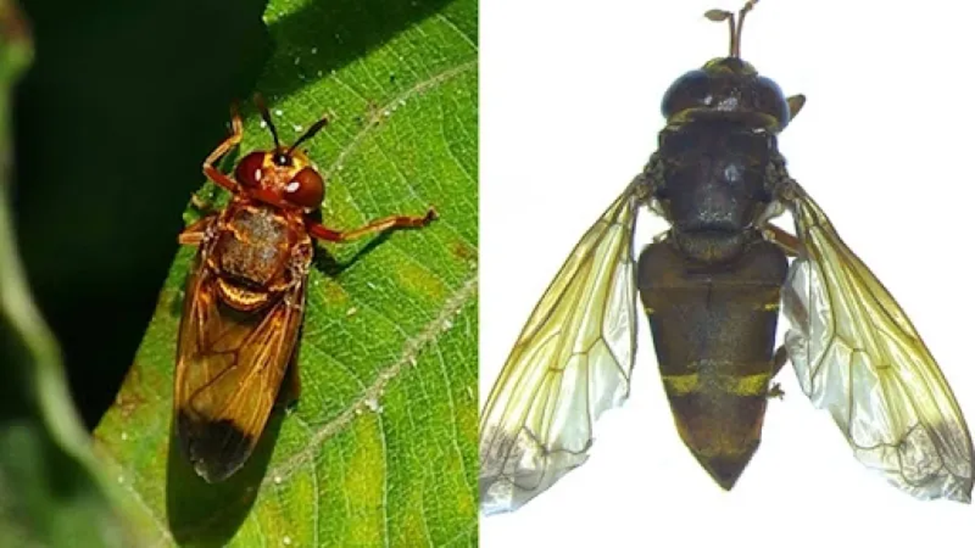
Why In the News?
Researchers have recently discovered two new, extremely rare ant fly species from Delhi and the Western Ghats, highlighting the hidden biodiversity of urban forests and biodiversity hotspots.
Understanding Ant Flies:
- Classification: Members of the subfamily Microdontinae (Syrphidae family).
- Ecological Niche: Renowned for myrmecophily, where larvae reside within ant nests and feed exclusively on ant brood.
- Behavioral Traits: Adults are inconspicuous, rarely visit flowers, and remain in close proximity to host ant colonies, making them exceptionally difficult to detect.
Profiles of the New Discoveries
1. Metadon ghorpadei (Urban Specialist)
- Location: Northern Ridge Forest, Delhi Ridge.
- Habitat: An urban, fragmented, and disturbed forest patch.
- Significance: Proves that even isolated urban green spaces harbor high-value biodiversity.
- Warns that urban planning focusing solely on “green cover” may overlook niche-specific species.
2. Metadon reemeri (Highland Specialist)
- Location: Siruvani Hills, Western Ghats, Tamil Nadu.
- Habitat: A globally recognized biodiversity hotspot with high endemism.
- Significance: Expands the known insect diversity of the Western Ghats.
- Emphasizes the urgency for molecular phylogenetics and targeted surveys in protected but under-studied regions.
Ecological & Conservation Significance
- Statistical Context: India hosts only 27 known Microdontinae species out of approximately 454 globally.
- Key Takeaways for Biodiversity:
- Cryptic Fauna: Highlights the need to protect “hidden” insect species that do not follow traditional pollination patterns.
- Management Actions: Stresses the importance of restoring native vegetation and controlling invasive species to maintain specialized habitats.
- Mapping: Calls for precise habitat mapping to prevent the extinction of rare, site-specific taxa
With respect to the biological phenomenon of 'Myrmecophily' observed in certain insect subfamilies, consider the following statements:
1.	It represents a specialized ecological niche where the larval development of the insect is entirely dependent on the ecosystem of ant nests.
2.	The relationship is always mutualistic, where the insect larvae provide defense to the ant brood in exchange for nutrition.
3.	High levels of habitat fragmentation in urban areas generally lead to the immediate extinction of myrmecophilous species due to their low mobility.

How many of the statements given above are correct?
(A) Only one
(B) Only two
(C) All three
(D) None

Answer: A
Explanation:
Statement 1 is correct: Myrmecophily (literally "ant-love") in the context of the Microdontinae subfamily is an obligate relationship. Their larvae are specialized to live within the complex environment of ant nests, making their developmental cycle entirely dependent on the host colony's ecosystem.
Statement 2 is incorrect: The term "Myrmecophily" describes a range of interactions, but it is not always mutualistic. In the case of these newly discovered ant flies, the relationship is predatory or parasitic, as the larvae actually feed on the ant brood (eggs and larvae) rather than providing a service like defense or honeydew.
Statement 3 is incorrect: While habitat fragmentation is a threat, it does not "generally lead to immediate extinction." The discovery of Metadon ghorpadei in the Northern Ridge of Delhi—a highly fragmented and disturbed urban forest—demonstrates that these species can persist in isolated "micro-habitats" as long as the specific host ant colonies remain viable.
Practice Today’s MCQs