Context
Scientists have reportedly discovered a new material—a lutetium-hydride compound doped with nitrogen—that exhibits superconductivity at room temperature (21°C), though it still requires high pressure (10 kilobars) to function. This discovery aims to overcome the “temperature barrier” that has historically limited the use of superconductors to extreme laboratory conditions.
1. What is a Superconductor?
A superconductor is a material that can conduct electricity or transport electrons from one atom to another with zero resistance.
- Critical Temperature: The specific temperature below which a material becomes superconducting.
- Energy Efficiency: Because there is no resistance, no energy is released as heat, making the transmission of electricity 100% efficient.
2. Key Physical Properties
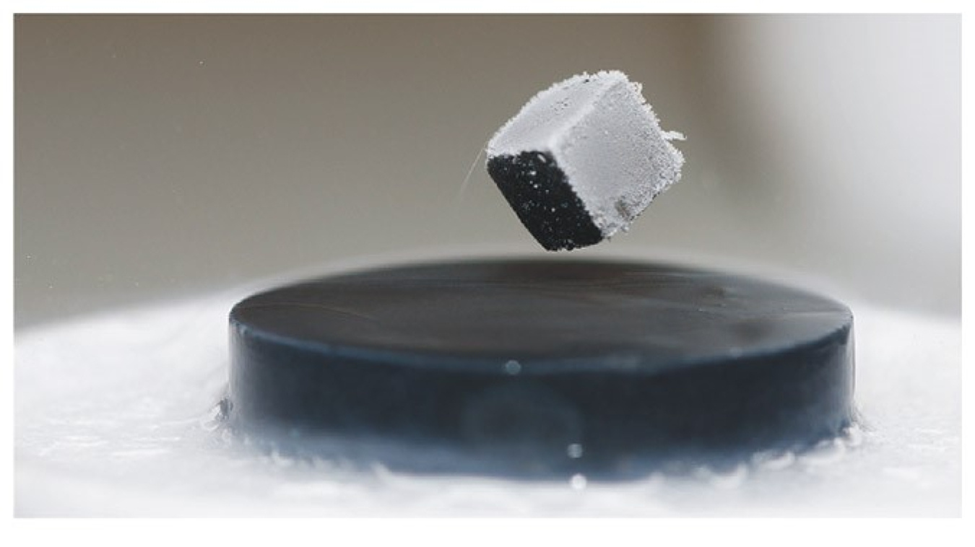
- The Meissner Effect: This is the hallmark of superconductivity. When a material transitions to a superconducting state, it expels all internal magnetic fields. This allows for quantum levitation or magnetic levitation (Maglev).
- This is the most important and defining property of superconductivity. When a material is cooled below a certain critical temperature, it enters the superconducting state and completely expels all internal magnetic fields. As a result, the material behaves as a perfect diamagnet.
- In this process, magnetic field lines cannot penetrate the material and are forced to move around its surface. This leads to the phenomenon where the material can float above a magnet—known as quantum levitation or magnetic levitation (Maglev).
- In real-world applications, this effect is used in Maglev trains, enabling frictionless motion and very high speeds. It also plays a significant role in modern physics and advanced technologies.
- Infinite Conductivity: Current flowing through a closed loop of superconducting wire can persist indefinitely without a power source.
- Exclusion of Magnetic Flux: Superconductors are perfect diamagnets.
3. Materials
- Superconductivity is one of nature’s most intriguing quantum phenomena. It was discovered more than 100 years ago in mercury cooled to the temperature of liquid helium (about -452°F, only a few degrees above absolute zero).
- Following the discovery of superconductivity in mercury, the phenomenon was also observed in other materials at very low temperatures..
- Superconductor material classes include chemical elements (e.g. mercury or lead), alloys (such as niobium–titanium, germanium–niobium, and niobium nitride), ceramics (YBCO and magnesium diboride), superconducting pnictides (like fluorine-doped LaOFeAs), single-layer materials such as graphene and transition metal dichalcogenides,[48] or organic superconductors (fullerenes and carbon nanotubes; though perhaps these examples should be included among the chemical elements, as they are composed entirely of carbon).
4. Applications
- Medical Imaging: Used in MRI (Magnetic Resonance Imaging) machines to create the powerful magnetic fields required for high-resolution body scans.
- Transportation: Maglev Trains use the Meissner effect for friction-less travel, reaching speeds of over 600 km/h.
- Particle Accelerators: Essential for the Large Hadron Collider (LHC) at CERN to steer subatomic particles.
- Power Grids: Superconducting cables could transmit power over long distances with zero line loss, solving the global energy wastage problem.
- Quantum Computing: Superconducting circuits act as “Qubits,” the basic unit of information in quantum computers.
With reference to superconductors, consider the following statements:

1. They conduct electricity with zero resistance.
2. They release heat during current flow.
3. They require a critical temperature to exhibit superconductivity.

Which of the statements given above is/are correct?
(a) 1 and 3 only
(b) 2 only
(c) 1, 2 and 3
(d) 1 only

Answer: A

Explanation:
•  Statement 1 is correct: Superconductors are materials that can conduct electricity or transport electrons from one atom to another with zero resistance.
•  Statement 2 is incorrect: Because there is no resistance, no energy is released as heat during the flow of current. This characteristic makes the transmission of electricity 100% efficient.
•  Statement 3 is correct: Materials only exhibit superconductivity below a specific temperature known as the Critical Temperature