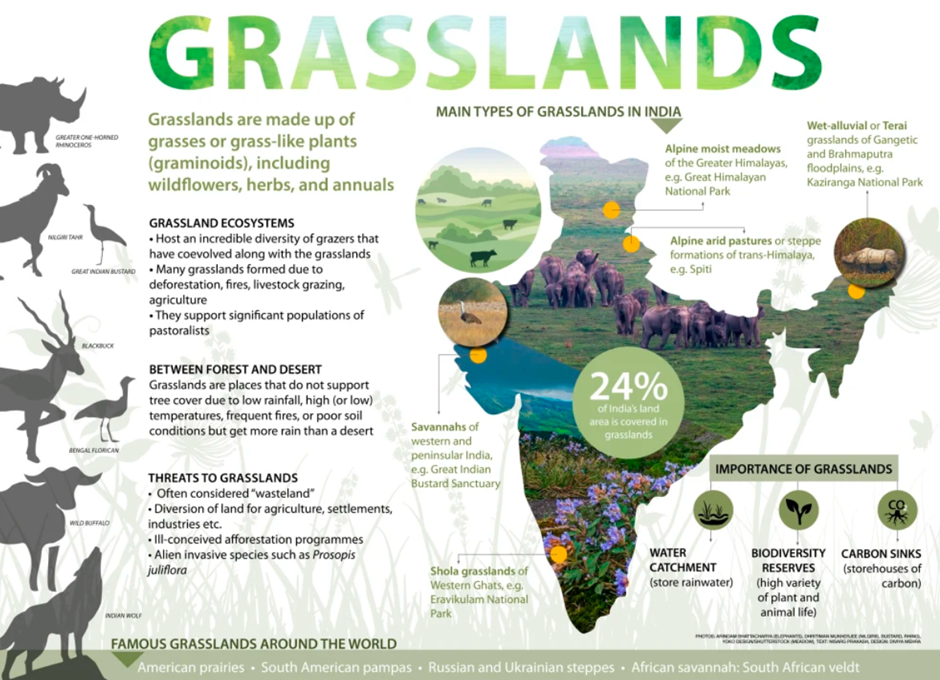
Wasteland’ Classification : Since the colonial era, grasslands and savannahs were categorized as “wastelands” due to the absence of timber.
Institutional Framework: The National Wastelands Development Board (1985) was established to classify and develop these lands.
- Current Scope: The “wasteland” category in India currently includes scrublands, degraded pastures, ravinous lands, and glacial areas, often overlooking their ecological value.
Grasslands vs. Forests
- Storage Location: Unlike forests, where biomass and carbon are stored primarily above ground, grassland productivity is concentrated below ground.
- Root Systems: Deep, fibrous root systems create dense mats that enhance Soil Organic Carbon (SOC).
- Fire Resilience: Since the majority of carbon is stored in the soil, grassland carbon stocks are relatively resilient to surface fires, unlike forest biomass which releases carbon when burnt.
What distinguishes Tropical Grasslands (Savannahs)?
- Location: Situated within the tropics on either side of the equator.
- Climate & Precipitation: Marked by moderate to low rainfall.
- Soil Profile: Generally nutrient-deficient and less fertile.
- Vegetation: Dominated by tall grasses (up to 3-4 meters).
- Key Examples: Savannahs (Africa), Campos (Brazil), Llanos (Venezuela).
- Fauna: Home to megafauna like elephants, giraffes, zebras, cheetahs, and leopards.
2. What defines Temperate Grasslands?
- Location: Found in mid-latitude zones.
- Climate: Characterized by hot summers and extremely cold winters (often sub-zero).
- Precipitation: Ranges from 25–75 cm (rain, dew, and snow).
- Soil Profile: Highly fertile; biologically active and ideal for agriculture.
- Vegetation: Grasses are shorter and softer compared to tropical varieties.
- Key Examples: Pampas (Argentina), Velds (South Africa), Steppe (Asia), Prairie (USA), Downs (Australia).
- Fauna: Bison, pronghorns, prairie dogs, wolves, and coyotes.
Why are grasslands ecologically vital?
- Carbon Sequestration: Acts as a significant carbon sink, storing carbon in deep root systems and soil.
- Biodiversity Hotspots: Supports a vast array of flora and fauna.
- Soil Conservation: Fibrous root mats bind soil, preventing erosion and maintaining structure.
- Water Management: Enhances groundwater quality through natural filtration.
- Nutrient Cycling: Facilitates the recycling of essential minerals through rapid decomposition.
What characterizes the Flora?
- Composition: Dominated by wild grasses, herbs, and scattered shrubs.
- Root System: Perennial grasses form thick root mats that stabilize the soil.
- Specific Types: Includes semi-natural mix (oak, hazel) and unique formations like the Shola meadows in South Indian hill slopes.
Which Fauna dominates these landscapes?
- Megafauna: Supports the world’s largest land mammals (Lions, Rhinos, Elephants, Bison).
- Indian Context: Habitat for the One-horned Rhinoceros, various deer species, and antelopes.
- Invertebrates: Soil-dwelling insects play a critical role in decomposition and soil aeration.
How do grasslands support the economy?
- Global Breadbaskets: Fertile temperate grasslands are prime hubs for wheat, barley, and maize cultivation.
- Livestock Industry: Serves as the primary forage source for cattle, sheep, and goats.
- Rural Utility: Provides thatching material for roofing and shrub-wood for fuel.
- Ecological Services: Predators and insects within the ecosystem regulate agricultural pests.
Grassland Ecosystems of India
- Sub-Himalayan (Terai Belt):
- Region: J&K to Arunachal Pradesh.
- Features: Tall, dense elephant grass with scattered trees.
- Semi-Arid:
- Region: Gujarat, Rajasthan, Western UP, Punjab.
- Features: Open stretches with sparse grass and xerophytic shrubs.
- Dry Sub-Humid:
- Region: Peninsular India (excluding Nilgiris).
- Features: Critical for cereal crops like wheat and barley.
- Montane:
- Region: Himalayas and North-East India.
- Features: High-altitude meadows; Includes Bugyals (Uttarakhand), Khajjiar (Himachal), and Dzukou Valley (Nagaland).
- Tropical Savannas:
- Region: Deccan Plateau and parts of Rajasthan.
- Features: Grass-dominated landscapes interspersed with scrub forests.
- Wet Grasslands:
- Region: Waterlogged plains of North and North-East India.
- Features: Tall, semi-aquatic grasses; Includes the floating Phumdis of Manipur (Loktak Lake).