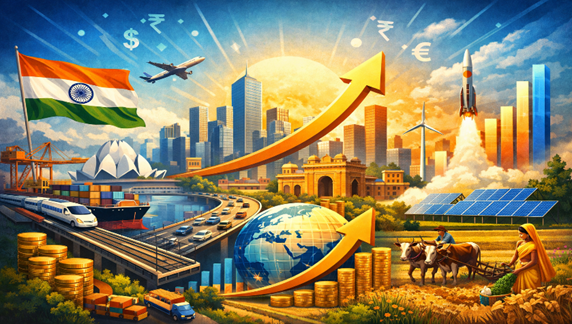
After Reading This Article You Can Solve This UPSC Mains PYQ
Faster economic growth requires increased share of the manufacturing sector in GDP, particularly of MSMEs. Comment on the present policies of the Government in this regard. (GS-3 Economy)
Context:
India ended 2025 as one of the fastest-growing major economies with robust GDP expansion — quarterly growth reached around 8.2% in Q2 FY26, stronger than the previous year, driven by resilient demand and cross-sector contribution.
Current Economic Status:
1. GDP Growth: The “Blockbuster” Quarter
- Q2 FY26 Performance: India’s real GDP surged to 8.2% in the July–September 2025 quarter. This significantly outpaced consensus estimates (7.3%) and marked a six-quarter high.
- Global Standing: India remains the world’s fastest-growing major economy. It has officially surpassed Japan to become the 4th largest economy globally and is on a trajectory to overtake Germany for the 3rd spot by 2027-28.
- Sectoral Drivers:
- Manufacturing: Grew at 9.1%, reflecting a strong industrial rebound.
- Services: Continued to lead with over 9% expansion.
- Construction: Grew at 7.2%, fueled by the government’s infrastructure push.
2. Inflation & Monetary Policy: A Sharp Pivot
- Historic Lows: Retail inflation (CPI) hit a record low of 0.25% in October 2025 and stood at 0.71% in November.
- RBI Action: Driven by benign inflation, the RBI initiated a decisive growth-oriented pivot, cutting the repo rate by a cumulative 125 basis points in 2025, bringing it down to 5.25%.
- Nominal GDP Concern: A narrow gap between real growth (8.2%) and nominal growth (8.7%) indicates a deflationary trend in some sectors, which could impact tax collection targets.
3. External Sector & Fiscal Health
- Forex Reserves: Jumped to $693.3 billion (as of Dec 19, 2025), providing a massive buffer against global currency volatility.
- Fiscal Deficit: The government is on track to meet its 4.9% target for FY25 and has set a more ambitious target of 4.4% for FY26, aiming for gradual consolidation below 4% by 2027.
- Exports: Merchandise exports expanded to $38.13 billion in November 2025, driven by electronics and pharmaceuticals.
Growth Potential of India:
1. The Digital Economy (The ‘Core’ Engine)
- 20% Contribution Goal: By 2029-30, the digital economy is projected to contribute one-fifth (20%) of India’s GVA, outpacing both agriculture and traditional manufacturing.
- AI & GenAI Depth: India’s AI market is expected to hit $17 billion by 2027. With nearly 1.25 million professionals, India will soon house 16% of the global AI talent pool.
- Digital Public Infrastructure (DPI): Systems like UPI and Aadhaar are estimated to add 2.9–4.2% to the GDP by 2030 by formalizing the economy and lowering transaction costs.
2. Manufacturing & “China+1” Strategy
The Production Linked Incentive (PLI) schemes have reached a critical maturity phase in 2025.
- Investment Realization: As of September 2025, over ₹2 lakh crore in actual investments have been realized across 14 sectors.
- Electronics Dominance: Mobile phone production skyrocketed to ₹5.45 lakh crore in FY25 (a 28-fold increase since 2014). India is now a net exporter of 4G and 5G telecom equipment.
- Import Substitution: In critical sectors like Telecom and Pharmaceuticals (APIs), India has achieved nearly 60% import substitution, reducing strategic dependence on China.
3. Demographic Dividend & Urbanization
- The 2041 Peak: India’s working-age population (20-59 years) is expected to peak in 2041 at 59% of the total population.
- Consumer Class: The middle class is expected to constitute 46% of the population by 2030, driving nearly 70% of the GDP through domestic consumption.
- Urban Productivity: Urbanization is projected to reach 47% by 2050, creating concentrated hubs of high-productivity service and manufacturing jobs.
4. Energy Transition Potential
- Nuclear Expansion: The “Nuclear Energy Mission for Viksit Bharat” (announced Feb 2025) aims for 100 GW capacity by 2047, involving regulated private participation for the first time.
- Renewable Milestones: India achieved its 50% non-fossil fuel capacity target in June 2025, five years ahead of the 2030 schedule.
- Biofuels: Met the 20% ethanol blending goal in 2025 and is now targeting 27% by 2030.
Challenges to Growth:
1. The Private Investment Paradox
Despite a “Goldilocks” macro-environment, private sector participation remains the “missing engine.”
- Stagnant Capex: Private corporate investment has hovered around 12% of GDP for over a decade. In FY25, it accounted for only 34.4% of Gross Fixed Capital Formation—the lowest since 2011-12.
- Profit vs. Investment: While corporate profits have risen, firms increasingly prefer liquid financial assets, share buybacks, or overseas projects over long-term domestic physical assets due to “wait-and-watch” sentiment.
2. Global Trade Headwinds (The “Tariff Wall”)
- U.S. Reciprocal Tariffs: In 2025, the U.S. announced tariffs of up to 50% on certain exports. India’s exports to the U.S. declined by ~37.5% between May and September 2025 in sensitive sectors like metals and machinery.
- FDI Fragility: India’s FDI inflows are susceptible to external shocks. Net FDI saw a sharp dip in late 2025 due to high repatriation and outward investment by Indian firms hedging against global volatility.
3. Structural and Labor Constraints
- The “Research Deficit”: India’s R&D spending remains low at ~0.64–0.7% of GDP (compared to 2.4% in China). The private sector contributes only 36% to this, leading to a “brain waste” where high-end STEM talent migrates abroad.
- Skill Mismatch: Only 4.1% of the workforce has formal vocational training. This keeps emerging states (like Bihar and Odisha) trapped in low-value “construction-led growth” rather than high-end manufacturing.
- Rural Distress & Informality: Less than 25% of marginal farmers are part of cooperatives. Those outside these networks are 2.5 times more vulnerable to climate shocks and price volatility.
4. Subnational Disparities
- Debt Burden: While states like Bihar are growing fast (9.2%), their Debt-to-GSDP ratio (39%) is double the recommended limit, leaving little fiscal room for new infrastructure.
- The “Freebie” Trade-off: Increasing revenue expenditure on populist cash transfer schemes (e.g., Ladli Behna) is often coming at the cost of essential capital expenditure.
Government’s Initiative:
1. The “Trade Diplomacy” Engine (FTAs)
India has moved away from its historical hesitation toward trade pacts, adopting a “Trade + Investment” strategy.
- India–New Zealand FTA (Concluded Dec 2025): * Zero-Duty Access: India secured zero-duty access for 100% of its exports (Textiles, Gems, Pharma).
- Investment Commitment: A first-of-its-kind $20 billion FDI pledge from New Zealand over 15 years.
- Safeguards: India protected its dairy and sensitive agriculture sectors by placing them in the Exclusion List.
- India–UK CETA (Signed 2025): Grants duty-free access to 99% of Indian exports, aiming for $100 billion bilateral trade by 2030.
- India–Oman CEPA (Dec 2025): Opens zero-duty access for 99.38% of Indian goods by value, strengthening the West Asia corridor.
- India–EU FTA (Pipeline): Negotiations are set to wrap up by January 2026, focusing on a balanced deal including a “Carbon Border Adjustment” dialogue.
2. Strategic Domestic Initiatives
The focus has shifted from mere “subsidies” to “wealth creation” and “self-reliance.”
A. Manufacturing & Innovation
- PLI 2.0 & SPECS: Expanding Production Linked Incentives to Deep-Tech, Semiconductors (25% capex incentive), and IT Hardware (laptops/servers).
- Rare Earth Permanent Magnet (REPM) Scheme: A new scheme to create domestic capacity for critical magnets used in EVs and defense, reducing China-dependence.
- Anusandhan National Research Foundation (ANRF): Operationalized in 2025 with a ₹1 lakh crore outlay to fund sunrise sectors like AI, Quantum Computing, and Climate Action.
B. Agriculture & Rural Prosperity
- PM Dhan-Dhaanya Krishi Yojana: A new mission focused on 100 high-potential Agri-districts to enhance productivity through crop diversification and post-harvest storage.
- Mission for Aatmanirbharta in Pulses: A 6-year mission focusing on Tur, Urad, and Masoor to end import dependence.
- Revamped MGNREGA: Now called the Poojya Bapu Grameen Rozgar Yojana, increasing guaranteed work from 100 to 125 days with a focus on skilling.
C. Energy & Sustainability
- SHANTI Bill 2025: Amends the Atomic Energy Act to allow regulated private participation in nuclear power for the first time.
- PM Surya Ghar: Aiming to provide 300 units of free electricity monthly to 1 crore households via rooftop solar.
3. Infrastructure & Digital Public Infrastructure (DPI)
- Asset Monetization Plan (2025-30): A second phase aimed at ploughing back ₹10 lakh crore from existing assets into new greenfield projects.
- BharatNet Phase III: Completing last-mile high-speed broadband to all Gram Panchayats and rural primary health centers.
- PM SVANidhi 2.0: Extended until 2030, providing street vendors with UPI-linked credit cards and loans up to ₹50,000.
Way Forward:
To reach the $10 trillion target by 2035, India must focus on the following four pillars (the 4Ds):
1. Development & Industrial Execution
- From Signing to Delivering: The priority for 2026 must shift from signing new FTAs to ensuring existing deals (like the India-NZ and India-UK pacts) deliver real export gains. This requires:
- Operationalizing the Export Promotion Mission: To help MSMEs navigate complex documentation and “Rules of Origin.”
- Lowering Logistics Costs: Using the PM Gati Shakti framework to cut logistics costs from 13-14% to below 8% of GDP to remain competitive.
- Product Quality Upgradation: Domestic execution must focus on improving product quality to overcome Non-Tariff Barriers (NTBs) such as the EU’s Carbon Border Adjustment Mechanism (CBAM).
2. Diversification of Trade & Markets
- “China + 1” Alternative: Recalibrating manufacturing to serve as a resilient global alternative in electronics, semiconductors, and renewables.
- Geographic Expansion: Actively tapping into emerging markets in Africa, ASEAN, and Latin America to reduce over-reliance on the US and EU markets, which are increasingly protectionist.
- Product Basket Expansion: Moving from low-value assembly to high-tech, design-led manufacturing to capture more value in the global supply chain.
3. Digitalization & Human Capital
- Leveraging the AI Wave: Scaling the AI Mission and National Quantum Mission to train 1 crore youth, ensuring the demographic dividend becomes “Innovation Capital” rather than a liability.
- Digital Public Infrastructure (DPI): Expanding 5G and AI infrastructure beyond metros to drive rural productivity and integrate the informal sector (80% of the workforce) into the formal economy.
4. Decarbonization & Green Growth
- The Green Imperative: Achieving the 500 GW renewable target and the National Green Hydrogen Mission to lower the carbon footprint of Indian exports.
Conclusion:
India’s growth momentum, driven by reforms, demographics and digital transformation, places it on a credible path towards becoming a developed nation. Converting this potential into reality, however, hinges on job-rich growth, human capital development, MSME competitiveness and climate-resilient development, ensuring that high GDP growth translates into inclusive and sustainable prosperity.