Why in the News?
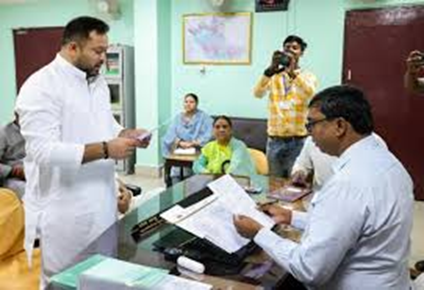
Recently, concerns have mounted about the fairness of India’s electoral nomination scrutiny after reports that candidates are being summarily disqualified on procedural grounds. A woman from Dadra & Nagar Haveli reported that her father’s municipal nomination was rejected without a hearing or any chance of verification, an example that underlines systemic problems in the nomination stage.
Background
- The nomination process (filing and scrutiny of nomination papers) is governed by the Representation of the People Act, 1951 (Sections 33–36) and the Conduct of Elections Rules, 1961.
- Section 36 authorises the Returning Officer (RO) to scrutinise nominations and reject those deemed invalid for “defects of a substantial character.”
- Section 36(2) gives the RO power to conduct a summary inquiry and reject on that ground.
- Article 329(b) bars courts from interfering during elections, so pre-poll judicial review is largely unavailable; the only ordinary remedy is an election petition after polling, when the damage is often irreversible.
What is the Problem?
- India’s nomination scrutiny vests extraordinary discretion in a single official — the RO. The statutory phrase “defects of a substantial character” is undefined in law, and there are no written guidelines on what is “substantial”.
- This opacity enables subjective decision-making and creates scope for procedural weaponisation — using technicalities to exclude candidates before a single vote is cast.
- There is no publicly available consolidated dataset on grounds of rejection, patterns, or party-wise breakdowns; that lack of transparency further shields possible misuse of procedure.
Few Cases
- Dadra & Nagar Haveli: nomination rejected without hearing or verification (reported by a caller).
- Bihar: an RJD candidate was rejected for leaving some fields blank.
- Surat: Opposition candidates were eliminated when proposers denied signatures, producing an unopposed Lok Sabha result.
- Varanasi (2019): BSF jawan Tej Bahadur Yadav was rejected for failing to obtain an Election Commission certificate overnight.
- Birbhum: former IPS officer Debasish Dhar was excluded because his no-dues certificate from government was delayed.
Why Procedural Rules have become traps
- Section 36 requires only qualified candidates to contest, but the verification process has become increasingly complex.
- Well-intended judicial directions (e.g., detailed affidavits on assets, liabilities and criminal cases) aimed at transparency have added more technical requirements, each a new ground for rejection.
- The Supreme Court’s ruling in Resurgence India v. Election Commission (2013) means false declarations lead to prosecution but do not automatically invalidate nominations — whereas incomplete declarations can. Consequently, a candidate who lies but fills all columns may remain on the ballot, while one who makes a good-faith omission can be disqualified. The system thereby punishes incomplete declarations more harshly than dishonest ones.
- Trivial technicalities — a missing signature, mismatched electoral number, filing a form minutes late, a blank affidavit column, a delayed oath or a missing no-dues certificate — can end a candidacy. The burden of proof rests with the citizen seeking to exercise the right to contest, not on officials who deny it.
Common Procedural “Traps”
- Oath trap: the oath must be taken after filing but before scrutiny, before a specified authority and within the prescribed time; too early, too late, or before the wrong authority can invalidate the nomination.
- Notarisation trap: Form 26 affidavits must be notarised by specified authorities; failure to do so can cause rejection.
- Certificate trap: candidates must produce no-dues / clearance certificates from municipal bodies, electricity boards, other government departments, or an EC clearance for government servants; each issuing office can become a chokepoint whose delay can veto a candidacy.
- Procedures intended as safeguards have therefore become opportunities for delay and manipulation — bureaucratic compliance is rewarded over democratic legitimacy.
Problems with the Checklist and Current Practice
- The RO Handbook requires that ROs point out defects at the time of filing and maintain a checklist. But the checklist has no legal standing; the Handbook explicitly states the checklist “will not prevent the Returning Officer from pointing out other defects… discovered later during scrutiny.”
- A nomination marked defect-free at filing can still be rejected at scrutiny for newly discovered defects. Candidates cannot rely on the checklist and ROs are under no legal obligation to honour it — the checklist therefore offers an illusion of transparency without real protection.
Comparative Approaches — Facilitation, not Filtration
- Other democracies adopt facilitative processes: in the U.K. ROs help candidates correct errors before deadlines; Canada provides a 48-hour correction period; Germany mandates written notice, time to remedy and multiple appeal layers; Australia encourages early submission to allow corrections. The shared principle: officials are facilitators, not sentinels.
Proposals and Principles for reform (set out in the article)
- Presumptive right to contest: every qualified citizen should have a presumptive right to stand; disqualification should follow only when the RO establishes, with clear evidence, a constitutional or statutory disqualification. Technical paperwork errors cannot alone justify disqualification.
- Classification of deficiencies: the law should classify defects into three categories:
- Technical/paperwork defects (missing signatures, blank affidavit columns, clerical errors, missing no-dues certificates) — cannot justify rejection.
- Matters requiring verification (disputed signatures, challenged documents) — require investigation before any rejection.
- Constitutional/statutory bars — justify immediate and absolute disqualification.
- Mandatory notice and remedy window: when a deficiency is found, the RO must issue a detailed written notice specifying the exact error, the legal provision violated and the correction required; candidates should be given a guaranteed 48-hour window to rectify the defect after receiving notice.
- Reasoned rejection orders: every rejection must be reasoned — it must state which exact requirement was unmet, which legal provision was violated, what evidence supports the finding, and why the defect is “substantial” enough to justify rejection.
- RO’s role redefined: shift the RO’s function from discretionary gatekeeper to duty-holder/facilitator whose job is to enable candidates to cure defects rather than to exclude them.
Digital Solution Recommended
- The Election Commission of India (EC) can build a digital-by-default nomination system (not necessarily digital-only) to reduce disqualifications from clerical errors (blank columns, misspelt names, typos). Key features proposed:
- An integrated online portal linked to the electoral roll to auto-validate voter ID, age and constituency details.
- Digital submission of oath, affidavits, proposer verification and deposit payment.
- A public dashboard showing each nomination’s progress with timestamps and reasons (filed, verified, deficiency notified, corrected, accepted or rejected).
- Digital processes would minimise errors, improve transparency, and create a traceable record to prevent arbitrary exclusions.
Democratic Stakes
- Arbitrary rejection violates two interlinked rights: the candidate’s right to contest and the voters’ right to choose.
- The article argues that the burden of proof must shift to the state to justify exclusion; citizens should not have to prove entitlement to participate. Without meaningful choice of candidates, the ballot becomes a ritual without substance.
Conclusion
- India needs a modern, fair and inclusive nomination process where procedure facilitates participation rather than becoming a tool for political exclusion. The Election Commission should adopt clear standards, due-process safeguards (notice + cure window, reasoned orders) and digital tools to prevent trivial procedural defects from determining who may stand for public office.
Representation of People Act
Free and fair elections are fundamental to a democratic system. To ensure elections are conducted freely, fairly, and impartially, the framers of the Indian Constitution included Part XV (Articles 324–329), empowering Parliament to enact laws regulating electoral processes.
The Election Commission of India (ECI), established under Article 324, serves as the guardian of election integrity, overseeing all elections in India.
To provide a legal framework for elections, Parliament enacted:
- Representation of the People Act, 1950 – covers voter registration, delimitation of constituencies, allocation of seats, and electoral offices.
- Representation of the People Act, 1951 – regulates election procedures, nominations, polling, results, disqualifications, and post-election disputes.
- Delimitation Commission Act, 2002 – provides the basis for redrawing constituency boundaries.
Representation of the People Act, 1950
The Representation of the People Act, 1950 provides the legal framework for conducting elections in India at both the national and state levels. It forms the foundation of India’s electoral system, ensuring equal representation and broad voter participation. Its main objectives are:

- Allocation of seats in the Lok Sabha, State Legislative Assemblies, and State Legislative Councils.
- Delimitation of constituencies for elections.
- Determining qualifications and disqualifications of voters.
- Preparation and revision of electoral rolls.
- Manner of filling seats in legislatures.
Delimitation of Constituencies
- Definition: Fixing territorial boundaries for legislative representation
- Delimitation Commission:
- Redraws constituencies after each census; orders final & binding
- President specifies date of effect; ECI consolidates into official orders
- History: Commissions in 1952, 1963, 1973, 2002; 2002 Commission frozen until post-2026 census
- Constitutional Provisions:
- Article 82: Parliament readjusts Lok Sabha seats post-census
- Article 170: State Assembly seats readjusted post-census
Allocation of Seats & Election Method
- Seats generally proportional to state population
- SC/ST reservations in Lok Sabha & State Assemblies
- ECI determines ST-reserved constituencies in Meghalaya, Mizoram, Nagaland, Tripura
- All Lok Sabha seats filled by direct elections
Schedules under RPA 1950
| Schedule | Content |
| First | Allocation of Lok Sabha seats, including SC/ST reservations |
| Second | Total seats in State Legislative Assemblies |
| Third | Allocation of State Legislative Councils |
| Fourth | Local authorities for Legislative Council elections |
Electoral Rolls
- Comprehensive list of eligible voters for a constituency
- Preparation & Supervision: By Election Commission of India
- Common Electoral Roll: Single list for all elections; supported by Law Commission
- Eligibility: Ordinary residents; includes armed forces, police, central govt employees abroad, holders of specified public offices, and their spouses
- Voter Disqualifications: Non-citizens, unsound mind, disqualified under corrupt practice laws; no multiple registrations
- Minimum Age: 18 years
- Non-resident Indians: Voting rights extended in 2010
Electoral Offices
- Chief Electoral Officer (CEO): Supervises electoral rolls, Model Code of Conduct, law & order, EVM security
- District Election Officer (DEO): Coordinates district election work, roll preparation, additional tasks
- Electoral Registration Officer (ERO): Prepares/revises rolls; ensures accuracy
- Returning Officer (RO): Scrutinizes nominations, supervises elections, declares results
Role of Judiciary
- Civil courts cannot entertain disputes over:
- Registration in electoral rolls
- Legality of ERO actions unless complaint by ECI/CEO
- No cognizance of offenses by election officers during roll preparation without formal complaint
Modern Amendments – Election Laws (Amendment) Bill 2021
- Aadhaar linkage allowed for identity verification
- Qualifying dates: Jan 1, Apr 1, Jul 1, Oct 1
- Requisition of premises: Expanded purposes for elections
- Gender-neutral language: ‘Spouse’ replaces ‘wife’ in RPA 1950 & 1951
The Representation of the People Act, 1951 (RPA 1951)
The Representation of the People Act, 1951 is a landmark legislation that governs the conduct of elections in India. While the RPA 1950 primarily addresses the preparation of electoral rolls, delimitation of constituencies, and allocation of seats, the RPA 1951 deals with the following provisions.
Key Provisions of RPA Act 1951
- Regulation of Elections: The Act governs the conduct of elections and by-elections at the national and state levels.
- Administrative Machinery: It provides the framework for administrative officers and institutions to supervise elections.
- Political Parties: The Act regulates the registration and recognition of political parties by the Election Commission of India (ECI).
- Qualifications and Disqualifications: Specifies criteria for membership of Parliament and State Legislatures.
- Curbing Corrupt Practices: Includes provisions to prevent bribery, undue influence, promotion of enmity, and other electoral offenses.
- Dispute Resolution: Lays down procedures for addressing doubts and resolving disputes arising from elections.
Important Sections of the Representation of the People Act, 1951
The Act includes several sections to uphold ethical conduct, transparency, and accountability in elections:
Section 8 – Disqualification of MPs and MLAs
- Purpose: Ensures candidates maintain ethical standards by disqualifying individuals with criminal convictions.
- Subsections:
- Section 8(1): Disqualification for convictions under specific laws such as the Indian Penal Code, Protection of Civil Rights Act 1955, Unlawful Activities (Prevention) Act 1967, Prevention of Corruption Act 1988, and Prevention of Terrorism Act 2002. Disqualification applies for six years from the date of conviction or six years after release.
- Section 8(2): Disqualification for offences under social welfare laws, including prevention of hoarding/profiteering, adulteration of food or drugs, and the Dowry Prohibition Act 1961.
- Section 8(3): Conviction for other offences carrying imprisonment of two or more years results in disqualification from the date of conviction plus six years after release.
- Section 8(4): Previously allowed appeals to retain seats; struck down by the Supreme Court in the 2013 Lily Thomas case.
Section 29A – Registration of Political Parties
- Purpose: Requires political parties to register with the Election Commission in order to contest elections.
Election Offenses
- Purpose: Defines corrupt and illegal electoral practices to ensure free and fair elections.
- Examples:
- Bribery or offering inducements to voters or candidates.
- Interference with the free exercise of electoral rights.
- Appeals based on religion, caste, race, community, or language.
- Promoting enmity or hatred among different social groups.
- Propagation or glorification of sati.
- Publication of false statements about candidates.
- Booth capturing.
- Use of government resources to gain electoral advantage.
Recent Supreme Court Judgments on RPA – Key Highlights
1. Lily Thomas v. Union of India (2013)
- Struck down Section 8(4) of RPA 1951
- Immediate disqualification upon conviction for offences punishable with 2+ years imprisonment
- Appeals do not prevent disqualification unless conviction is stayed by higher court
- Impact: Closed loopholes allowing convicted criminals to hold office indefinitely
2. Association for Democratic Reforms v. Union of India (2024) – Electoral Bonds Case
- Electoral Bonds Scheme struck down as unconstitutional
- Violated voters’ right to information under Article 19(1)(a)
- Invalidated: Section 29C (RPA 1951), Sections 181–182 (Companies Act 2013), Section 13A (Income Tax Act 1961)
- Impact: Major victory for political funding transparency and democratic accountability
3. Association for Democratic Reforms v. Election Commission of India (2024) – EVM-VVPAT Case
- Rejected 100% VVPAT verification and return to ballot paper voting
- Directions:
- Symbol Loading Units (SLUs) must be sealed & stored in strong rooms for 45 days post-results
- Candidates finishing 2nd or 3rd may request verification of 5% of EVMs within 7 days; costs borne by candidate (refundable if tampering found)
- Impact: Strengthened electronic voting security while maintaining public confidence
Challenges
| Criminalization | Delayed convictions; focus on winnability Statistics (ADR Report): 47% of ministers across 27 State Assemblies and Union Council have declared criminal cases; 27% face serious charges including murder, kidnapping, and crimes against women. | Criminal elements enter legislatures; moral degradation of institutions |
| Enforcement Gaps | Weak monitoring and limited resources | Violations go unpunished; electoral provisions become ineffective |
| Funding Opacity | No spending caps for parties; anonymous donations | Wealthy actors dominate elections; smaller parties disadvantaged |
| Election Commission Limited Autonomy | Executive control; non-collegial appointments | Political pressure; independence of ECI compromised |
| Slow Justice | Lengthy trials; multiple elections during appeals | Accused continue legislating; disqualifications are delayed |
| Incomplete Disclosures | False or incomplete candidate affidavits; weak verification | Voters lack reliable information; accountability undermined |
| Model Code Weakness | Non-statutory; limited enforceability | Frequent violations with minimal penalties |
| Machinery Misuse | Ruling party leverages state resources | Unequal contest; incumbency advantage strengthened |
Way Forward
- Expedited Disqualification and Fast-Track Courts:
- Fast-track courts for electoral offences & criminal cases against sitting legislators/candidates
- Strict timelines: 6–12 months for disposal
- Prevents indefinite delays allowing accused to continue in politics
- Enhanced Transparency Mechanisms:
- Digitize & centralize candidate disclosures on Election Commission portal
- Mandatory disclosure of income tax returns, sources of wealth, criminal case status (FIR, charge-framing, trial stage)
- Stringent penalties/disqualification for false affidavits
- Election Commission Empowerment:
- Financial & administrative autonomy via separate budget allocation
- Transparent appointment of Chief Election Commissioner & Election Commissioners (PM, Leader of Opposition, Chief Justice of India involvement)
- Statutory backing for Model Code of Conduct with enforcement & penalties
- Comprehensive Political Funding Reforms:
- Caps on political party & candidate spending
- Real-time disclosure of contributions > ₹20,000 (donor identity & PAN)
- Partial state funding to reduce dependence on private donations
- Prohibit cash donations; mandate digital/banking channels
- Strengthen Disqualification Provisions:
- Bar individuals with serious charges (5+ years imprisonment) from contesting
- Extend disqualification period: 3 → 5 years
- Lifetime disqualification for heinous crimes post-conviction (Law Commission 255th Report)
- Technology Integration:
- Blockchain for electoral roll management & expense tracking
- AI for detecting discrepancies in affidavits & expenditure reports
- EVM-VVPAT protocols with enhanced verification mechanisms (Supreme Court-directed)
- Committee Recommendations Implementation:
- Dinesh Goswami Committee (1990): Limit candidates to 2 constituencies, strengthen anti-defection law, bye-elections within 6 months
- Indrajit Gupta Committee (1998): State funding via annual corpus; enhance party funding transparency
- Law Commission 170th Report (1999): Proportional representation, amend Section 8, expedite election petitions
- Law Commission 255th Report (2015): Extend election expense regulation, disclose donations > ₹20,000, dedicated High Court election benches
- Vohra Committee (1993): Address criminal-politician-bureaucrat nexus via coordinated law enforcement
- Voter Awareness and Civil Society Engagement:
- Strengthen voter education programs to reject candidates with criminal backgrounds
- Support independent election monitoring by civil society & media
- Global Best Practice: Countries like Canada, Australia, and New Zealand have highly autonomous EMBs with complete financial independence and merit-based recruitment.
- The UK, Canada, and New Zealand enforce strict caps on both candidate and political party spending.
UPSC MAINS PYQs
1. On what grounds can a people’s representative be disqualified under the Representation of the People Act, 1951? Also, mention the remedies available to such a person against his disqualification. (2019)
2. “There is a need for simplification of procedure for disqualification of persons found guilty of corrupt practices under the Representation of People’s Act.” Comment. (2020)
3. Discuss the procedures to decide the disputes arising out of the election of a Member of Parliament or State Legislature under the Representation of the People Act, 1951. What are the grounds on which the election of any returned candidate may be declared void? What remedy is available to the aggrieved party against the decision? Refer to case laws. (2022)