Context
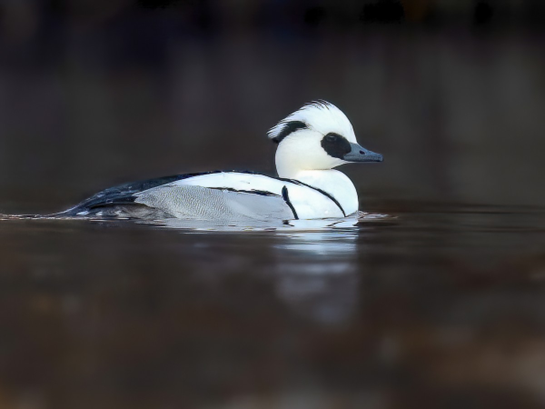
Recently, the seventh waterbird census at the Kaziranga National Park and Tiger Reserve in Assam spotlighted a rare avian guest—the Smew (Mergellus albellus), a striking Eurasian diving duck. This first-ever recorded sighting of the Smew in the Kaziranga landscape occurred at the Rowmari-Donduwa beels in the Laokhowa-Burhachapori Wildlife Sanctuaries. While the sighting is a testament to the health of Assam’s wetlands, ornithologists have expressed concern that such sporadic sightings of “vagrant” species may be linked to climate-driven range shifts and the degradation of traditional wintering habitats.
1. Biological Profile of the Smew (Mergellus albellus)
- Appearance: They are medium-sized ducks. Males are distinctively white with a “black mask” and fine black lines on the body, while females (often called ‘redheads’) have a chestnut-colored head and mottled grey body.
- Feeding Behavior: As a diving duck, it specializes in catching small fish, aquatic insects, and crustaceans. Their presence typically indicates a fish-rich, sheltered water body.
- Breeding Grounds: They primarily breed in the Eurasian Taiga (northern coniferous forests) and are rare winter visitors to the Indian subcontinent.
2. Habitat and Distribution
- Global Range: They are found across the Palearctic region, from Scandinavia across Siberia.
- In India: They are considered vagrants or rare winter migrants. Previous sightings have been recorded in northern and central India, such as the Haiderpur wetland in Uttar Pradesh.
- Recent Sighting: The discovery in the Rowmari-Donduwa beels (floodplain lakes) within the Kaziranga landscape highlights the importance of the Central Asian Flyway.
3. Conservation Status
- IUCN Red List: The Smew is currently categorized as Least Concern globally, but its population is declining due to habitat loss and human activities.
- Other Related Species: The Common Pochard (another Eurasian diving duck found in India) is listed as Vulnerable, emphasizing the precarious state of migratory diving ducks.
4. Ecological Indicators
- The arrival of rare diving ducks underscores the resilience of floodplains.
- They serve as bio-indicators; their presence signals a healthy aquatic food chain and relatively low levels of human disturbance in the wetland.
Q. Consider the following statements regarding the Smew (Mergellus albellus), recently seen in the news:

1. It is a diving duck that primarily breeds in the Eurasian taiga regions.
2. In India, it is a common perennial resident found across the southern peninsular wetlands.
3. Its presence in a wetland is generally considered an indicator of a healthy fish-rich aquatic ecosystem.

How many of the above statements are correct?

 (a) Only one
 (b) Only two
 (c) All three
 (d) None

Correct Answer: (b) Only two

Explanation
•	STATEMENT 1 IS CORRECT: The Smew is indeed a diving duck that breeds in the northern coniferous forest belt (taiga) of Europe and Asia.
•	STATEMENT 2 IS INCORRECT: The Smew is not a perennial resident of India; it is a rare winter visitor (vagrant). Furthermore, it is primarily sighted in Northern and North-eastern India (like Assam and UP), not commonly across the southern peninsula.
•	STATEMENT 3 IS CORRECT: Since the Smew specializes in feeding on small fish and aquatic invertebrates, its presence indicates a productive and balanced wetland environment.