Context
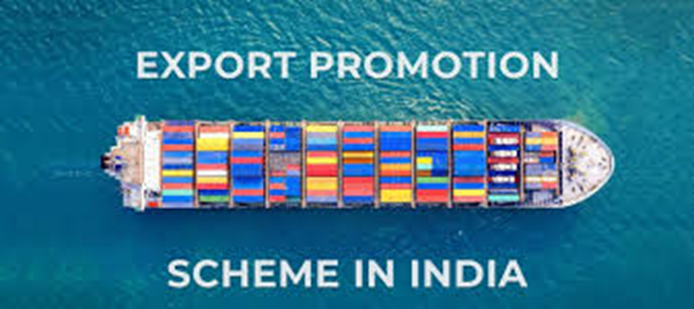
Recently, the Ministry of Commerce and Industry launched seven additional interventions under the Export Promotion Mission (EPM), a comprehensive ₹25,060-crore initiative aimed at strengthening India’s export ecosystem until 2030-31.
1. Export Promotion Mission (EPM)
Announced in the Union Budget 2025-26, the EPM serves as an umbrella framework to consolidate various fragmented schemes into a single, result-oriented mechanism.
- Structure: It operates through two categories:
- Niryat Protsahan (Financial): Focuses on interest subvention, credit guarantees, and export factoring to lower the cost of credit.
- Niryat Disha (Non-Financial): Focuses on market readiness, international branding, quality compliance, and logistics support.
- Key Interventions: Includes the Direct E-commerce Credit Facility (up to ₹50 lakh with 90% guarantee) and support for Overseas Warehousing (up to 30% of project cost).
2. RoDTEP Scheme (Remission of Duties and Taxes on Exported Products)
The RoDTEP scheme replaced the Merchandise Exports from India Scheme (MEIS) to ensure Indian exports are WTO-compliant.
- Objective: To refund “embedded” central, state, and local duties (like Mandi tax, coal cess, and electricity duty) that are not rebated under GST.
- Mechanism: Rebates are issued as transferable e-scrips maintained in an electronic ledger by the CBIC.
- Extension: The scheme is currently valid for all sectors, including SEZ and EOU units, until March 31, 2026.
3. EPCG Scheme (Export Promotion Capital Goods)
- Feature: Allows the import of capital goods (machinery) at zero customs duty.
- Obligation: The exporter must fulfill an Export Obligation (EO) equivalent to 6 times the duty saved, within a period of 6 years.
- Target: Primarily aimed at technological upgradation and modernization of the manufacturing and service sectors.
4. Advance Authorization Scheme (AAS)
- Feature: Allows duty-free import of inputs (raw materials) that are physically incorporated into an export product.
- Requirement: It requires a minimum 15% value addition.
- Condition: Inputs are subject to “Actual User” condition and are not transferable even after the export obligation is met.
Q. With reference to the Remission of Duties and Taxes on Exported Products (RoDTEP) scheme, consider the following statements:

1. It was introduced to replace the Merchandise Exports from India Scheme (MEIS) to comply with World Trade Organization (WTO) norms.

2. The rebates under this scheme are provided in the form of non-transferable physical certificates.

3. The scheme covers taxes and levies at the central, state, and local levels that are not refunded under any other mechanism.

Which of the statements given above is/are correct?

A) 1 and 2 only
B) 1 and 3 only
C) 2 and 3 only
D) 1, 2, and 3

Answer: B

Solution:
•	STATEMENT 1 CORRECT: The RoDTEP scheme was launched in January 2021 to replace the MEIS after India lost a challenge at the WTO, as MEIS was deemed an illegal export subsidy.
•	STATEMENT 2 INCORRECT: Rebates are issued as transferable electronic scrips (e-scrips), not non-transferable physical certificates. They can be used to pay basic customs duties or sold to other importers.
•	STATEMENT 3 CORRECT: RoDTEP specifically targets "embedded" taxes like Mandi tax, duty on fuel used in transportation, and electricity duty which are outside the ambit of GST.