Why in the News?
- Recently, the Union Government operationalized two critical credit-linked interventions under the Export Promotion Mission (EPM): the Interest Subvention Scheme and the Collateral Support for Export Credit.
- These measures are designed to lower the cost of capital and ease borrowing constraints for MSME exporters.
- With this rollout, three out of the eleven planned components under the EPM have now been activated to bolster India’s export ecosystem.
Export Promotion Mission (EPM): Overview
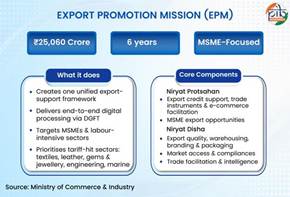
- The Export Promotion Mission (EPM) is a flagship initiative of the Government of India designed to enhance the global competitiveness of Indian exports, with a special focus on MSMEs, first-time exporters, and labour-intensive sectors.
- Announced in the Union Budget 2025–26, the Mission brings together multiple export-support measures into a single, digitally driven and outcome-oriented framework to improve efficiency and impact.
Institutional Framework and Governance of Export Promotion Scheme
- The EPM follows a whole-of-government approach, involving coordinated participation from:
- The Department of Commerce,
- The Ministry of MSME,
- The Ministry of Finance, and
- Export Promotion Councils, Commodity Boards, financial institutions, industry bodies, and State Governments.
- The Directorate General of Foreign Trade (DGFT) acts as the nodal implementing authority for the Mission.
- The scheme is operationalised through two complementary sub-schemes that address both financial and capability-related constraints faced by exporters.
Sub-Schemes under EPM
1. Niryat Protsahan (Financial Support):
- Focuses on improving access to affordable trade finance, especially for MSMEs.
- Provides interest subvention on pre- and post-shipment export credit, export factoring, and exporter credit facilities.
- Offers collateral support for export-linked loans, with guarantees up to 85% for micro and small enterprises and 65% for medium enterprises, subject to a ₹10 crore cap per exporter.
- Implemented through scheduled banks and the Credit Guarantee Fund Trust for Micro and Small Enterprises (CGTMSE) to enhance liquidity and competitiveness.
2. Niryat Disha (Non-Financial Support):
- Aims to strengthen export readiness and market access.
- Supports quality certification, regulatory compliance, and alignment with global standards.
- Provides assistance for international branding, packaging, logistics, and export warehousing.
- Promotes district-level capacity building to encourage exports from non-traditional and underrepresented regions.
Key Features of the Export Promotion Mission
- Unified Export Framework: The Mission replaces fragmented schemes with a single, flexible, and adaptive mechanism aligned with current global trade conditions.
- Digital Delivery: A DGFT-managed digital platform enables paperless processing, integrated approvals, and transparent monitoring.
- Targeted Sectoral Support: Priority is given to tariff-impacted sectors such as textiles, leather, gems and jewellery, engineering goods, and marine products.
- Regional Inclusion: Special emphasis is placed on interior and low-export districts to widen India’s export base and promote balanced regional growth.
- Scheme Convergence: Existing initiatives such as the Interest Equalisation Scheme (IES) and the Market Access Initiative (MAI) are streamlined within the EPM structure.
- Policy Alignment: The Mission is supported by RBI Trade Relief Measures (2025), which help ease liquidity constraints for export-oriented enterprises.
Significance of Export Promotion Mission
- Improve access to affordable trade finance and reduce the cost of credit for exporters, particularly MSMEs.
- Enhance export readiness and competitiveness through financial and non-financial support.
- Integrate India’s export ecosystem with global value chains.
- Support sectors affected by global tariff escalations.
- Promote inclusive participation of non-traditional districts in global trade.
- Strengthen India’s export competitiveness, contributing to Atmanirbhar Bharat and the vision of Viksit Bharat @ 2047.
India’s Major Initiatives to Promote Exports
- PM Gati Shakti National Master Plan: It aims to integrate infrastructure planning across sectors, improve multimodal logistics connectivity, and significantly reduce transportation time and costs for exporters.
- National Logistics Policy (NLP): It seeks to lower overall logistics costs by promoting multimodal transport, digital logistics platforms, and seamless coordination among stakeholders.
- Credit Guarantee Scheme for Exporters (CGSE): It provides up to 100% government-backed credit guarantees, especially benefiting MSME exporters by improving liquidity and reducing risk for lending institutions.
- Production Linked Incentive (PLI) Schemes: These schemes encourage large-scale manufacturing and export growth in key sectors such as electronics, pharmaceuticals, textiles, drones, and advanced manufacturing.
- Trade Infrastructure for Export Scheme (TIES): It supports the development of export-related infrastructure, including testing laboratories, cold storage facilities, inland container depots (ICDs), and border haats.
- Free Trade Agreements (FTAs): FTAs with partners such as the UAE, Australia, and EFTA countries enhance market access for Indian goods through tariff reductions and improved trade facilitation.
- Districts as Export Hubs (DEH): It promotes district-specific products by strengthening local capacity, branding, logistics support, and integration into global value chains.
With reference to India’s Air Defence System, consider the following statements:
1. The S-400 Triumf is an indigenously developed long-range surface-to-air missile system.
2. The Akash missile system uses command guidance and phased array radar to engage multiple airborne threats.
3. Integrated Counter-UAS grids are deployed along sensitive borders to neutralize hostile drones and UAVs.

Which of the statements given above is/are correct?
(a) 1 and 3 only
(b) 2 and 3 only
(c) 1 and 2 only
(d) All of the above

Answer: (b) 2 and 3 only

Explanation:
Statement 1 is incorrect: The S-400 Triumf is procured from Russia, not indigenously developed. It is a long-range SAM capable of intercepting aircraft, drones, and ballistic missiles up to 400 km.
Statement 2 is correct: The Akash missile system is indigenously developed and employs command guidance and phased array radar, allowing it to engage multiple airborne threats simultaneously.
Statement 3 is correct: Integrated Counter-UAS grids are deployed along sensitive borders to detect, jam, and neutralize hostile UAVs and drones, enhancing India’s airspace security.