After Reading This Article You Can Solve This UPSC PYQ Question:
What changes has the Union Government recently introduced in the domain of Centre-State relations? Suggest measures to be adopted to build the trust between the Centre and the States and for strengthening federalism. 2024 (15 Marks, GS-2 Polity)
Context
The Justice Kurian Joseph Committee argues that Indian federalism is witnessing increasing centralisation of power by the Union. Drawing from Constituent Assembly debates and earlier Centre–State commissions, it highlights structural concerns such as ease of constitutional amendments, misuse of Governors, fiscal imbalance post-GST, reorganisation of Jammu & Kashmir, growing control over education and health, and anxieties over delimitation.
Key Features of Federalism
Federalism is a dual polity system where power is constitutionally divided between a central authority and regional states, ensuring autonomy for both while maintaining national unity through a shared framework.
1. Dual Government Polity: The existence of two levels of government—the Union (Central) and the States. Each operates within its own sphere, drawing authority directly from the Constitution.
2. Written and Supreme Constitution: The Constitution is the supreme law of the land. It defines the structure, organization, and powers of both levels to prevent arbitrary encroachment.
3. Division of Powers: Powers are clearly demarcated through the Seventh Schedule, which contains three lists:
- Union List: Subjects of national importance (Defense, Foreign Affairs).
- State List: Subjects of local importance (Police, Agriculture).
- Concurrent List: Subjects where both can legislate (Education, Forests).
4. Independent Judiciary: An independent judiciary (the Supreme Court) acts as the “Umpire.” It resolves disputes between the Center and States and interprets the Constitution to maintain the federal balance.
5. Rigidity of the Constitution: Provisions affecting the federal structure (like Article 368) cannot be changed unilaterally by the Center. They require a special majority in Parliament and ratification by at least half of the State legislatures.
6. Bicameralism: The existence of two houses in Parliament. The Rajya Sabha (Upper House) specifically represents the interests of the States at the national level, acting as a federal check.
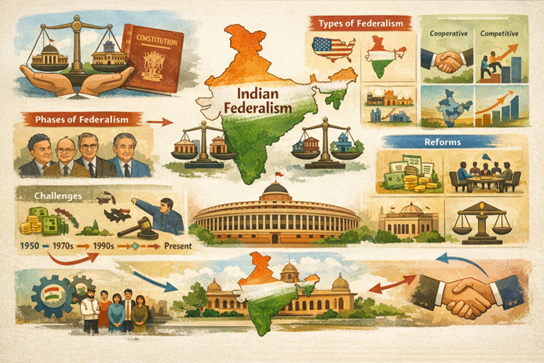
Types of Federalism
1. Structural Models: These define how a federation is initially formed.
- Holding Together Federalism: A large country decides to divide its power between the constituent states and the central government to maintain diversity and unity.
- Example: India, Spain, Belgium.
- Coming Together Federalism: Independent states come together on their own to form a bigger unit to increase their security and economic pull.
- Example: USA, Australia, Switzerland.
2. Functional Styles
These describe how the different levels of government interact in day-to-day administration:
- Dual Federalism (“Layer Cake”): The Union and States remain supreme in their respective spheres without interfering in each other’s affairs. Powers are clearly demarcated and separate.
- Cooperative Federalism (“Marble Cake”): A flexible relationship where the Center and States work together on shared goals.
- Example: The GST Council and NITI Aayog are the best Indian examples of this.
- Competitive Federalism: States compete with one another (and sometimes with the Center) to attract investments and improve governance.
- Example: Indices like the SDG India Index or Ease of Doing Business rankings foster this spirit.
- Fiscal Federalism: This involves the transfer of financial resources from the Center to the States.
- Example: Article 280 (Finance Commission) governs this in India.
3. Special Categories
- Asymmetric Federalism: Not all constituent units have the same powers. Some states are granted special status due to historical or cultural reasons.
- Example: Articles 371 to 371-J provide special provisions for states like Maharashtra, Gujarat, Nagaland, and Karnataka.
- Quasi-Federalism: A system that is federal in structure but unitary in spirit. K.C. Wheare used this term for India because the Center holds “residuary powers” and can override states during emergencies.
Nature of Indian Federalism
The Indian Constitution does not use the word “Federation.” Article 1 describes India as a “Union of States.”
1. The “Quasi-Federal” Tag: The nature of Indian federalism is best described as “Sui Generis” (unique).Scholar K.C. Wheare famously called India “Quasi-Federal” because it is a federal state with subsidiary unitary features, rather than a unitary state with subsidiary federal features.
2. Unitary Tilt (The “Strong Center”): Unlike the US, the Indian Center has superior powers:
- Article 3: Parliament can change state boundaries or names without their consent.
- Residuary Powers: Vested in the Union (not the States).
- Emergency Provisions: During an emergency, the federal structure can turn completely Unitary (Articles 352, 356, 360).
- Single Citizenship: Only Indian citizenship exists; there is no “State” citizenship.
- Unified Judiciary & All India Services: IAS/IPS officers are recruited by the Center but serve the States.
3. Federal Strength (The “Basic Structure”)
- Despite the tilt, the States are not mere administrative agents:
- S.R. Bommai Case (1994): The Supreme Court ruled that Federalism is part of the Basic Structure.
- Independent Powers: Within the “State List” (Schedule 7), states have supreme legislative authority.
- Financial Autonomy: Articles 280 (Finance Commission) and 279A (GST Council) ensure a mandatory share of revenue for States.
Phases of Federalism in India
Phase I: Single Party Dominance (1950–1967)
- “The Congress System”: Identical parties at the Center and in almost all States led to a centralized, consensus-based federalism.
- Planning Commission: State autonomy was diluted by centralized economic planning (the “Socialist Pattern”).
- Nature: Cooperative but dominated by the Union.
Phase II: Confrontational Federalism (1967–1989)
- Rise of Regionalism: Opposition parties won power in several states (e.g., DMK in Tamil Nadu, Left in WB).
- Article 356 Abuse: The Center frequently dismissed state governments using President’s Rule.
- Key Development: The Sarkaria Commission (1983) was set up to review Center-State relations due to rising friction.
Phase III: Multi-Party / Coalition Era (1989–2014)
- Regional Leverage: National governments depended on regional parties for survival, shifting the power balance toward the States.
- S.R. Bommai Judgment (1994): The Supreme Court restricted the arbitrary use of Article 356.
- Economic Liberalization: States began competing for global investments independently.
Phase IV: Dominant Party & Cooperative-Competitive (2014–Present)
- Structural Shifts: Replacement of the Planning Commission with NITI Aayog (Cooperative Federalism).
- One Nation, One Tax: Implementation of GST, creating a constitutional body (GST Council) where Center and States vote together.
- Friction Points: Renewed debates over the role of the Governor, Central Agencies (ED/CBI), and the “Cess and Surcharge” issue.
Challenges to Indian Federalism
A. Fiscal Federalism & The “Shrinking Pool”
- Cess and Surcharge: These are not part of the divisible pool, meaning they aren’t shared with States. In 2025-26, they constitute 18–20% of the Center’s gross tax revenue.
- Finance Commission Tensions: High-performing states (especially in the South) argue that “Income Distance” criteria penalize their economic and demographic success.
- GST Autonomy: States have lost the power to levy most indirect taxes, increasing their dependency on Central transfers.
B. The Office of the Governor
- Constitutional Deadlocks: Governors in states like Tamil Nadu and Kerala have faced criticism for withholding assent to Bills indefinitely (Pocket Veto).
- Political Partisanship: The office is increasingly viewed as an “agent of the Center,” causing friction in states ruled by opposition parties.
C. Overreach on State Subjects
- Concurrent List Expansion: The Center is legislating more frequently on subjects like Education and Agriculture with minimal state consultation.
- Central Agencies: Allegations of “weaponizing” the ED, CBI, and NIA have led several states to withdraw “General Consent” for investigations.
D. Institutional Erosion
- NITI Aayog: Unlike the former Planning Commission, NITI Aayog lacks the financial power to allocate capital grants to states.
- Inter-State Council (Art 263): This constitutional dispute-resolution body remains underutilized, meeting too infrequently to bridge the trust deficit.
E. New Emerging Conflicts (2025-26)
- One Nation, One Election: Concerns that national narratives will overshadow regional issues and disrupt state assembly tenures.
- Delimitation Fear: States that successfully managed population growth fear a loss of Lok Sabha seats to high-population states after the upcoming census.
Measures To Strengthen Indian Federalism
1. Reforming the Office of the Governor
- Time-bound Decisions: Implement the Punchhi Commission’s recommendation to set a fixed timeframe (e.g., 6 months) for Governors to decide on State Bills.
- Neutral Appointments: Ensure Governors are eminent persons from outside the state, not active in politics recently, as suggested by the Sarkaria Commission.
2. Fiscal Federalism Fixes
- Sharing Cess and Surcharge: Amend the Constitution to include a portion of cesses and surcharges in the divisible pool shared with States.
- Grant Autonomy: Empower NITI Aayog or a similar body to provide statutory capital grants to states, filling the void left by the Planning Commission.
3. Institutional Revitalization
- Active Inter-State Council (Art 263): Make it a mandatory, permanent forum for discussing all major policy shifts and bills concerning the Concurrent List.
- Zonal Councils: Hold regular meetings of Zonal Councils to resolve specific regional and boundary disputes before they escalate.
4. Consultative Lawmaking
- Federal Impact Assessment: Before legislating on Concurrent List subjects (like Education or Agriculture), the Center should conduct a “Federal Impact Assessment” in consultation with states.
- Democratic Delimitation: Address the concerns of performing states (South India) regarding the 2026 Delimitation exercise to ensure they are not politically penalized for population control.
Conclusion
Indian federalism must evolve from “command-and-control” to a collaborative-competitive model. By revitalizing constitutional bodies like the Inter-State Council and ensuring fiscal transparency, India can balance regional aspirations with national integrity, fostering a resilient, decentralized, and inclusive ViksitBharat.