Context
Recently, the President of Finland, Alexander Stubb, conducted a significant four-day state visit to India (March 4–7, 2026) to participate in the Raisina Dialogue and hold bilateral talks with Prime Minister Narendra Modi. During this visit, both nations elevated their relationship to a Strategic Partnership in Digitalization and Sustainability, focusing on trade, critical technologies, and a shared commitment to a rules-based international order.
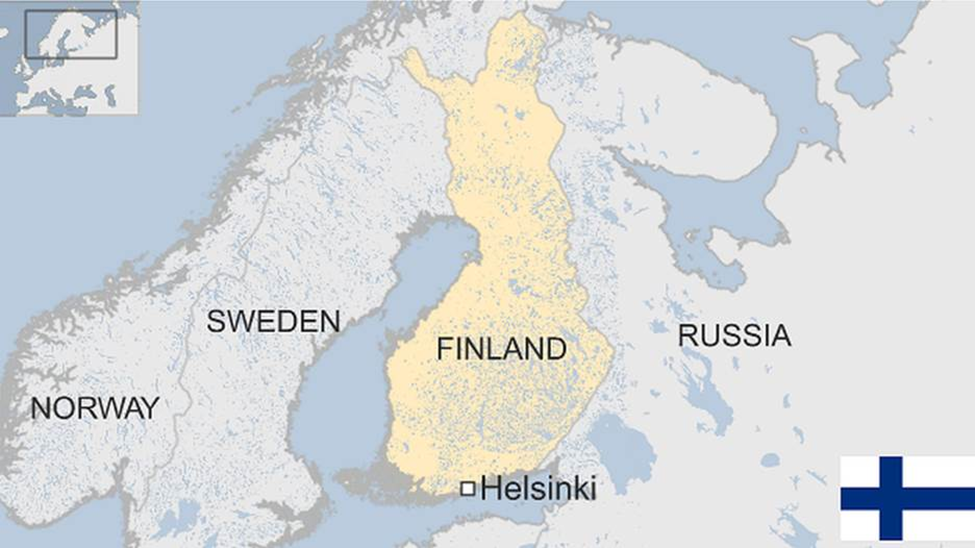
1. Geographical Location and Borders
Finland is a Nordic country situated in Northern Europe. It is the northernmost country in the European Union.
- Land Borders:
- East: Russia (shares a massive 1,340 km border, now the longest NATO-Russia frontier).
- North: Norway.
- Northwest: Sweden.
- Water Bodies:
- South: Gulf of Finland (separates Finland from Estonia).
- West: Gulf of Bothnia (separates Finland from Sweden).
- Southwest: Baltic Sea.
2. Physical Features
- The Fennoscandian Shield: Finland sits on an ancient, stable segment of the Earth’s crust known as the Baltic or Fennoscandian Shield, composed of Precambrian granites.
- Land of Lakes: Known as “the land of a thousand lakes,” Finland actually has approximately 188,000 lakes. Lake Saimaa is the largest and is famous for the endangered Saimaa ringed seal.
- Archipelagos: The Åland Islands, an autonomous, Swedish-speaking region of Finland, lie at the entrance to the Gulf of Bothnia. The Archipelago Sea between the Finnish mainland and Åland contains the world’s largest number of islands.
- The Arctic Circle: About one-third of Finland lies north of the Arctic Circle (66.5° N), encompassing the region of Lapland.
- Highest Point: Mount Halti (Haltitunturi), located on the border with Norway.
3. Key Maritime Geography
| Feature | Details |
| Gulf of Bothnia | The northernmost arm of the Baltic Sea; water salinity is very low (brackish) due to numerous calving rivers. |
| Gulf of Finland | Extends between Finland (north), Estonia (south), and Russia (east). Helsinki and Tallinn face each other across this gulf. |
| Saimaa Canal | A transportation canal that connects Lake Saimaa to the Gulf of Finland, passing through Russian territory (Vyborg). |
4. Climate and Vegetation
- Taiga Biome: Finland is Europe’s most heavily forested country (over 70% coverage), dominated by Scots pine, Norway spruce, and birch.
- Isostatic Rebound: Due to the removal of heavy ice sheets after the last Ice Age, the land in Finland is still rising (post-glacial rebound), particularly in the Kvarken Archipelago (a UNESCO World Heritage site).
Q. Consider the following statements regarding the geography of Finland:

1. Finland shares land borders with only two countries: Sweden and Russia.

2. The Gulf of Finland separates the Finnish mainland from the country of Estonia.

3. A significant portion of Finland’s territory lies within the Arctic Circle.

4. The Åland Islands, located in the Baltic Sea, are an integral part of Finland.

How many of the statements given above are correct?
A) Only one
B) Only two
C) Only three
D) All four

Solution: C) Only three

•	STATEMENT 1 IS INCORRECT: Finland shares land borders with three countries: Sweden (Northwest), Norway (North), and Russia (East).
•	STATEMENT 2 IS CORRECT: The Gulf of Finland is an arm of the Baltic Sea situated between Finland to the north and Estonia to the south.
•	STATEMENT 3 IS CORRECT: Approximately one-third of Finland, primarily the Lapland region, lies north of the Arctic Circle.
•	STATEMENT 4 IS CORRECT: The Åland Islands are an autonomous, demilitarized region of Finland located at the entrance to the Gulf of Bothnia.