After Reading This Article You Can Solve This UPSC Mains Model Question:
Discuss the potential of futuristic marine and space biotechnology in positioning India as a global hub for sustainable biomanufacturing. Highlight the opportunities, challenges, and the role of government initiatives. 250 Words (GS-3 Science & Technology)
Introduction
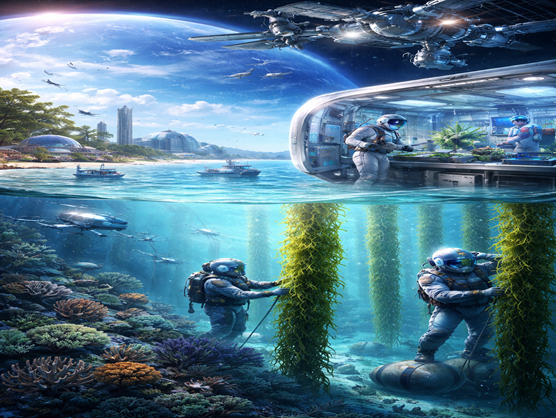
Futuristic marine and space biotechnology explores life in extreme frontiers—the deep oceans and outer space—to develop novel biomaterials, enzymes, food systems and manufacturing processes.
About Marine and Space Biotechnology
- Marine Biotechnology
- Study and application of marine microorganisms, algae, and fauna.
- Outputs: Bioactive compounds, enzymes, biomaterials, nutraceuticals, food ingredients, biostimulants.
- Space Biotechnology
- Studies microbes, plants, and human biology under microgravity and radiation.
Scope of Marine Biotechnology: The “Blue Frontier”
1. Deep-Sea Bioprospecting (The “Treasure Hunt”)
- Microbial “Extremophiles”: Discovery of bacteria and fungi in high-pressure, zero-light environments (like the Central Indian Ocean Basin). These organisms produce extremozymes—enzymes that remain stable at extreme temperatures, essential for the detergent, textile, and biofuel industries.
- Novel Therapeutics: Marine organisms are sources of unique secondary metabolites. Current research targets anti-cancer, anti-viral, and anti-inflammatory compounds that are more potent than terrestrial alternatives.
2. Integrated Seaweed Biomanufacturing
Under the BioE3 framework, seaweed is no longer seen just as a food source but as a biological refinery:
- Phycocolloids: Production of high-purity Agar, Alginate, and Carrageenan to replace imports (India currently imports ~70% of its high-grade agar).
- Methane-Reducing Feed: Developing specific seaweed-based additives for livestock that can reduce bovine methane emissions by up to 90%, aiding India’s climate goals.
- Bio-stimulants: Seaweed extracts used as organic fertilizers to improve soil health and crop resilience against drought.
3. Marine Functional Foods & Nutraceuticals
- Microalgae for Omega-3: Cultivating Schizochytrium and other microalgae to produce DHA/EPA oils. This provides a vegan, heavy-metal-free alternative to fish oil, protecting marine food chains.
- Pigments & Antioxidants: Commercial extraction of Astaxanthin and Lutein from marine sources for the global wellness market.
4. Environmental Remediation (Blue-Green Solutions)
- Oil Spill Recovery: Engineering specialized marine microbes (bioremediation) that can “eat” crude oil and toxic hydrocarbons in the event of maritime accidents.
- Carbon Sequestration: Utilizing fast-growing macro-algae and seagrass to create “Blue Carbon” sinks, which are up to 10 times more efficient at storing carbon than terrestrial forests.





Why Marine and Space Biotechnology Matters for India?
I. Why Marine Biotechnology Matters
- With a 7,517 km coastline and a 2.1 million sq. km EEZ, India’s “Blue Frontier” is an untapped goldmine.
- Resource Independence: Reduces dependence on land-based resources. E.g., seaweed-derived agar and alginates are critical for India’s massive pharma industry.
- Climate Resilience: Seaweed farming requires zero freshwater or fertilizer and acts as a massive carbon sink (Blue Carbon).
- Agricultural Revolution: Marine bio-stimulants improve crop yields and soil health, offering an organic alternative to chemical fertilizers.
- Economic Diversification: Targets the “Blue Economy” to contribute significantly to India’s goal of a $300 billion bioeconomy by 2030.
II. Why Space Biotechnology Matters
- As India builds the Bharatiya Antariksh Station (BAS) and prepares for Gaganyaan, space biology becomes the foundation of long-term presence.
- Strategic Autonomy: Developing indigenous Life Support Systems (BLSS) ensures India doesn’t rely on foreign tech for astronaut survival (oxygen, water recycling).
- Medical Breakthroughs: The unique microgravity environment allows for “perfect” Protein Crystallization, accelerating drug discovery for cancer and rare diseases back on Earth.
- Human Health: Research on bone/muscle loss in space provides direct solutions for India’s aging population and osteoporosis patients.
- Off-Earth Manufacturing: Space-based 3D Bioprinting of tissues and organs could bypass the complexities of gravity-driven cell settling on Earth.
India’s Current Status in Marine and Space Biotechnology
I. Current Status: Marine Biotechnology
India is positioning itself as a global leader in the “Blue Bioeconomy.”
- Mission Mode: The Deep Ocean Mission (DOM) is in its peak execution phase.
- Matsya-6000: India’s indigenous manned submersible has successfully completed shallow-water “wet tests” (late 2025) and is preparing for the 6,000-meter dive in the Central Indian Ocean.
- Infrastructure: A National Institute of Marine Biotechnology is being established to centralize research on deep-sea extremophiles.
- Commercial Success: India has emerged as one of the largest producers of seaweed-based bio-stimulants, with coastal clusters in Tamil Nadu and Gujarat driving export growth.
- Global Ranking: India currently ranks 3rd in the Asia-Pacific for marine bioprocessing capacity.
II. Current Status: Space Biotechnology
India’s space biotech is revolving around the upcoming Bharatiya Antariksh Station (BAS) and the Gaganyaan mission.
- Microgravity Research:ISRO and the Department of Biotechnology (DBT) have launched the “Micro-G Biofoundry” program.
- Protein Crystallization: Recent experiments on PSLV’s orbital platform (POEM) have successfully grown high-purity insulin crystals, proving India’s capability for space-based drug R&D.
- Life Support Systems: India has achieved 80% indigenization in its Bioregenerative Life Support Systems (BLSS), specifically using spirulina-based oxygen scrubbers.
- Space-Health Monitoring: A dedicated “Space Biotech Lab” has been set up at the Institute of Stem Cell Science and Regenerative Medicine (inStem) to study bone-density solutions for Gaganyaan astronauts.
Key Policies & Missions for Marine and Space Biotechnology
I. The Policy Umbrella: BioE3 Policy
- The BioE3 (Biotechnology for Economy, Environment, and Employment) Policy is the primary legislative framework. It explicitly identifies “Futuristic Marine and Space Research” as one of its six core thematic verticals.
- Objective: To transition India from “consumptive manufacturing” to “regenerative biomanufacturing.”
- The Bio-AI Link: The policy mandates the creation of Bio-Artificial Intelligence (AI) Hubs. These hubs use AI to model how marine microbes or space-grown cells behave, drastically reducing the time needed for physical “extreme environment” trials.
- Hub-and-Spoke Model: Under BioE3, the government is setting up Biomanufacturing Hubs across coastal states (for marine) and near space clusters like Bengaluru (for space).
II. Key Missions: The “Blue” & “Black” Frontiers
1. Deep Ocean Mission (DOM) & Samudrayaan
- Implemented by the Ministry of Earth Sciences (MoES), this ₹4,077 crore mission is the hardware provider for marine biotechnology.
- MATSYA-6000: India’s flagship manned submersible. By early 2026, it is scheduled for shallow-water demonstrations (up to 500 meters), with the full 6,000-meter dive targeted for 2027.
- Marine Station for Ocean Biology: A dedicated component of DOM focused specifically on blue biotechnology—turning deep-sea biological discoveries into industrial products like “extremozymes.”
2. Gaganyaan & The Microgravity Program
- ISRO’s human spaceflight program is the vehicle for space biotechnology.
- Micro-G Biofoundry: A joint ISRO-DBT initiative to conduct biological experiments on the Bharatiya Antariksh Station (BAS).
- Vyommitra Trials (Early 2026): The uncrewed Gaganyaan flight carrying the robot Vyommitra will also carry “passive” biological payloads to study the impact of cosmic radiation on microbial DNA before human flight.
- Space-Health Mission: A policy mandate to develop indigenous Bioregenerative Life Support Systems (BLSS), using algae-based systems to recycle air and water for the astronauts.
Challenges for Marine and Space Biotechnology
1. Technical & Environmental Challenges
- The “Extreme” Barrier: Deep-sea equipment must withstand pressures up to 600 bar, while space biotech must counter the dual threats of microgravity (cell settling) and cosmic radiation (DNA damage).
- Technological Dependence: Despite the “Atmanirbhar” push, India still relies on imports for high-end laboratory reagents, pilot-scale purification systems, and specialized sensors for extreme environments.
- Extraction Complexity: For instance, the Lithium found in J&K or marine nodules is often in complex clay/mineral forms, requiring expensive and yet-to-be-scaled domestic extraction tech.
2. Structural & Financial Bottlenecks
- “Wide but Not Deep” Ecosystem: While India has over 10,000 biotech startups, most are in early stages. There is a “Death Valley” in Series B and C funding, where startups struggle to scale from lab-prototype to commercial GMP (Good Manufacturing Practice) facilities.
- Low R&D Spend: India’s Gross Expenditure on R&D (GERD) hovers around 0.6-0.7% of GDP, significantly lower than China (2.4%) or the USA (3.5%).
- Fragmented Demand: Demand for space/marine data and bio-products is split across ministries (Agriculture, Energy, Earth Sciences), leading to duplication of efforts and lack of economies of scale.
3. Regulatory & Ethical Gaps
- Outdated Frameworks: Current clinical trial and patent laws are not yet fully equipped to handle AI-driven drug discovery, CRISPR gene editing, or the commercialization of Marine Genetic Resources (MGRs).
- Access & Benefit Sharing (ABS): Under the High Seas Treaty, India must navigate complex international laws regarding who “owns” the genetic data discovered in international waters.
- Brain Drain: Specialized talent in bioinformatics, thermal control, and synthetic biology often migrates due to better post-doc incentives and higher compensation in hubs like Singapore or Boston.
Way Forward for Marine and Space Biotechnology
1. Integration via “Bio-AI Hubs”
- Predictive Modeling: Use the newly launched Bio-AI Hubs to simulate how deep-sea extremophiles or space-bound cells will react to harsh environments. This reduces the need for expensive and risky physical trials.
- Digital Twins: Create digital replicas of marine and space bioreactors to optimize production efficiency before deployment.
2. Strengthening “Lab-to-Market” Pathways
- Bio-Foundry Network: Scale up the National Biofoundry Network (launched late 2025) to provide startups with “plug-and-play” facilities for pilot-scale production.
- Venture Capital Infusion: Utilize the ₹1,000 crore Space VC Fund and BIRAC’s equity schemes to bridge the “Death Valley” in late-stage funding for biotech startups.
3. Regulatory Harmonization & IPR
- Single-Window Clearance: Implement a fast-track regulatory pathway for “Extreme Biotech” products, reducing the approval timeline from 5 years to under 2 years.
- Sovereignty & Liability: Pass the Space Activities Bill to provide legal clarity on liability for private biotech experiments on the Indian Space Station (BAS).
4. International “Giga-Partnerships”
- The “Blue-Black” Alliance: Partner with the EU (Blue Growth) and NASA (ISS) for joint deep-sea and microgravity research, while asserting India’s leadership in the Global South through the IMEC mineral and bio-corridors.
Conclusion: The Vision of Viksit Bharat @2047
The exploration of the Deep Sea and Outer Space is central to the vision of a “Developed India.”(Vikshit Bharat) by 2047, India aims to be a Bio-Superpower where 15–20% of its GDP is driven by a high-performance bioeconomy. The BioE3 Policy acts as the catalyst to move from a land-centric, chemical-based economy to a regenerative, bio-based industrial model.